


Analysis of the DeadLock Ransomware Group’s Evolving Tactics and Infrastructure
The cybersecurity landscape continues to evolve, with the emergence of sophisticated threats posing significant challenges to organizations worldwide. One such threat is the ransomware group known as DeadLock, which has recently garnered attention for its innovative use of decentralized infrastructure to facilitate communication with victims and manage data leak operations. This strategic shift aims to bolster the group’s operational resilience, ensuring a more robust framework for extortion efforts.
The Microsoft Threat Intelligence team has provided insight into DeadLock’s recovery ecosystem, detailing how it amalgamates the Session messaging network with blockchain-backed services. This combination allows for the secure storage and distribution of resources essential to the extortion process. Such a decentralized approach is not only aimed at enhancing communication between attackers and victims but also establishes a layer of anonymity and resilience against traditional takedown efforts.
Observations indicate that DeadLock has been deployed by a range of threat actors, including affiliations with both Lynx and INC ransomware groups. The very first detection of DeadLock in July 2025 revealed its employment of double extortion tactics. These methods involve encrypting victim environments while simultaneously exerting pressure through threats of publicly releasing stolen data. As of now, the group claims to have affected 96 victims, with a notable concentration in countries such as Italy, Spain, Poland, Türkiye, and the United States.
In an analysis released by the Singapore-based firm Group-IB in January, it was highlighted that DeadLock has managed to maintain a relatively low profile compared to its counterparts. This is largely attributed to its detachment from known affiliate programs and the absence of a dedicated data leak site. Interestingly, the first victims associated with this group were not discovered until late May 2026, indicating a strategic approach to avoid immediate detection by cybersecurity professionals.
The group’s ransomware attacks are characterized by unique indicators, including the encryption of files marked with the ".dlock" extension. Victims also find their desktop wallpapers replaced with a message explicitly stating "Your infrastructure DeadLocked," a tactic designed to disorient and pressure victims into compliance. Additionally, DeadLock employs a hybrid cryptographic approach, combining Curve25519 elliptic-curve cryptography with the XChaCha20 stream cipher to perform its encryption tasks selectively.
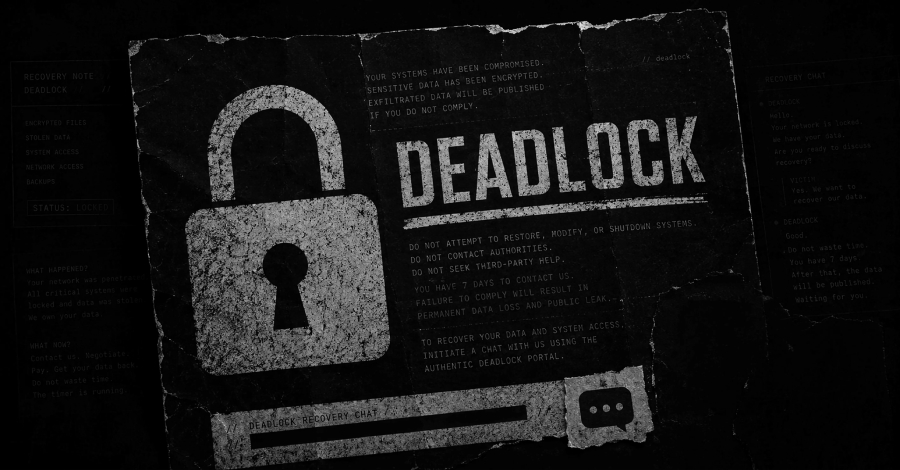
Victims of DeadLock receive a ransom note urging them to download the Session messaging application, an end-to-end encrypted platform. Once downloaded, victims are instructed to make payments either in Bitcoin or Monero, often after providing a decrypted version of a locked file as evidence of compliance. Significantly, one version of the ransom note claims to offer a "security report" that outlines how the attackers breached the victim’s network, further enhancing the threat’s perceived legitimacy. Furthermore, the note reassures victims that payment may lead to additional security recommendations to prevent future attacks, creating an unsettling cycle of dependence.
Another striking feature of DeadLock’s operations is its implementation of geofencing mechanisms intended to exclude targets located in former Soviet Union countries, certain CIS-linked countries, and select Middle Eastern regions. This tactic signifies a calculated effort to avoid detection and maintain operational integrity.
The ransomware’s technical capabilities extend to a sophisticated “resource-aware throttling mechanism.” This feature ensures that system response remains stable throughout the encryption process, pausing operations when memory usage exceeds 29% or CPU load hits 70%. Coupled with the use of AnyDesk for remote control, the ransomware maneuvers within the compromised systems adeptly, ensuring minimal interruptions while executing its malicious agenda.
From a defensive perspective, the Windows version of DeadLock employs several measures to undermine oversight. Utilizing a PowerShell script, it stops non-allowlisted services and deletes Volume Shadow Copies, obscuring trace evidence left in the aftermath of its attack. The malware further protects itself by erasing its own binary post-encryption and implementing a batch script to erase all evidence of its presence on the victim’s machine.
Perhaps the most innovative aspect of DeadLock’s approach is the integration of an HTML note titled “RECOVERY_CHAT.
The recovery chat enhances operational capabilities, including access to a data leak blog hosted on the Polygon blockchain, allowing victims to browse leaked files without requiring a web server. This unique architecture represents a significant evolution from traditional ransomware communication channels, complicating efforts to dismantle these threats. As such, DeadLock exemplifies a troubling trend in cyber criminality, evolving rapidly in response to defensive measures, and highlights the urgent need for organizations to bolster their cybersecurity frameworks in an increasingly perilous digital landscape.
This concrete amalgamation of aggressive tactics, decentralized communication, and innovative infrastructure necessitates a robust and adaptive defense strategy, emphasizing a proactive posture against evolving cyber threats.