
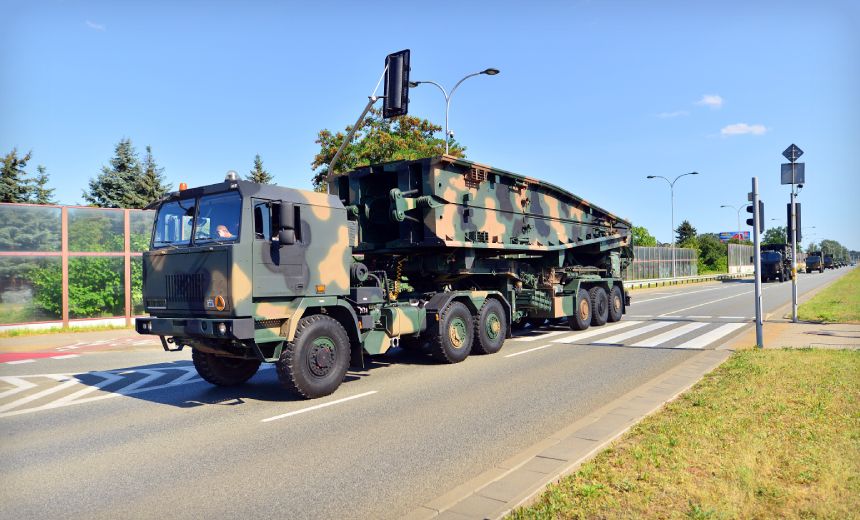


Most NATO Aid to Ukraine Travels Through Poland
In recent statements at the Billington Critical Infrastructure Cybersecurity Summit held in San Antonio, Texas, Maj. Gen. Mariusz Chmielewski, head of Poland’s Cyber Command, revealed that Polish authorities received crucial intelligence regarding Russian cyber threats to their national infrastructure from the United States. This intelligence was instrumental in bolstering Poland’s defenses against potential attacks aimed at its transportation and power systems.
Chmielewski outlined that the collaborative efforts between U.S. and Polish cyber forces began after the onset of the full-scale Russian invasion of Ukraine in February 2022. He emphasized that Poland has since become a vital logistical hub for NATO military aid entering Ukraine, confirming that over 90% of this assistance travels through Poland, arriving by both sea and air and subsequently transported via road and rail to the conflict zone.
This critical intelligence sharing, as detailed by Chmielewski, gained prominence during a severe winter freeze that hit Poland shortly after Christmas last year. At this time, an ambitious cyber operation was underway, aimed at incapacitating segments of the Polish power grid during extreme cold conditions, with temperatures plummeting to 5-10 degrees Fahrenheit. The disclosure of the technical elements involved in this attack was meticulously documented earlier this year by CERT-PL, Poland’s national Cyber Emergency Response Team, underscoring the seriousness of the security challenges posed.
Moreover, after U.S. intelligence reported that data from Polish transportation networks had been compromised and was found in the possession of Russian intelligence, Poland’s Cyber Command took a proactive stance. Their response comprised a strategic three-fold approach. First, they urged private transportation firms to enhance their cyber defenses, including the implementation of sensors to monitor network activities for any anomalies. This initial defensive measure was integral in safeguarding against further breaches.
Second, Chmielewski revealed that Polish and U.S. cyber teams actively engaged in "threat hunting," which involves proactive identification and eradication of potential threats within networks. This approach reflects a commitment to not just reactively defend but actively secure critical infrastructure from ongoing threats. Chmielewski acknowledged the significant assistance provided by the U.S. Air Force, particularly from the 16th Air Force at Joint Base San Antonio, in these efforts, showcasing the collaborative nature of the current cybersecurity landscape.
Poland’s Cyber Command has aimed to extend its operational reach into the civilian sector, recognizing the interconnectedness of various critical infrastructures. Col. Michal Golak, who leads the Cybersecurity Division within Poland’s Cyber Command, expounded on the necessity of understanding the cross-sectoral dependencies that influence the sectors targeted by cyber actors. He pointed out that the power grid serves as a foundational element essential for various operations, affecting telecommunications, transportation, railways, and more.
An illuminating detail emerged regarding the tactics employed by Russian hackers, attributed to the FSB, the Russian state security agency. Golak explained that attackers exploited a private Access Point Name (APN) to traverse lateral movements across the operational technology (OT) networks of multiple power stations as well as renewable energy plants. This specific tactic highlights the vulnerabilities present in systems that were otherwise designed to keep their traffic isolated from public internet threats.
Private APNs usually function as secure cellular pathways, routing data exclusively from authorized devices. However, in this scenario, they served as vectors through which attackers could navigate and compromise various components of Poland’s power grid. Golak stressed the importance of identifying such dependencies, as understanding them is crucial for assessing the security of technology used within critical infrastructure and understanding how they might be exploited by adversaries.
In summary, Poland’s Cyber Command is actively engaged in a comprehensive strategy to bolster national security against increasing cyber threats linked to the geopolitical climate, particularly amidst the ongoing conflict involving Ukraine. The collaboration with U.S. cyber forces not only enhances Poland’s defensive posture but also establishes a model for addressing cybersecurity challenges across allied nations. Understanding complex infrastructure dependencies remains a pivotal aspect of this security landscape as the country navigates through these turbulent times, highlighting the increasing importance of cyber defense in national security strategies.