
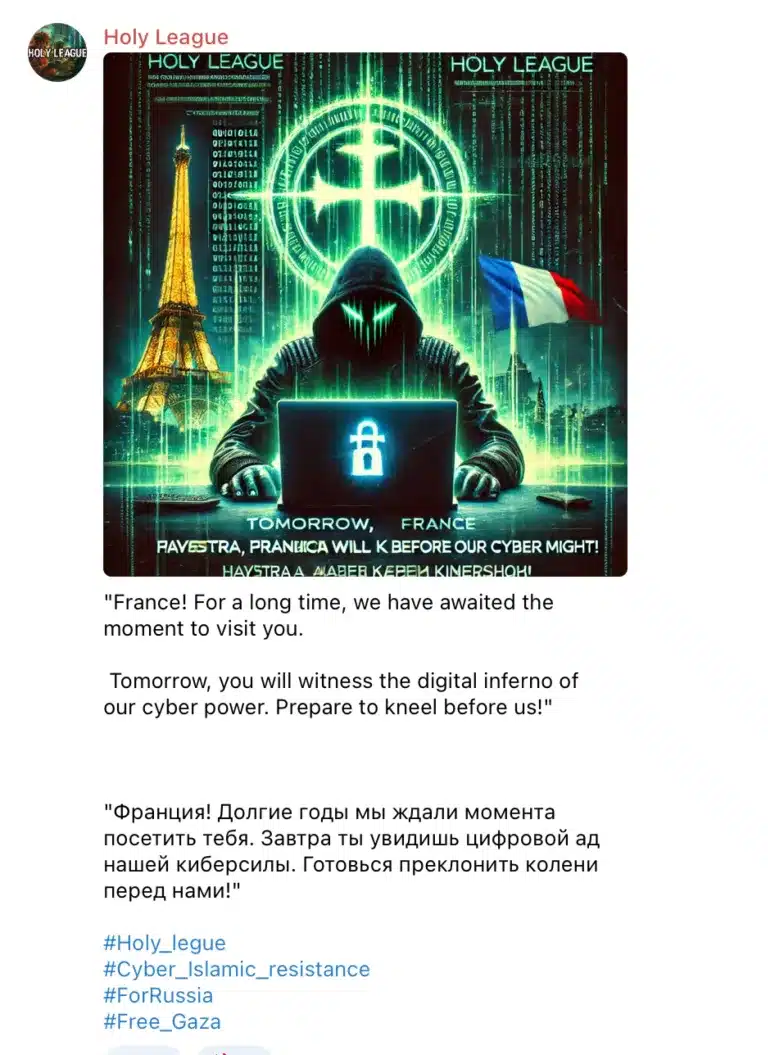


In a surprising turn of events, hacktivist groups with pro-Russian and pro-Palestinian affiliations have joined forces to launch cyberattacks against France. The collaboration, dubbed the “Holy League,” is a unique alliance that aims to retaliate against France’s support of Ukraine and Israel. This unexpected union highlights the convergence of interests among groups with differing ideologies when it comes to destabilizing common adversaries.
The Holy League’s cyberwar against France was announced on December 6 through their Telegram channel. Prominent members of the alliance, including the pro-Russian group NoName057(16), the pro-Islamic threat group Mr. Hamza, and the pro-Palestinian collective Anonymous Guys, coordinated a series of attacks targeting French assets. These attacks included Distributed Denial of Service (DDoS) attacks, compromised Industrial Control Systems (ICS), website defacements, and data breaches of several French entities.
Cyble Research & Intelligence Labs (CRIL) identified 10 groups involved in the cyberattacks on France. NoName057(16) and the People’s Cyber Army focused on attacking official websites of French cities and private organizations, including the financial giant AXA. Mr. Hamza targeted high-value government entities such as the Ministry of Foreign Affairs and the French National Cybersecurity Agency. Anonymous Guys aimed at ministries and governmental departments like the Ministry of Armed Forces and the Ministry of Agriculture.
The Holy League’s campaign also included defacement attacks by the pro-Russian group Z-Pentest against smaller enterprises in various sectors. Additionally, four members of the alliance – Hunt3rKill3rs, Shadow Unit, EvilNet, and KozSec – claimed breaches of systems in France. Shadow Unit, in particular, targeted the SCADA systems of the Corus Nuclear Power Plant and the French Marne Aval station.
The collaboration between these diverse hacktivist groups signals a new era of cyber conflict where geopolitical interests can transcend ideological differences. The joint efforts of pro-Islamic and pro-Russian hackers against France serve as a warning of potential threats to other nations. This shift in hacktivist alliances emphasizes the importance of cybersecurity measures to mitigate the risks posed by coordinated cyberattacks.
The implications of the Holy League’s activities extend beyond France, raising concerns about the potential for similar threats targeting other countries. As hacktivist groups continue to unite against common adversaries, the cybersecurity landscape is evolving into a more complex and challenging environment. The collaboration between ideologically diverse groups highlights the need for greater vigilance and preparedness in defending against cyber threats in this new era of cyber conflict.