
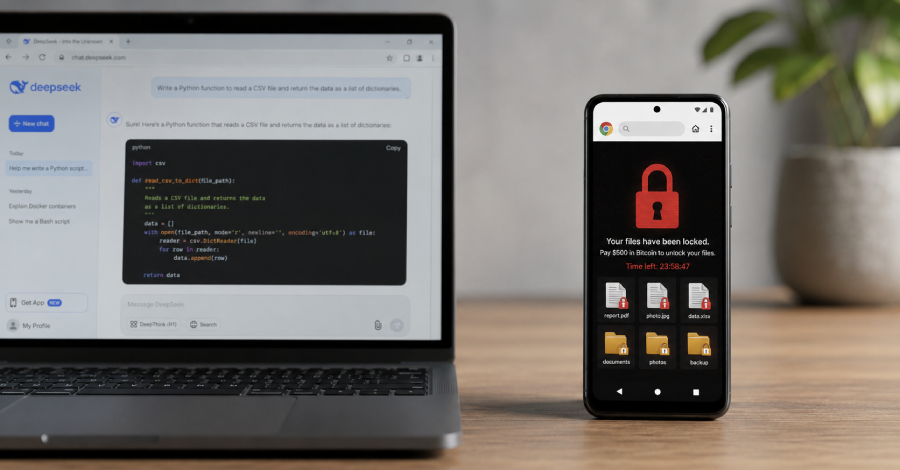


In a significant development within the realm of cybersecurity, researchers from Check Point have identified a novel malware artifact that utilizes an advanced AI model called DeepSeek. This groundbreaking discovery merges theoretical concepts surrounding browser-based malware with practical applications, crafting a ransomware technique capable of executing entirely within web browsers on both Windows and Android systems. The implications of this find are profound, highlighting a shift in how cyber threats can evolve.
Check Point emphasized that this marks the initial documented instance where a cutting-edge AI model has successfully connected the dots between an abstract risk associated with browser-only ransomware and a concrete, operational attack method. They noted that this discovery has surfaced a novel attack pathway which security analysts previously deemed unviable, primarily due to restrictions imposed by browser sandboxing mechanisms. According to the firm, the necessity for extensive expertise to identify new attack vectors has diminished, indicating that security postures must adapt accordingly to this change before malicious actors exploit it on a large scale.
The malware in question is a Python Flask application, labeled “InfernoGrabber” v9.0 by its creator. This software was submitted to VirusTotal on January 25, 2026, and is reported to function as a comprehensive toolkit for information theft and ransomware deployment. Operating as a malicious web server, InfernoGrabber lures users with a deceptive Discord avatar AI upscaler, all while executing a range of harmful activities, including the theft of Discord tokens and credit card information, logging keystrokes, and even clandestinely activating webcams and microphones.
Among its more insidious features, this malware implements specific routines for exploiting browser vulnerabilities, particularly targeting issues cataloged as CVE-2023-4863. Data is surreptitiously exfiltrated using a hard-coded Discord webhook. Furthermore, the application incorporates a ransomware module that displays a ‘WinLocker’ screen demanding a ransom in Bitcoin. The malware’s architecture also includes an administrative dashboard that enables the attacker to oversee stolen data.
The emergence of InfernoGrabber coincides with a broader trend where artificial intelligence and large language models (LLMs) redefine the cybersecurity landscape. These technologies have empowered offenders to harness sophisticated methods for crafting malware and exploits. The use of DeepSeek is particularly noteworthy due to its demonstrated ability to accommodate harmful requests more readily compared to its Western counterparts like Anthropic, Google, or OpenAI. This discrepancy may be attributed to factors such as its free web access, regional availability where other models are not present, and its facility for generating functional malicious applications from expansive prompts.
Check Point’s research team uncovered the Python artifact during their analysis of approximately 3,000 files associated with DeepSeek over the past year. Alarmingly, 1,383 of these files have been labeled as malicious or threatening. The malware represents a form of In-Browser Ransomware that utilizes native techniques previously unseen in practical applications. Although the specific prompt used to generate this malware remains undisclosed, its attack mechanism heavily relies on employing phishing tactics to deceive users into granting a web page extensive file system access.
Once the victim has been ensnared, the malware can enumerate local files, access their contents, encrypt and overwrite them, and display an extortion message, all facilitated without the need for a native payload installation or browser exploitation. This entire sequence of events can occur purely within a legitimate browser environment, which vastly broadens the attack surface across various platforms including Windows, macOS, ChromeOS, Linux, and Android.
Pedro Drimel Neto, leader of the malware analysis team at Check Point, confirmed that the attack successfully operates across multiple operating systems, aside from the iOS platform where the attack could not be replicated due to the absence of the File System Access API. This ubiquity of risk emphasizes how the attack surface may be larger than previously considered, affecting a substantial number of desktop and mobile users.
Another alarming aspect of AI-supported development is that it allows individuals with limited technical knowledge to generate sophisticated malicious code. This ease of access raises serious questions about cybersecurity preparedness. The process allows a less experienced user to formulate broad prompts that may yield effective attack blueprints, even when those users do not possess a firm understanding of the underlying technology.
Drimel Neto noted that their findings reveal that even vague prompts can lead to the emergence of functional malware. The existence of LLMs that exhibit lower resistance to harmful requests offers malicious users greater opportunities for exploitation. Eli Smadja, the head of research at Check Point, emphasized that the current scenario illustrates a seismic change in the development of cyber attacks. For the first time, it has been shown that an AI model can autonomously navigate legitimate platform features to produce an operational attack technique—without prior human knowledge of those systems.
Smadja urged organizations to proactively fortify their defenses. This includes reevaluating permission frameworks and treating browser prompts as significant security decisions. As AI technology continues to intertwine with cybersecurity, the lines between theoretical understanding and practical application are becoming increasingly blurred, necessitating a vigilant and adaptive response from security professionals worldwide. The future of AI security cannot rely solely on the hope that models will refuse blatantly malicious requests; rather, it must anticipate that the next wave of cyber attacks may emerge from an unintentional yet accurate AI hallucination.