
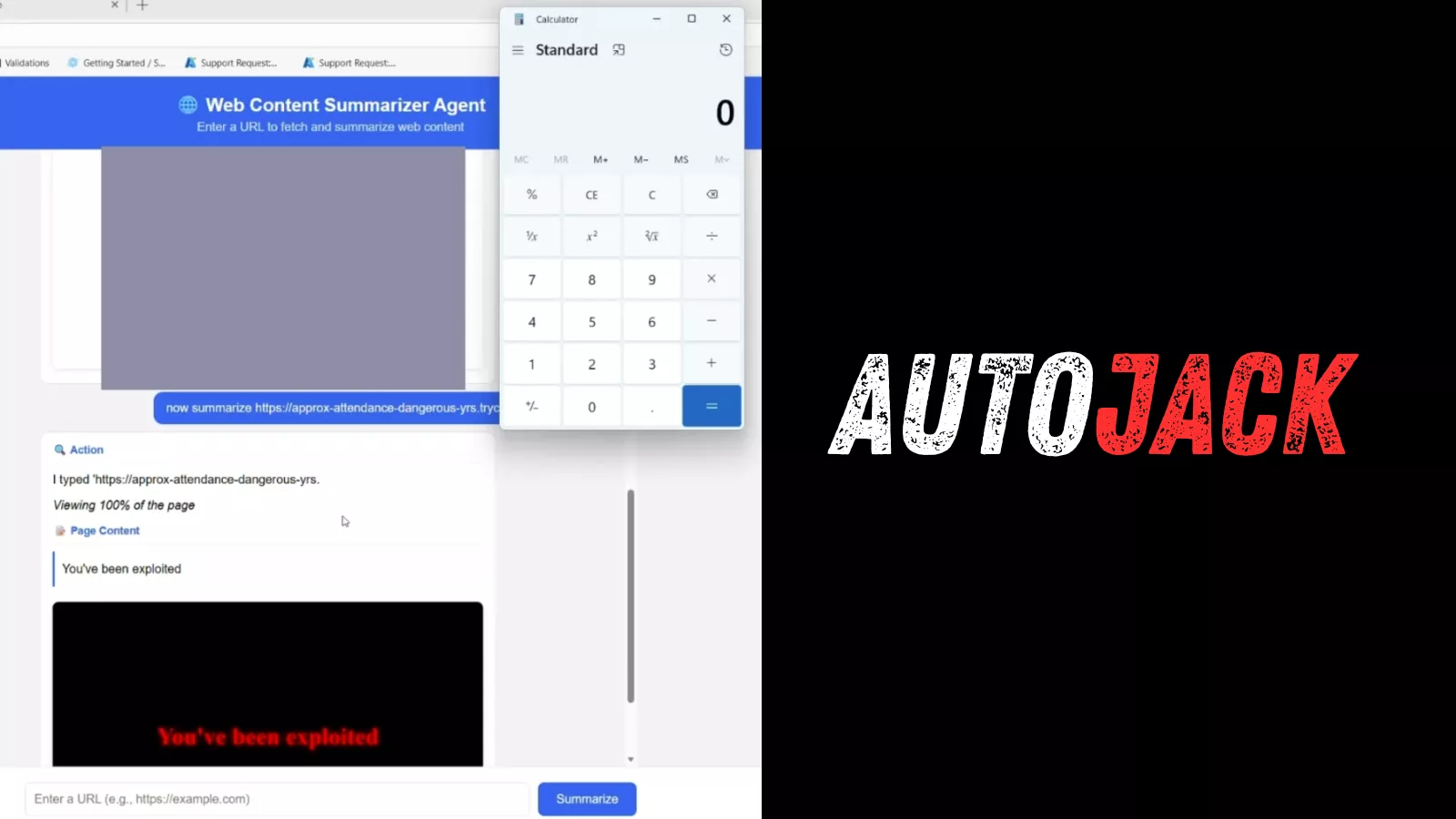


AutoJack Exploit: A Critical Security Threat to Microsoft’s AutoGen Studio
A significant security vulnerability, named AutoJack, has been identified, allowing a single malicious web page to hijack Microsoft’s AutoGen Studio browsing agent. This exploit enables the silent execution of arbitrary code on the host machine, requiring no more user interaction than the submission of a URL. This alarming revelation underscores the potential risks associated with integrating online browsing capabilities into development tools, especially those involving multi-agent AI systems.
Understanding AutoGen Studio and Its Vulnerabilities
AutoGen Studio is an open-source prototyping user interface developed by Microsoft Research, designed to facilitate multi-agent AI systems. The core of AutoJack exploits a unique facet of this system: its built-in web-browsing capabilities. This feature permits AutoGen Studio to cross the localhost trust boundary, effectively transforming the AI browsing agent into an unknowing delivery vehicle for Remote Code Execution (RCE). The manipulation of this functionality raises serious concerns about the secure operation of AI systems that can interact with potentially harmful online content.
The AutoJack exploit cleverly chains together three separate vulnerabilities present in AutoGen Studio’s Model Context Protocol (MCP) WebSocket surface. Each vulnerability is linked to a different Common Weakness Enumeration (CWE) identifier, reflecting distinct areas of security oversight.
-
CWE-1385 – Missing Origin Validation in WebSockets: The MCP WebSocket is configured to only accept connections from
http://127.0.0.1orhttp://localhost. While this setup appears to safeguard against malicious actions from a conventional web browser on a site like evil.com, it fails to protect against JavaScript executed by a headless browser controlled by AutoGen. This existing mechanism completely bypasses the intended origin checks since the browser inherits localhost identity. -
CWE-306 – Missing Authentication for Critical Function: In a further lapse of security, AutoGen Studio’s authentication middleware neglects to enforce strict authentication for the
/api/mcp/*paths. It was presumed that the WebSocket handler would conduct necessary checks, which it does not. Consequently, this oversight allows unauthenticated connections to be accepted, undermining the application’s overall security. - CWE-78 – OS Command Injection via server_params: This serious vulnerability involves the WebSocket endpoint’s handling of the
server_paramsquery parameter. The parameter is decoded from a base64 string into a JSON blob and parsed directly intoStdioServerParams. The critical flaw lies in the fact that commands and arguments are forwarded tostdio_client()without any executable allowlist in place. An attacker could easily inject commands likecalc.exe,powershell.exe -enc …, orbash -c '...'as the designated “MCP server.”
Exploitation Process
An illustrative scenario of the AutoJack exploit involves a developer running AutoGen Studio on localhost:8081, alongside a browsing agent such as a web summarizer created with MultimodalWebSurfer. An attacker’s malicious webpage might be planted in a deceptive manner, enticing the user to provide a controlled URL. The headless browser navigates to this malicious page, and embedded JavaScript establishes a WebSocket connection to ws://localhost:8081/api/mcp/ws/?server_params=.
Since the agent operates locally, the origin check passes successfully. Additionally, the authentication middleware’s failure to enforce checks for the /api/mcp/* paths means no verification token is needed. As a result, AutoGen Studio decodes the malicious payload and executes the attacker-specified commands under the developer’s account. In test scenarios, this exploit has successfully resulted in launching calc.exe on the developer’s desktop mere seconds after the agent rendered the harmful page.
Patching and Mitigation
Research teams alerted the Microsoft Security Response Center (MSRC) about these vulnerabilities, leading to immediate corrective measures. The upstream main branch was fortified in commit b047730 (version 0.7.2). Importantly, it’s noteworthy that the vulnerable MCP WebSocket surface had not been included in any PyPI release; hence, developers using AutoGen Studio through pip (specifically version 0.4.2.2) are not susceptible to this particular exploit.
Microsoft’s maintainers have rectified the issues by relocating server_params to secure, server-side UUID-keyed storage and eliminating /api/mcp from the authentication middleware’s skip list.
To enhance security, developers and defenders are advised to adopt the following precautions:
- Install AutoGen Studio only from PyPI using the command (
pip install autogenstudio), ensuring that the vulnerable MCP route is absent from the published version. - Avoid running AutoGen Studio with any browsing agents on machines that also process untrusted web content.
- Implement allowlists for executables that may be invoked as MCP servers.
- Isolate agent identity from developer identity using containers, distinct OS users, or virtualization solutions.
- If building the application from the main branch, utilize builds created at or after commit b047730.
Conclusion: A Call for Vigilance
The AutoJack exploit highlights a pressing risk pattern emerging across AI agent frameworks. As these agents gain the ability to access untrusted online content while simultaneously interacting with privileged local services, the security boundaries of local environments can be compromised. To safeguard against such vulnerabilities, maintaining consistent control-plane authentication, enforcing strict action allowlisting, and ensuring identity isolation are critical measures that must be urgently addressed across all development frameworks.
For continuous updates on such security developments, follow Google News, LinkedIn, and X, and consider setting GBH as a preferred source on Google.