
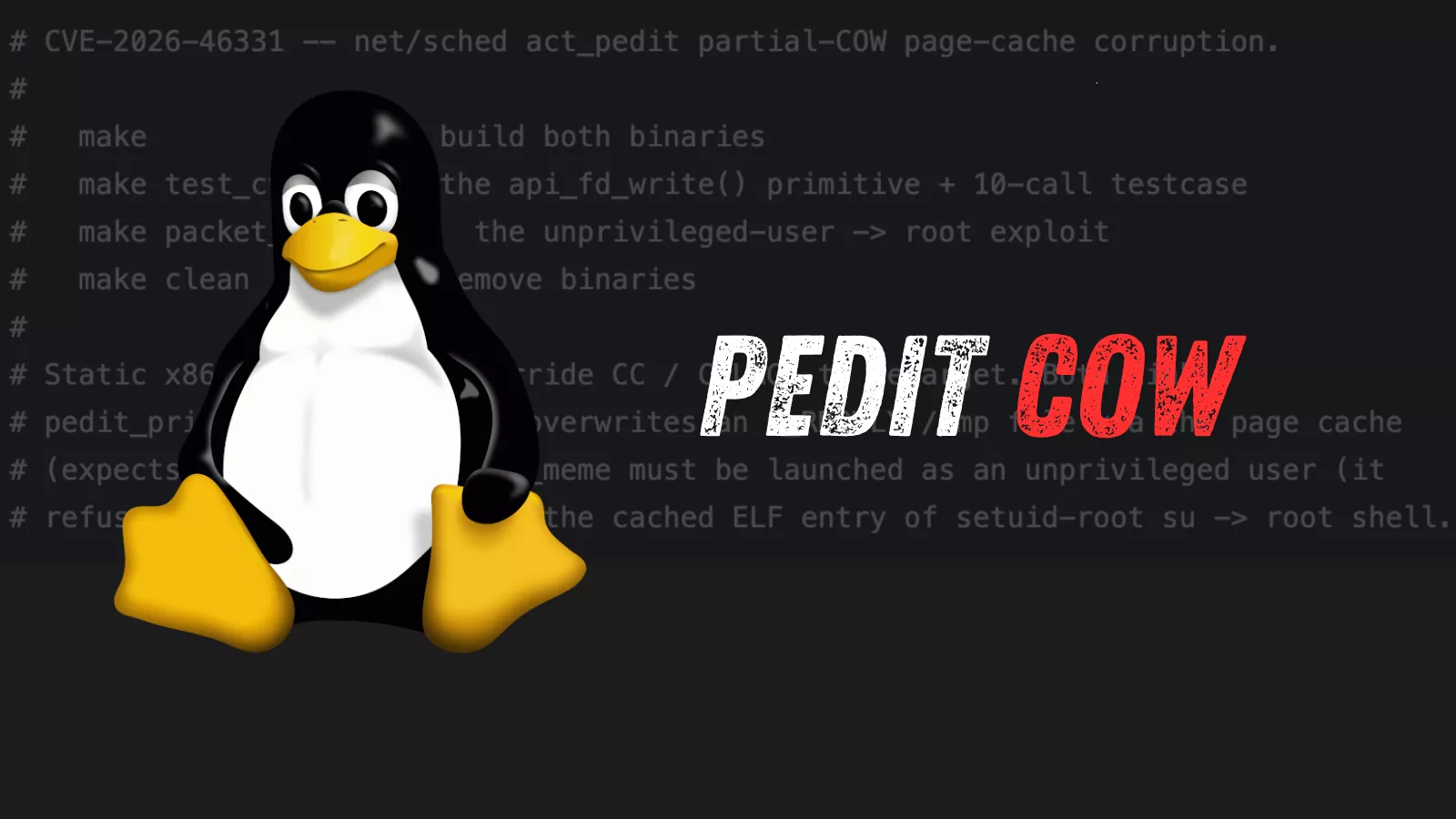


A recent vulnerability discovered in the Linux kernel’s traffic-control subsystem has sent shockwaves through the cybersecurity community. Officially cataloged as CVE-2026-46331 and popularly dubbed “Pedit COW,” this flaw allows unprivileged local users to gain full root access on affected systems. Security researchers are particularly alarmed at the implications of such a widespread vulnerability, especially given its accessibility.
In a matter of just 24 hours following its formal assignment on June 16, 2026, an effective proof-of-concept exploit named packet_edit_meme became publicly available on GitHub. This rapid disclosure significantly shortens the window of vulnerability for systems that have not yet applied necessary patches.
The underlying issue resides within the kernel function tcf_pedit_act(), which is responsible for modifying packet headers in real time through the act_pedit traffic-control module. This function operates under a Copy-on-Write principle, which ideally ensures that a private copy of a memory page is created prior to any alterations. However, the flaw arises from a critical sequencing error that leads to the writable range being validated prematurely—before runtime offsets are fully resolved.
Consequently, certain manipulation keys, which determine their final destination at execution, can inadvertently cause writing to occur outside of the private copy. This results in the corruption of a shared page-cache page. In some cases, this could potentially affect a cached executable, such as /bin/su, which is critical for gaining elevated privileges.
This bug traces back to a particular software commit, 899ee91156e5, and has persisted across every kernel version from v5.18 to v7.1-rc7. Although a fix was proposed on the netdev mailing list in late May 2026, it was simply characterized as a routine data-corruption patch without any accompanying CVE reference or security advisory. This neglect has unfortunately extended the duration of exposure for many systems significantly longer than necessary.
Comparisons to previous Linux kernel exploits, such as Dirty Pipe, DirtyClone, and Dirty Frag, have been made by security researchers. All of these exploits capitalized on weaknesses in kernel architecture by manipulating memory in ways that should not have been possible. Like its predecessors, Pedit COW capitalizes on this vulnerability groundwork, but it astonishingly introduces a new vector: it allows unprivileged users to configure traffic-control actions within their own user namespaces, enabling them to obtain CAP_NET_ADMIN capabilities without any system-level permissions.
The exploit packet_edit_meme showcases this attack method effectively. It initiates a user namespace child to acquire CAP_NET_ADMIN, then leverages the Copy-on-Write violation to corrupt the in-memory ELF image of /bin/su that resides in the kernel page cache. In doing so, the entry point of this binary is modified with shellcode that triggers setgid(0), followed closely by setuid(0) and ultimately execve("/bin/sh"). This malicious transformation allows the execution of the compromised binary, resulting in a fatal breach as a root shell is successfully dropped.
Due to the nature of the attack, which operates exclusively in memory without altering the on-disk binary, traditional file-integrity monitoring tools report no irregularities during the entire attack sequence. This feature makes detecting the exploit particularly challenging for system administrators.
As the cybersecurity community scrutinizes this flaw, significant attention has been directed towards identifying affected distributions. Tests conducted in June 2026 confirmed successful exploitation on several systems, including Red Hat Enterprise Linux (RHEL) 10.0, Debian 13 Trixie, and Ubuntu 24.04.4, which experienced a bypass of AppArmor’s unprivileged namespace restrictions. Notably, Ubuntu 26.04 appeared to be immune to initial attacks, although it fundamentally remains vulnerable to the COW primitive.
Both Red Hat and Debian have responded accordingly, with Red Hat acknowledging vulnerabilities in their supported versions, while Debian has released patches for Trixie. However, earlier versions of Debian remain without a fix, significantly increasing risks for users who rely on them.
To mitigate the effects of this critical vulnerability, the only comprehensive solution is to install the patched kernel and reboot affected systems. Administrators are urged to prioritize patching especially for multi-tenant hosts, Kubernetes nodes, and CI/CD runners, as these applications are at a heightened risk of exploitation due to their shared nature.
In cases where immediate patching is not possible, disabling the act_pedit module is recommended via a simple command. Alternatively, disabling unprivileged user namespaces can neutralize the exploit’s entry point but may impact containerization functionalities.
Given the severity of the Pedit COW vulnerability and its ramifications, cybersecurity protocols surrounding affected systems must be revisited and fortified. Following such incidents, hosts suspected of encountering the exploit should be treated as fully compromised, irrespective of what file-integrity monitoring tools may report, reaffirming the necessity for vigilance in an ever-evolving digital landscape.