
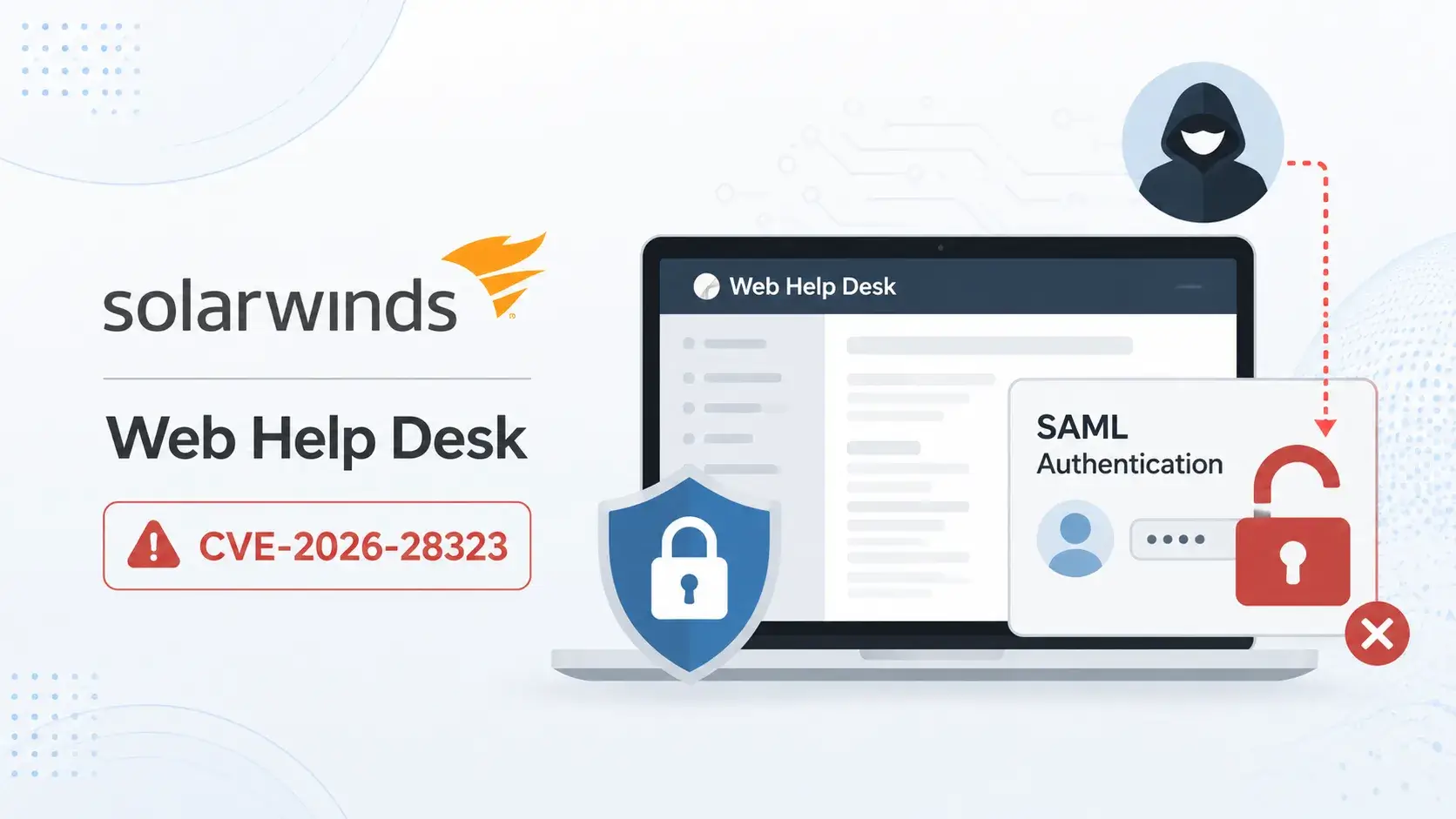
SolarWinds Releases Critical Update to Address Authentication Bypass Vulnerability in Web Help Desk
In a significant move to bolster security, SolarWinds has introduced the Web Help Desk (WHD) version 2026.2.1, designed specifically to mitigate a critical authentication bypass vulnerability that has raised alarm bells among IT security professionals. This vulnerability poses a serious threat by allowing attackers to gain unauthorized access to affected systems, leveraging weaknesses inherent in SAML-based single sign-on (SSO) implementations.
The flaw, identified as CVE-2026-28323, has been assigned a notably high CVSS score of 9.8, indicating its critical nature. Its effects are particularly concerning for deployments that enable SAML 2.0 authentication. Cybercriminals may exploit this vulnerability to bypass authentication controls, effectively impersonating legitimate users without requiring valid credentials. The potential ramifications for enterprise environments reliant on centralized identity providers—such as Okta, Azure AD, or ADFS—could be severe.
Security researcher Dhabaleshwar Das played a crucial role in identifying and responsibly disclosing this vulnerability. The findings have underscored the criticality of secure configurations in enterprise help desk environments, especially for organizations that utilize single sign-on systems. SolarWinds elaborated that the issue lies in how SAML authentication responses are processed. Due to insufficient validation mechanisms, crafted assertions can be mistakenly accepted as legitimate, paving the way for unauthorized access.
In practical terms, an adversary with network access or those capable of intercepting authentication flows could forge SAML responses. This action would grant them privileged access to the WHD platform, endangering sensitive ticketing information, administrative controls, and potentially any connected backend systems. Given that help desk platforms host sensitive data, including user credentials and internal communications, successful exploitation of the vulnerability could allow threat actors to facilitate lateral movement, escalate privileges, and compromise more extensive systems within enterprise frameworks.
This vulnerability is especially concerning in light of WHD 2026.2.1’s increased reliance on modern SSO mechanisms, following a shift away from deprecated legacy servlet authentication methods. Organizations that have recently transitioned to SAML-based authentication as part of system upgrades may find themselves at an elevated risk if they do not act quickly to install necessary patches.
To address this vulnerability, SolarWinds has confirmed that WHD version 2026.2.1 includes comprehensive remediation. Alongside fixing the authentication bypass flaw, the update features several security enhancements, such as enforced HTTPS, improved TLS configurations, and stronger security headers through a new Caddy-based reverse proxy architecture.
Moreover, the release also rectifies issues related to previously disclosed vulnerabilities, including a denial-of-service flaw (CVE-2026-28299) that could enable attackers to crash WHD servers using memory exhaustion techniques. Remediations for risks linked to third-party components, specifically pgAdmin4—which contained command injection vulnerabilities, remote code execution, and LDAP-related flaws—have also been included. This denotes a commitment to cumulative security improvements within this release cycle.
In light of the critical nature of the vulnerabilities addressed, security experts are strongly advising all organizations to upgrade to WHD 2026.2.1 as soon as possible. They highlight the importance of auditing SAML configurations, including identity provider settings and the processes involved in certificate validation. Administrators are also urged to monitor authentication logs for any anomalies and enforce strict access controls. Implementing additional verification measures, such as conditional access policies, can bolster defenses against potential attacks.
The urgency of addressing authentication-bypass vulnerabilities is underscored by the fact that unpatched systems may become prime targets for nefarious actors seeking to infiltrate enterprise networks. The release of WHD 2026.2.1 shines a light on the ongoing risks associated with SSO misconfigurations and implementation flaws, highlighting the necessity for rigorous validation of authentication workflows in enterprise software deployments.
As organizations continue to evolve in their use of modern technology solutions, the risks surrounding authentication and access control remain ever-present. Hence, as enterprises seek to navigate the complexities of maintaining secure environments, proactive measures must be taken to close gaps that could otherwise lead to significant vulnerabilities.