
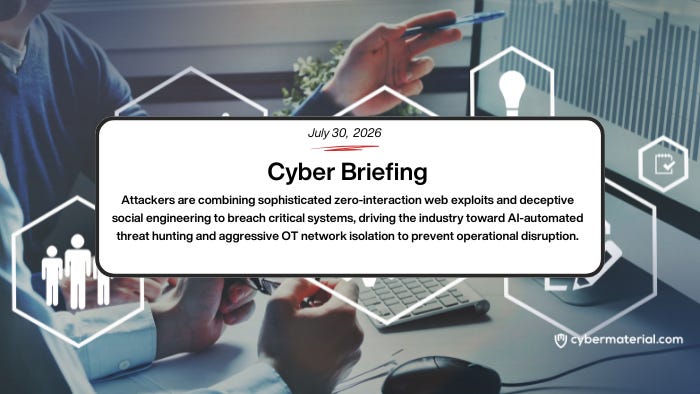


Cybersecurity Briefing: New Threats and Innovations
In recent cybersecurity developments, a notable uptick in attacks targeting enterprise communications and end-user platforms has been recorded. State-backed actors, along with malware operators, have demonstrated advanced capabilities in gaining persistent access and exfiltrating sensitive data. Prominent among these threats is the Russian threat group designated as TA488, known for exploiting vulnerabilities within Microsoft Exchange Outlook Web Access. Utilizing a cross-site scripting vulnerability (CVE-2026-42897), TA488 has managed to deploy a persistent browser backdoor named OWAReaper. Alarmingly, this backdoor can be activated simply by targets viewing malicious emails, allowing attackers to establish a foothold that persists even after password resets and endpoint reimaging.
The ramifications of these cyber threats extend beyond individual organizations, impacting national security and infrastructure. Reports indicate that the campaign has been active since July 2026, primarily targeting government and private sectors across the United States and Europe. Affected organizations are urged to act swiftly by applying Microsoft’s July 2026 security update, auditing mailbox permissions, and implementing cross-layer monitoring that correlates OWA activity with permission changes.
Rising Threat of MacSync Malware
Alongside the aforementioned threats, macOS users are facing a targeted attack vector through a six-stage malware family known as MacSync. Reportedly identified by security researchers at Huntress, this malware is being distributed via malicious Google ads disguised as guides for installing Claude AI. Victims clicking on these ads are led to a fake support page hosted on the legitimate claude.ai domain. The attack begins when victims are tricked into pasting malicious commands into their Terminal. This insidious approach allows the malware to steal sensitive data, including browser credentials, cryptocurrency wallet information, SSH keys, and Telegram sessions. In a prolonged assault, it even deploys a remote access trojan and replaces genuine hardware wallet applications with nefarious versions that capture recovery phrases.
Coordinated Attack on Minnesota Water Utilities
A major coordinated cyberattack recently targeted over 30 community water utilities in Minnesota. Occurring on July 26-27, 2024, the attack primarily affected operational technology systems. Minnesota IT Services (MNIT) promptly activated cybersecurity incident response capabilities following the attack’s discovery, although specific details about the attackers and methodologies remain undisclosed. This incident has raised alarms about the vulnerability of essential services and the need for fortified defenses against such invasive tactics.
Innovations in Cyber Defense
In light of rising operational threats, both industry vendors and cybersecurity authorities are responding by prioritizing automated defenses and establishing stringent isolation measures. A variety of new AI-driven tools are being deployed. PortSwigger has introduced an agentic AI penetration testing assistant, Burp AT. This tool empowers security testers by allowing them to delegate investigative tasks to AI agents while retaining control over validation and judgment. Burp AT leverages existing tools from Burp Suite, making it easier for security professionals to streamline automated tasks while ensuring a human touch remains in the inspection process.
Additionally, Dropzone AI has launched its own innovative solution known as AI Threat Hunter. This automated threat hunting tool is designed to assist security operations centers in identifying hidden threats that may elude standard alert systems. By running structured hunt packs across enterprise environments, AI Threat Hunter proactively searches for emerging risks that might not be caught by predefined detection rules. By making threat hunting a regular operation rather than an occasional task, this tool positions organizations to better defend against cyber threats.
Infrastructure Security Guidelines
To further bolster defenses, a new guidance document referred to as the CI Fortify Guide has been released. It emphasizes the need for critical infrastructure operators to isolate vital operational technology systems from other networks. This isolation is crucial for containing cyber incidents and maintaining essential services during attacks. The guide outlines a structured six-step process for network isolation, which includes identifying minimum systems required for critical services and progressively mapping connections, as well as constructing separation points.
This comprehensive approach not only enhances the safety of vital infrastructure but also enables operators to react more effectively during cyber incidents. Organizations are encouraged to implement graduated isolation approaches, which can escalate to full physical separation of critical systems as threat levels rise.
Conclusion
The cybersecurity landscape continues to evolve, presenting both significant threats and advancements in defense strategies. Organizations across all sectors must remain vigilant and proactive in their approach to cyber threats. With sophisticated attacks like those from TA488 and the emergence of tools like Burp AT and AI Threat Hunter, it is imperative that cybersecurity practices adapt and improve to ensure the integrity and safety of sensitive data and operational capabilities. The guidance provided in the CI Fortify Guide serves as a necessary framework for critical infrastructure operators to follow, enhancing resilience against potential cyber incursions.