


Cybersecurity Updates: Newly Emerged Threats Due to AI & Software Vulnerabilities
In recent developments within the cybersecurity landscape, significant threats have emerged that warrant urgent attention from organizations and individuals alike. Most notably, the increasing weaponization of artificial intelligence (AI) and the compromise of software supply chains have created fertile ground for malicious cyber activities.
The Rise of Fake Claude AI Installers
A particularly concerning trend is the propagation of fake Claude AI installers. Cyber attackers have cleverly disguised malware within phony installation pages, promoted via deceptive Google Ads targeting unsuspecting users seeking the legitimate AI assistant. This criminal campaign effectively leverages convincing installation guides alongside a multi-stage infection strategy that exploits trusted components of Windows and employs fileless execution techniques to evade detection. Users are advised to download Claude AI exclusively from official sources governed by Anthropic and to thoroughly verify URLs before proceeding with any installation prompted through search advertisements. Neglecting these precautions could inadvertently lead to severe security breaches.
Scammers Outsmart AI Email Filters
In another alarming turn of events, scammers are reportedly utilizing hidden text techniques in phishing emails, allowing them to bypass AI-driven email security filters. By embedding benign content from respected brands or well-known literary works using zero-font HTML or color-matching methods, these cybercriminals create messages that remain invisible to human eyes yet are detectable by machine learning algorithms. Although these attacks currently constitute a small fraction—less than 1%—of observed email traffic, security researchers caution that such strategies will likely become an ever-growing threat as companies increasingly depend on AI-powered email defenses.
AI-Powered Applications Expose Corporate Data
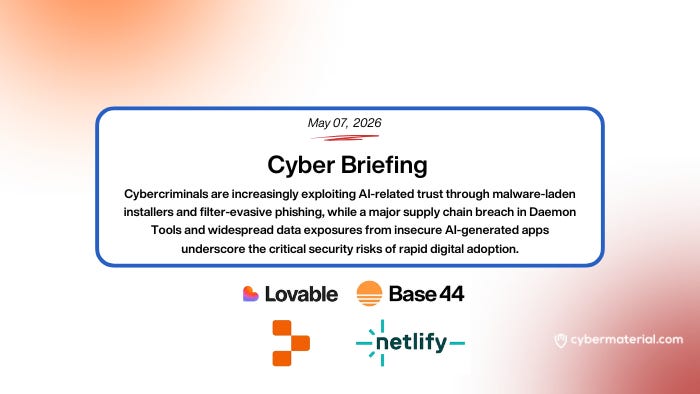
The emergence of AI-generated web applications through various platforms such as Lovable, Base44, Replit, and Netlify has inadvertently exposed vast amounts of sensitive corporate data to the public internet. These innovative services enable developers to create functional web applications almost instantaneously, but they often neglect to implement necessary security measures. As a result, confidential data—including databases, API keys, and other sensitive information—has been left accessible without authentication. Organizations are urged to conduct immediate audits of any applications developed on these platforms and to enforce strict access controls prior to their deployment.
Daemon Tools Supply Chain Attack
Adding to the mounting concerns, the Daemon Tools supply chain attack serves as a stark reminder of the risks associated with compromised legitimate software binaries. Disc Soft recently released Daemon Tools Lite version 12.6 after discovering that an earlier version had been compromised in an attack that dates back to April 8, 2026. Kaspersky has reported thousands of attempts to infect systems across more than 100 countries, with various sectors—including retail, government, and education—being particularly affected. The malicious payloads, which included Quic RAT malware, have called for immediate actions from users of the affected software to uninstall it, run comprehensive security scans, and ensure they download the latest verified versions only from official channels.
Warnings from International Intelligence Alliances
While organizations pivot towards autonomous "agentic" AI systems, the Five Eyes intelligence alliance, alongside the UK’s National Cyber Security Centre (NCSC), has issued urgent advisories regarding the security implications of these systems. The increasing sophistication and autonomy associated with agentic AI pose significant risks, as these technologies are capable of making decisions without human oversight. Organizations deploying such systems must prioritize strict access controls, continuous monitoring, and rigorous validation processes to mitigate potential misuse or unintended consequences, emphasizing the need for enhanced transparency in AI-driven decision-making processes.
Concerns Surrounding the UK Online Safety Act
Concerns about the efficacy of regulatory measures are further underscored by a survey from Internet Matters, which revealed that the UK’s Online Safety Act, implemented in July 2025, has yielded limited improvements in its goal to protect children online. While some children report encountering age-appropriate content and a portion of families feel marginally safer, nearly half of the surveyed children admitted to circumventing age verification checks using various deceptive methods. Additionally, many children still encountered harmful content even after protective measures were put in place, leaving parents rightfully apprehensive about privacy risks associated with data collection for age verification.
Cyber Hackathons Emphasize Human Judgment
Lastly, amidst these pressing challenges, institutions such as Lloyds Banking Group, Hack The Box, and Google Cloud Security recently conducted a two-day hackathon focused on cybersecurity for the UK financial services sector. The event brought together 33 teams from 16 organizations to compete under realistic threat scenarios, testing skills in web exploitation, digital forensics, cryptography, and payment systems security. Participants, meanwhile, demonstrated the need for human judgment in crisis situations that involve interconnected financial systems, a critical element that AI tools, despite their prowess, cannot replicate.
With the evolution of cyber threats and the continuing challenges posed by rapidly advancing technologies, it is imperative for organizations, government bodies, and individuals to remain vigilant and proactive in protecting themselves from these emerging risks.