
Cyber Briefing: Essential Updates on Recent Cybersecurity Threats
Cybersecurity has emerged as a crucial focal point for organizations and individuals alike, particularly given the heightened threats stemming from various vulnerabilities in widely used software systems. In this weekly briefing, we summarize the most pressing issues in the realm of cybersecurity, underscoring vulnerabilities and incidents that require urgent attention.
Critical Vulnerabilities Identified
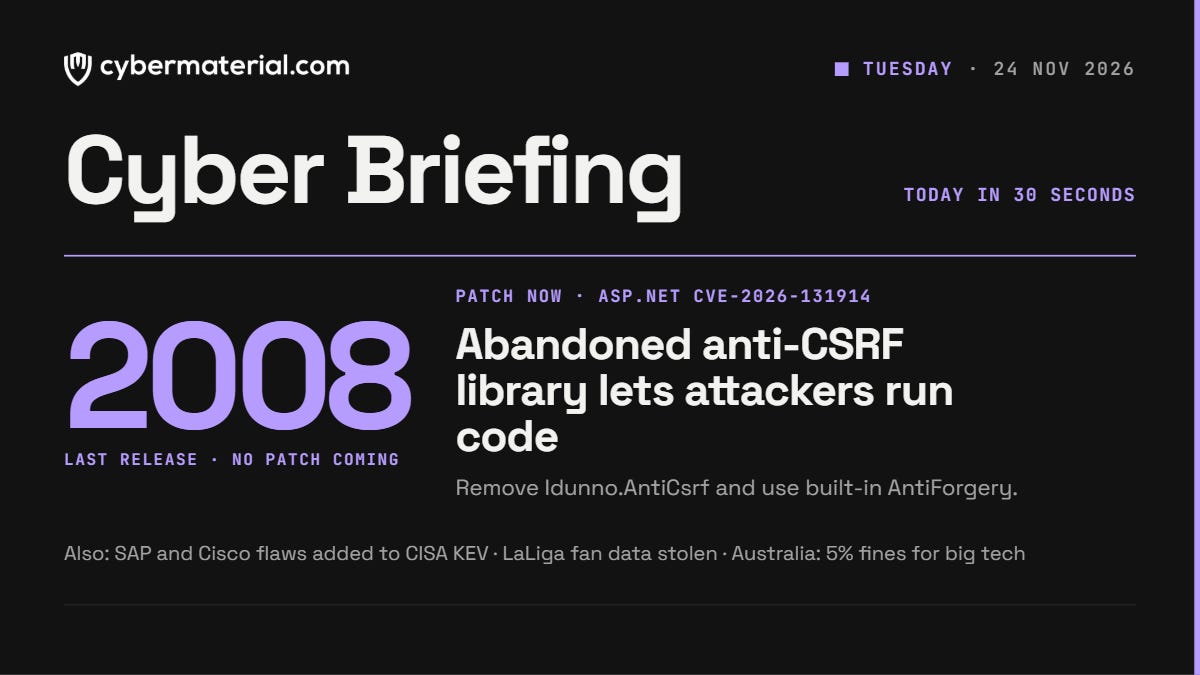
Among the most alarming developments is the revelation regarding the Idunno.AntiCsrf module, which is used within ASP.NET applications. This vulnerability, categorized as CVE-2026-131914, boasts a critical CVSS score of 9.3. Security experts at Mandiant have reported that attackers are actively exploiting this flaw, which allows unauthorized code execution without the need for authentication. Notably, this particular library has not received updates since 2008, meaning that no patches will be available to mitigate the risks it presents. Organizations relying on this outdated module are urged to remove it from their applications as a matter of priority.
In addition, the Cybersecurity and Infrastructure Security Agency (CISA) has identified flaws in SAP NetWeaver and Cisco Expressway as being actively exploited. Federal agencies were given a deadline until November 23 to apply necessary patches, specifically SAP Note 3660969 and Expressway version X15.5.20. These flaws represent significant risks to the functionalities of systems employing these platforms, necessitating immediate remediation.
Data Breaches and Their Implications
In a disconcerting turn of events, LaLiga, Spain’s premier football league, reported a data breach affecting its fan platform. Between November 14 and November 16, attackers accessed the system and extracted personal data belonging to users registered with LaLiga and six affiliated clubs. This incident is expected to lead to an increase in phishing attempts targeting football fans, who may receive fraudulent communications allegedly coming from these clubs.
Security researchers have also made alarming discoveries related to AI prompt data theft. Specifically, findings indicate that as many as three hosting providers have been compromised, with attackers successfully extracting AI prompts that contained sensitive information. Researchers noted that roughly 200 AWS access keys planted in these prompts were stolen and were actively being utilized within hours of the breach. This incident underscores a pressing need for users to refrain from embedding sensitive data within AI prompts and to consider localized hosting solutions whenever feasible.
Emerging Solutions Amidst Rising Threats
In a bid to address vulnerabilities, OpenAI and Cisco have joined forces to introduce Shirudo, an open-source Linux security tool leveraging extended Berkeley Packet Filter (eBPF) technology. Designed to temporarily block exploitation of known vulnerabilities without necessitating system restarts, Shirudo enables organizations to deploy targeted protections while they work toward permanent patches. Currently, this tool requires a specially patched Linux kernel and a TPM 2.0 chip for production use, highlighting its potential for fostering enhanced security measures in the face of pervasive threats.
Furthermore, cybersecurity is not solely a technological challenge. Australia’s Labor Government recently solidified a partnership with the Greens to advance a Digital Duty of Care law through the Senate. This legislation aims to strengthen obligations on organizations to protect user data, emphasizing the growing importance of responsible data handling practices in the digital landscape.
Conclusion
The current cyber threat landscape is rife with vulnerabilities that threaten the integrity of systems and the privacy of users. Organizations must prioritize addressing known issues, implementing timely patches, and fostering a culture of cybersecurity awareness. As these threats evolve, staying informed and prepared remains paramount for all stakeholders in the realm of cybersecurity. The need for proactive measures, continuous education, and collaboration in the industry has never been more pressing.