


Cybersecurity Updates: Critical Vulnerabilities and Security Breaches on October 20, 2026
As cyber threats continue to escalate, cybersecurity professionals and organizations are staying vigilant in addressing vulnerabilities and breaches that may affect sensitive data. On October 20, 2026, significant incidents surfaced, including critical software flaws, a substantial data breach, and the exposure of illegal ransomware operations harnessing artificial intelligence (AI) capabilities.
Major Vulnerability Discovered in NGINX
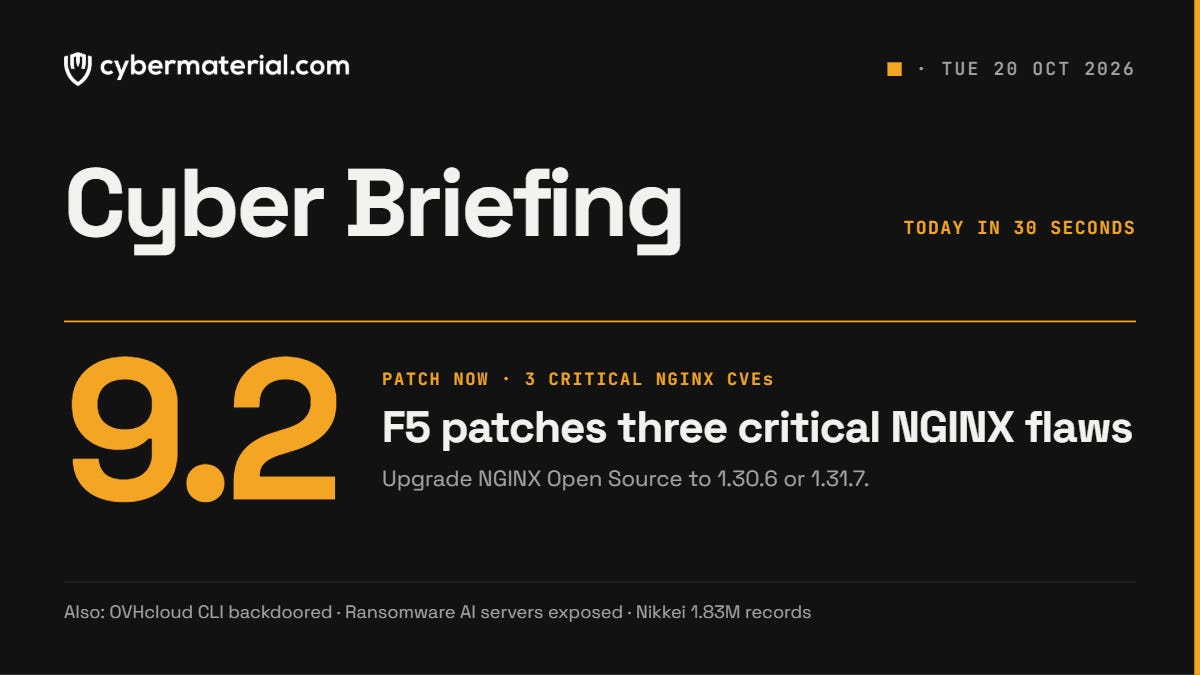
F5 Networks announced a critical advisory concerning multiple vulnerabilities in NGINX, specifically highlighting three flaws classified as critical with a CVSS score of 9.2. The advisory details two heap buffer overflow vulnerabilities (CVE-2026-15176, CVE-2026-93479) and one use-after-free vulnerability (CVE-2026-97205) in the software. Exploitation of these flaws could allow an unauthenticated remote attacker to execute crafted HTTP requests that might crash worker processes. While there have been no reports of these vulnerabilities being exploited in the wild, F5 recommends users upgrade their NGINX installations to either Open Source 1.30.6 or 1.31.7 to mitigate potential risks.
In its advisory, F5 emphasized the necessity of specific configuration to exploit each bug, which includes the use of aliases with $request_filename, regex captures in maps, or asynchronous I/O (AIO) with Server-Side Includes (SSI). Until users apply the patch, turning off AIO or SSI and switching regex mapping to named captures is advisable.
OVHcloud Incident: Compromised CLI Binaries
On the same day, another serious issue came to light involving OVHcloud, where an attacker gained access to a GitHub account of a contributor and allegedly replaced binaries and checksums in five versions of the OVHcloud CLI (versions 0.11.0 to 0.15.0). The substitute files were backdoored to steal secrets, remaining live for approximately 94 minutes before being identified and removed. Customers who may have inadvertently downloaded these compromised versions are urged to rotate their secrets and credentials immediately.
Russian Ransomware Operations Using AI
Additionally, an investigation by SOCRadar uncovered seven exposed servers linked to the INC Ransomware and The Gentlemen affiliates. The analysis revealed disturbing insights, including the presence of 46 encryptor builds for six different victims and a staggering $23,920 spent on OpenRouter AI capabilities. Further alarming was the discovery of “Phantom,” an autonomous attack framework featuring 18 skill modules, indicating a sophisticated level of operation within these ransomware groups.
Data Breach at Nikkei: Millions of Records Exposed
The day also witnessed a significant data breach when the Japanese media giant Nikkei reported that approximately 1.83 million customer records had been exposed. Among the compromised data, roughly 150,000 records contained personal information such as names, physical addresses, email addresses, phone numbers, and dates of birth. These revelations place the affected individuals at heightened risk of phishing attacks and potential identity theft. Nikkei has urged those impacted to remain vigilant regarding their accounts and monitor them closely for any suspicious activities.
Cybersecurity Measures and Initiatives
In light of these events, several organizations and regulatory bodies have taken steps to strengthen cybersecurity protocols. For instance, the UK’s Financial Conduct Authority (FCA) is advocating for financial firms to extend their reporting obligations to encompass AI failures and near-misses, underlining the urgency of addressing risks associated with AI and automated technologies.
Moreover, Microsoft announced new dynamic permissions controls for AI agents during its upcoming security framework enhancements. The features will enable the adjustment of permissions based on task assessment and calculated risk, emphasizing the importance of managing risks in AI implementations.
In an era where cyber threats evolve rapidly, staying informed on the latest advisories, breaches, and industry responses is crucial for organizations looking to safeguard their operations. Cybersecurity experts recommend proactive measures, including software upgrades, rigorous monitoring, and employee training to mitigate risks stemming from vulnerabilities and exploitations. As the landscape continues to shift, organizations must adapt their strategies and practices to ensure robust defenses against cyber adversaries.