


Cyber Briefing: Urgent Cybersecurity Alerts and Updates
In the latest edition of Cyber Briefing, a crucial resource for individuals and organizations navigating the complex landscape of cybersecurity, several significant vulnerabilities and updates have emerged. These news highlights underscore the importance of vigilance and prompt action for safeguarding digital assets in today’s cyber-threat environment.
Key Updates in Cybersecurity
PHP Vulnerabilities Demand Immediate Action
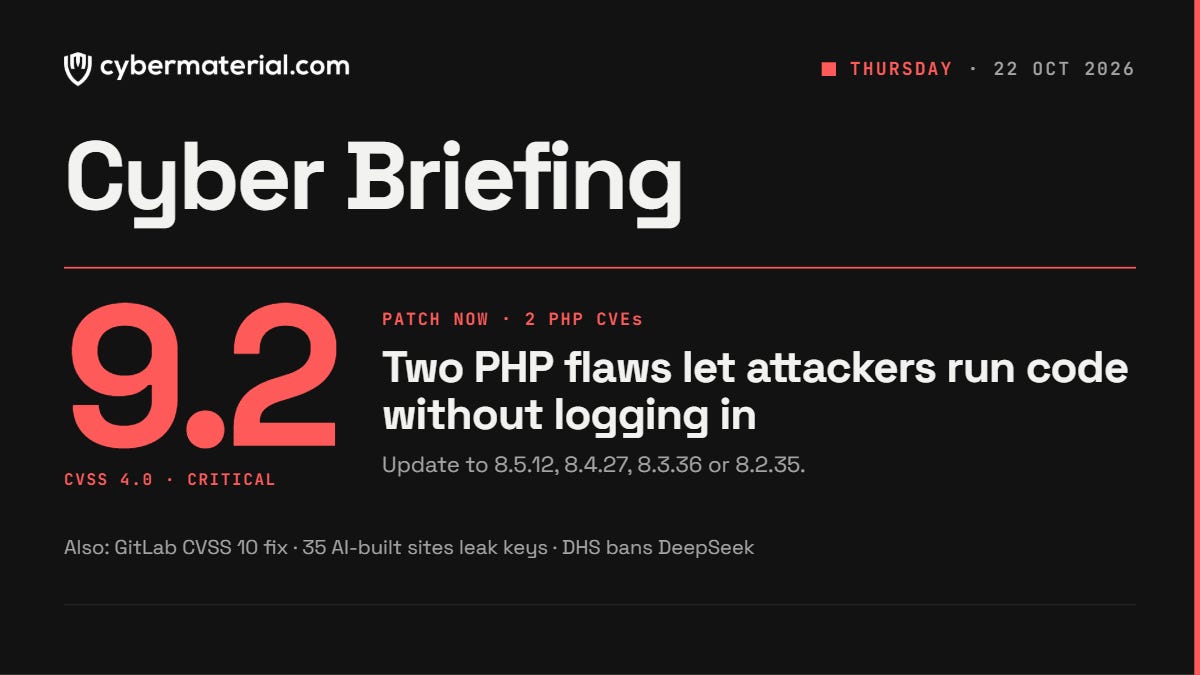
The cybersecurity landscape has been jolted by the revelation of two critical vulnerabilities in PHP, both rated 9.2 under the CVSS 4.0 standard. These vulnerabilities, identified as CVE-2026-109618 and CVE-2026-109619, permit unauthenticated remote code execution—an alarming threat for any systems utilizing PHP. The PHP team has swiftly released versions 8.5.12, 8.4.27, 8.3.36, and 8.2.35, effectively addressing these vulnerabilities. Given that every PHP installation serving web requests is at risk—this includes configurations such as PHP-FPM, Apache mod_php, php-cgi, FrankenPHP, and LiteSpeed—it is imperative for organizations to act promptly.
According to recent data from Palo Alto Networks’ Xpanse, there are approximately 22.6 million exposed PHP instances globally. The urgency of the situation was underscored by Amazon, which reported an attempted exploitation of these vulnerabilities on October 17. While attempts to compromise systems have been detected, it has been noted that no successful breaches have been confirmed to date.
Recommended Action: Organizations are urged to update the PHP runtime on all web servers immediately, leveraging their respective distribution or Long-Term Support (LTS) vendor’s backport if necessary. In scenarios where updates cannot be performed, taking the affected site offline or implementing Web Application Firewall (WAF) rules is suggested to mitigate potential risks.
GitLab’s Critical CI/CD Security Flaw
In another alarming instance, GitLab has addressed a severe vulnerability cataloged as CVE-2026-97229, which has been assigned a maximum severity score of 10.0. This flaw involves an integer overflow in the CI/CD regular-expression compiler, potentially allowing unauthenticated attackers to execute arbitrary code on self-managed GitLab servers. The affected versions include Community Edition (CE) and Enterprise Edition (EE) releases prior to 19.2.8, 19.3.4, and 19.4.2.
Fortunately, GitLab.com and GitLab Dedicated instances have already been patched, and no reports of in-the-wild exploitation have surfaced as of this announcement.
Recommended Action: Administrators are advised to upgrade their self-managed GitLab servers to versions 19.4.2, 19.3.4, or 19.2.8, ensuring adequate time for any necessary database migrations.
AI-Built Websites Compromise Sensitive Information
Recent research conducted by Cyble Research and Intelligence Labs (CRIL) unveiled a troubling trend regarding AI-generated websites. Out of over 1.3 million newly registered domains, 22,306 have origins linked to AI builders, with 35 of these sites inadvertently exposing sensitive data. Notably, 16 live OpenAI keys and secret keys from Stripe and Supabase were discovered, posing serious risks to users and organizations alike.
These vulnerabilities were identified as a result of proprietary AI applications replicating server-side secrets into front-end code, creating a widespread risk when templates were cloned across multiple domains.
Recommended Action: Developers and webmasters utilizing AI tools must exercise caution and ensure that sensitive keys and credentials are not hardcoded into publicly accessible code.
DHS Mandates Removal of DeepSeek Tools
In a significant regulatory move, the Department of Homeland Security (DHS) has mandated civilian federal agencies to eliminate DeepSeek products and any third-party services utilizing the DeepSeek models. This directive was published in the Federal Register following concerns about sensitive information potentially reaching unauthorized entities in the People’s Republic of China (PRC). While this ban does not extend to private corporations or individual users, it represents a growing concern about supply chain security amid escalating global tensions.
Advancements in Cybersecurity Tools
Beyond addressing current threats, advancements in cybersecurity technology continue to evolve. SentinelOne has unveiled a new tool—the Singularity Agentic Detection and Response (ADR)—designed to identify AI agents, enforce their permissions, and monitor their activities in real time. This tool integrates seamlessly with SentinelOne’s existing behavioral prevention measures, thus providing organizations with a robust solution for managing AI deployment risks.
Conclusion
As these developments unfold, it becomes increasingly evident that organizations must stay vigilant and proactive in their cybersecurity strategies. With vulnerabilities like those seen in PHP and GitLab, alongside the emerging risks from AI technologies and the mandates from the DHS, a comprehensive approach to cybersecurity is more crucial than ever. By prioritizing timely updates and implementing robust security measures, organizations can better protect themselves in an ever-evolving cyber landscape.
This critical information serves to empower cyber professionals, guiding them in making informed decisions that could protect both their internal environments and their users’ data. The call to action spans across effective communication within organizations to ensure that these vulnerabilities are addressed swiftly to prevent potential exploitation.