
Cybersecurity News Updates: Key Developments on October 26, 2026
In the rapidly evolving field of cybersecurity, new developments arise daily, impacting both individual users and large organizations alike. On October 26, 2026, significant updates from renowned companies and government agencies shed light on critical issues and potential vulnerabilities that users must address promptly.
Apple’s Major Software Update
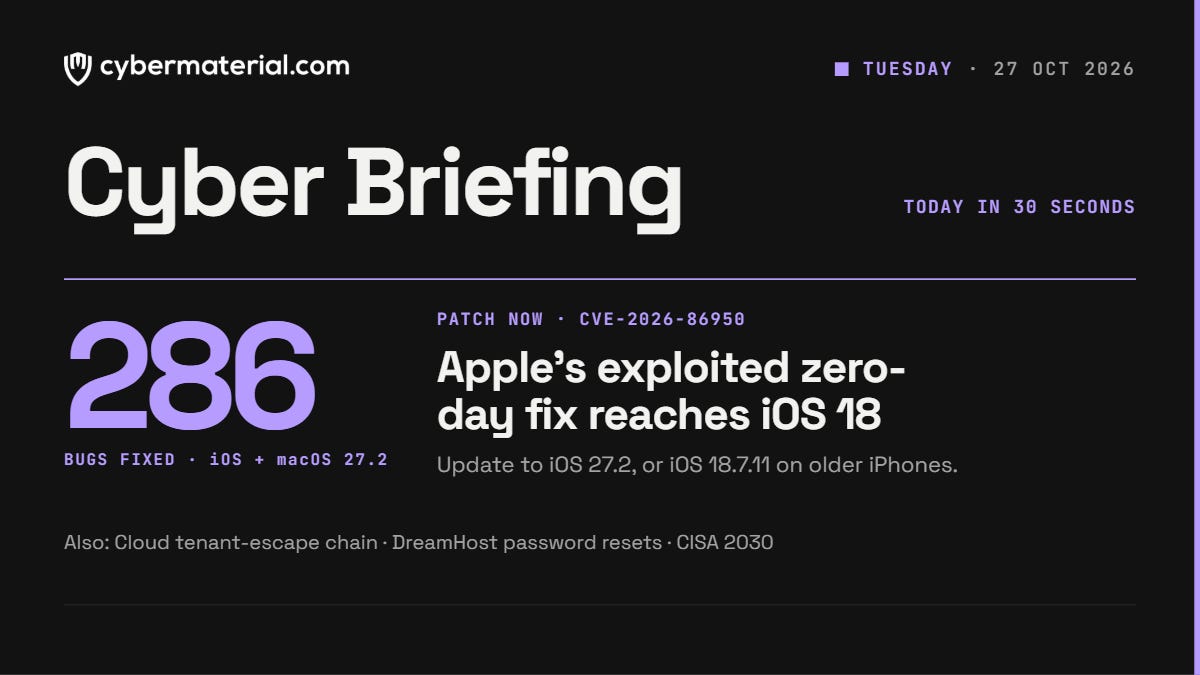
Apple has made a noteworthy impact by releasing a significant software update for its devices. The company announced the launch of iOS and macOS version 27.2, addressing an impressive total of 286 vulnerabilities. Among these updates, the macOS Golden Gate 27.2 and iOS/iPadOS 27.2 have particularly focused on patching serious security flaws, with 263 and 163 bugs fixed respectively. Approximately 140 of these vulnerabilities were common across both systems.
Most importantly, Apple also released iOS/iPadOS 18.7.11, which includes a fix for a critical zero-day vulnerability identified as CVE-2026-86950. This specific flaw, an out-of-bounds write tied to CoreGraphics and initially reported by Meta, poses significant risk and may have already been exploited through targeted attacks. The vulnerabilities affect older iPhone models, particularly the XS, XS Max, XR, and the seventh-generation iPad. Apple has emphasized that this fix is crucial for safeguarding users, especially those operating on prior versions of iOS.
To mitigate risks, Apple strongly recommends that users update their operating systems immediately. The fix for iOS and iPadOS 18.7.11, along with earlier versions from September 2026, is vital, while newer versions, 27 and Golden Gate 27, are not affected.
A Security Incident at DreamHost
In a separate development, the web hosting provider DreamHost has confronted security challenges that led to a forced password reset for certain email and FTP/SFTP accounts. This incident impacted their File Manager and webmail services, though the browser-based File Manager was restored on the same day. In light of these interruptions, affected users need to acquire new login credentials from their account administrators to regain access.
While DreamHost has not disclosed the details surrounding the security incident or the number of accounts compromised, the precautionary measures indicate the seriousness with which the company treats such vulnerabilities.
Kubernetes Vulnerability Discovered
In a critical security revelation, researchers unearthed a vulnerability chain within a major cloud provider’s managed Kubernetes infrastructure. The weakness allowed attackers to entirely bypass tenant isolation, demonstrating that cloud breaches can arise from flaws in the provider’s infrastructure rather than just customer-side misconfigurations. Exploiting weak pod security policies within Kubernetes version v1.25.16+k0s.0, attackers were able to escape contained environments. They combined this with a flaw linked to a Konnectivity service, leading to server-side request forgery (SSRF) breaches on the control plane.
This vulnerability culminated in root access through manipulation of D-Bus and a kernel privilege escalation vulnerability, showcasing the complexity of attacks that can occur within cloud environments. Thankfully, these vulnerabilities were responsibly disclosed via a bug bounty program and have since been patched, reflecting an ongoing commitment to safety within the technology industry.
CISA’s Strategic Cyber Defense Initiative
On the same day, the Cybersecurity and Infrastructure Security Agency (CISA) announced the release of their strategic framework, CISA 2030: Defend, Harden, Prevail. This comprehensive strategy is grounded in three pillars—leading national cyber defense, prioritizing critical infrastructure at risk of disruption, and enhancing national resilience through emergency communications. It emphasizes operational technology security, software security, and safeguarding emerging technologies.
CISA plans to reassess its core services within two months, aiming to provide an implementation plan within six months while committing to a progress report after one year. Officials recommend that critical infrastructure owners review the strategy to align their own security priorities for 2027.
Zoom’s New AI Management Tools
Finally, Zoom is set to introduce centralized AI management tools aimed at providing organizations oversight regarding autonomous AI agents operating within their platforms. These new features, anticipated between December 2026 and early 2027, will equip administrators with critical visibility into active AI agents, the data they access, and the ability to enforce compliance policies. This initiative arises from growing concerns about the lack of oversight surrounding AI systems, especially those interacting with sensitive business and client information.
In conclusion, the cybersecurity landscape is consistently transforming, with new vulnerabilities emerging and companies working tirelessly to address them. As today’s reports indicate, vigilance alongside swift action in updating and implementing security measures is paramount for organizations and individuals to protect against the ever-evolving threat landscape.