
AI Automates Cyber Compliance Tasks, Cutting Exam Prep Time for Lean Security Teams
By Randy Lindberg – November 4, 2026
In the ever-evolving landscape of cybersecurity, the burden of compliance weighs heavily on security teams, particularly within credit unions and community banks. These teams, often comprised of just one to three members, find themselves grappling with overwhelming workloads. This trend has been consistent across various institutions, from a modest $300 million credit union to a more substantial $5 billion bank. Despite the dedication and skill of these individuals, the mathematical reality of their tasks often complicates matters significantly.
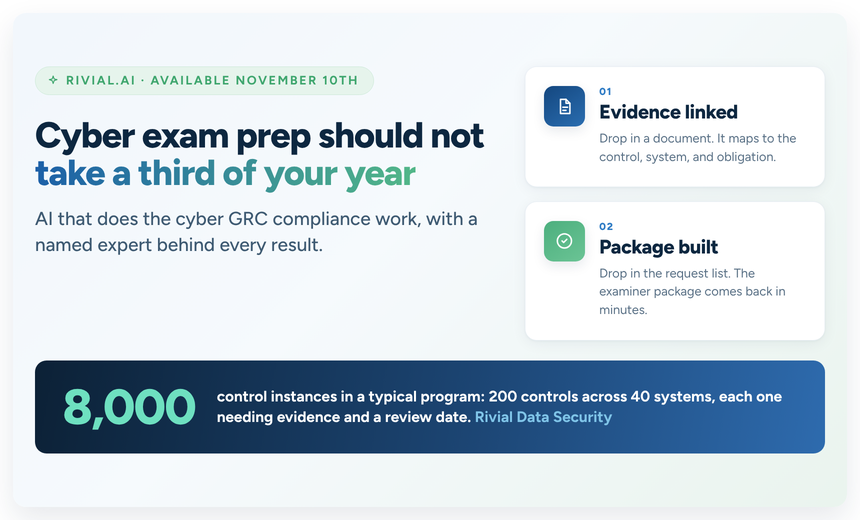
To illustrate this point, one must consider the sheer volume of compliance tasks that these teams face. A typical cybersecurity program is encumbered with approximately 200 controls spanning around 40 systems. This results in a staggering total of 8,000 control instances, each requiring an appointed owner, corresponding evidence, and a specified review date. As a direct consequence, cybersecurity practitioners estimate that preparing for audits and examinations consumes up to a third of their year. This time, unfortunately, detracts from other essential work that genuinely mitigates risk.
Current Tools Fall Short
Despite advancements in technology, many existing governance, risk, and compliance (GRC) software solutions merely track tasks rather than alleviate the burden. Security teams typically enter control data, upload evidence, and compile examination packages manually. In essence, these software solutions function as digital filing cabinets rather than proactive tools that streamline the compliance process.
While some newer products have integrated artificial intelligence features, their capabilities often remain limited. These AI tools tend to review previously inputted information and suggest minor adjustments. Although this assistance can save a few minutes, it does not resolve the underlying issues. The critical question arises for vendors: When an AI completes its assigned tasks, is the work finished, or does it fall back to the human team to pick up where it left off?
Enter Rivial.ai
On November 10, 2026, Rivial Data Security is set to launch Rivial.ai, a transformative software designed specifically for lean security teams operating in regulated industries. This innovative tool dramatically shifts the compliance landscape by automating key tasks.
By simply uploading any document, Rivial.ai intelligently recognizes it as evidence and connects it to the relevant controls, systems, and obligations. The software automatically updates each record, evaluating whether the document adequately supports the corresponding control and flagging any associated risks. When faced with an examiner’s request list, Rivial.ai can produce a comprehensive package in mere minutes, complete with organized folders, well-crafted narratives for each item, and a single response file ready for submission to regulatory portals.
This advancement marks a significant departure from traditional tools that merely house compliance programs. In contrast, Rivial.ai actively manages them, enabling security teams to function more efficiently and effectively.
Human Oversight Remains Essential
It is crucial for regulated institutions to understand that, while AI brings remarkable efficiency to the compliance process, human oversight remains indispensable. Every modification made by Rivial.ai comes with a recommendation that must be accepted or rejected by the security team. These actions are meticulously logged, with Rivial Data Security’s experts reviewing all AI-generated outputs. Consequently, when examiners arrive, they are presented with well-organized evidence, complete with a clear audit trail showing the origin of each file and the individual who approved them.
The incorporation of AI must not compromise accountability. In a regulatory environment, AI that lacks transparency is ill-suited for scrutiny by bodies such as the National Credit Union Administration or the Federal Deposit Insurance Corporation. However, AI that includes designated reviewers and maintains a thorough audit trail exemplifies a compliance tool that can stand up to regulatory challenges.
Redefining Time Allocation
With routine compliance tasks managed efficiently by Rivial.ai, security teams can redirect their efforts toward activities that truly mitigate risk. Instead of investing hours in assembling evidence and preparing binders, team members can focus on essential responsibilities such as addressing identified risks from assessments and ensuring that controls are effectively implemented across all systems.
This shift in focus allows teams to operate with a sustained readiness for audits and examinations, eliminating the usual stall that occurs when compliance becomes a frantic scramble to demonstrate past actions rather than an ongoing commitment to security. CISOs in such optimized environments transition from being overwhelmed by document requests to becoming trusted leaders capable of articulating the institution’s security posture and future strategies.
Ultimately, the goal of this transformation is to maximize efficiency while maintaining compliance integrity, thereby empowering security teams to thrive instead of merely survive in a landscape increasingly defined by regulatory scrutiny. For those interested in viewing what an examiner package looks like when assembled by Rivial.ai with human oversight, they are encouraged to explore the tool further at Rivial Data Security’s website.
In sum, the integration of AI in cyber compliance signifies a pivotal advancement, promising to lighten the load for lean security teams while ensuring robust compliance frameworks remain intact.