
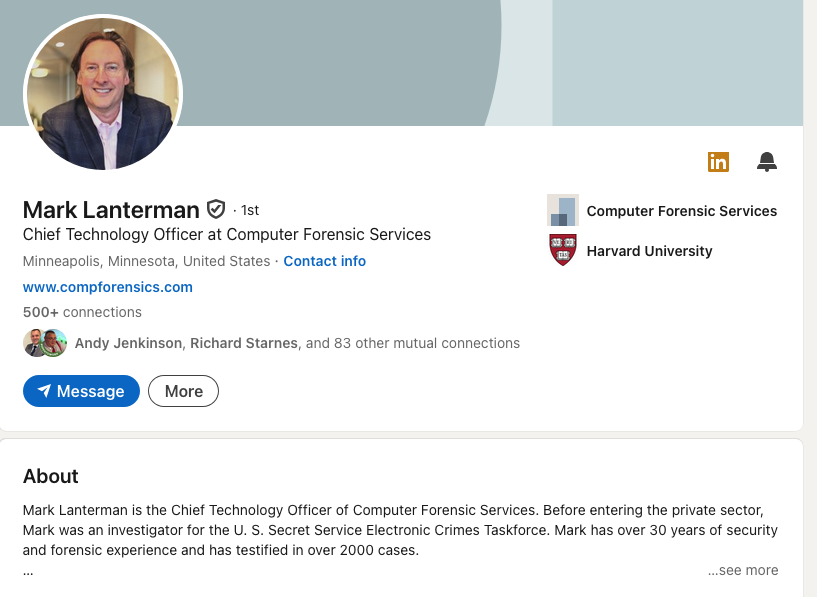


A Minnesota cybersecurity and computer forensics expert, Mark Lanterman, who has been a pivotal figure in thousands of courtroom trials over the past three decades, is now under scrutiny for the authenticity of his credentials. The Federal Bureau of Investigation (FBI) has launched an inquiry into Lanterman’s educational and employment background, raising concerns about the validity of testimonies he has given in various cases.
Lanterman, a former investigator for the U.S. Secret Service Electronics Crimes Task Force, founded the Minneapolis consulting firm Computer Forensic Services (CFS) where he has testified as an expert in over 2,000 cases. His expertise spans across a range of legal areas including sexual harassment, theft of intellectual property, white-collar crime, and class action lawsuits. However, recent developments have cast doubt on the credibility of Lanterman’s qualifications.
The investigation was triggered by allegations made by Sean Harrington, an attorney and forensics examiner, who accused Lanterman of providing false information under oath regarding his educational background. Harrington claimed that Lanterman misrepresented his academic credentials, including a Bachelor of Science and Master’s degree in computer science from the now-defunct Upsala College, and postgraduate work at Harvard University.
Further scrutiny into Lanterman’s background revealed discrepancies in his claims. The law firm Perkins Coie LLP, which is currently defending a case involving Lanterman’s forensic analysis, found no evidence to support his educational claims. Upsala College, where Lanterman purportedly obtained his degrees, had no records of his transcripts, casting doubt on his academic journey.
Lanterman admitted that he could not provide evidence of attending Upsala College and clarified that his “postgraduate work” at Harvard was actually an online cybersecurity course from HarvardX. These revelations have raised concerns about the accuracy of Lanterman’s testimony and the potential impact on cases where he has been a key witness.
Moreover, Lanterman’s integrity came under further scrutiny when it was discovered that he removed a police officer role from his resume and attempted to obtain his personnel file from a previous employer under false pretenses. The law firm representing a case involving Lanterman raised concerns about his deceptive behavior, calling for his exclusion from the case and potential sanctions.
The fallout from these revelations has had broader implications on cases where Lanterman’s testimonies were crucial. Legal experts suggest that defendants in cases influenced by Lanterman’s expert opinions may have grounds for appeal if he is discredited. The duty of law firms to vet expert witnesses thoroughly has come into question, highlighting the importance of due diligence in verifying credentials.
One of the most notable cases involving Lanterman was the conviction of Stephen Allwine for the murder of his wife, where Lanterman’s forensic findings played a significant role. Allwine has now petitioned for a review of his case in light of the allegations against Lanterman, casting doubt on the credibility of previous convictions based on Lanterman’s testimony.
As the investigation unfolds and the credibility of Lanterman’s credentials comes into question, the legal community awaits the potential impact on adjudicated cases and the implications for the expert witness system. The revelations surrounding Lanterman’s background have raised concerns about the integrity of legal testimonies and the need for transparency in expert qualifications in legal proceedings.