
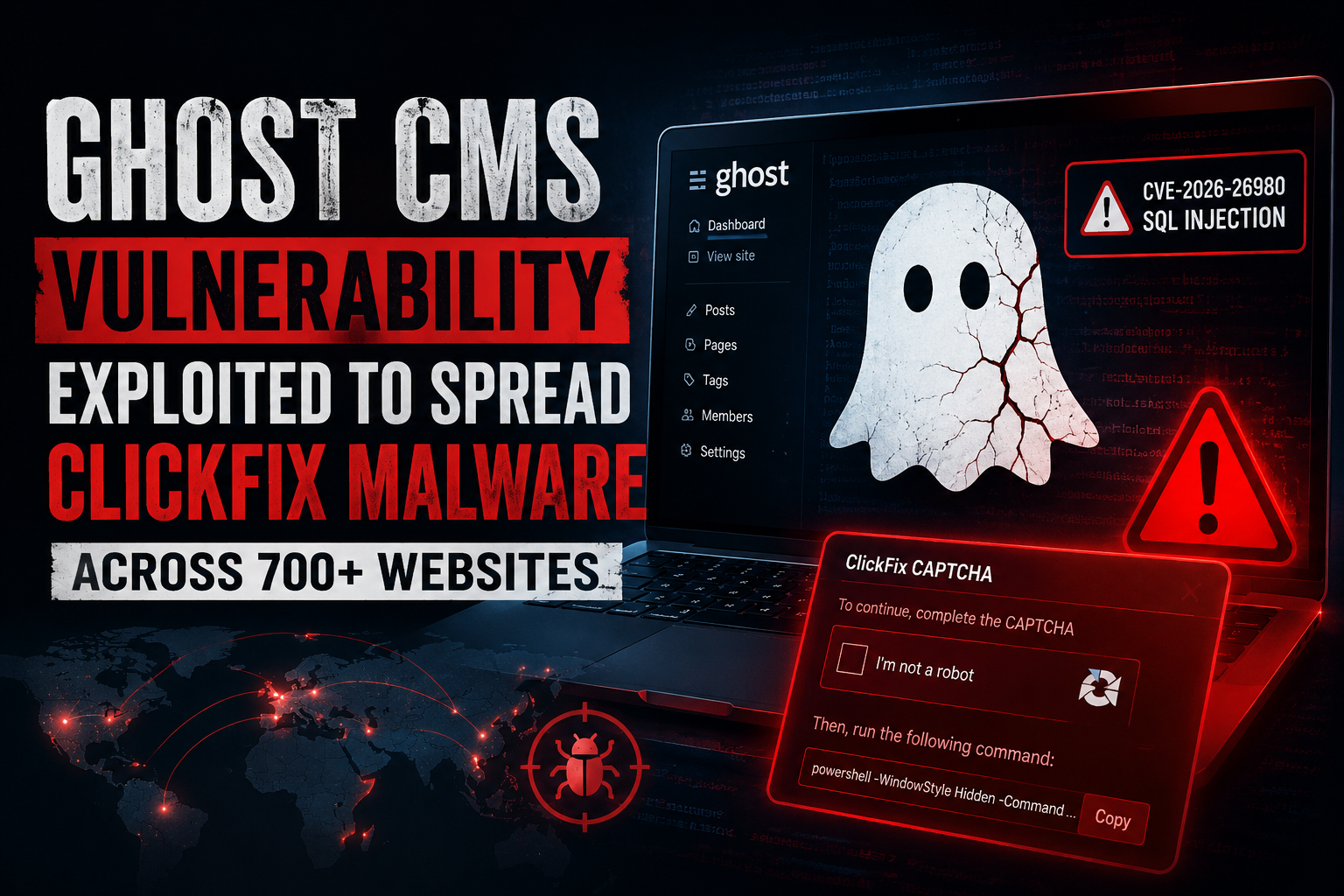
Security Experts Uncover Extensive Cyberattack Targeting Ghost CMS Vulnerability
In a significant revelation, cybersecurity researchers have identified a widespread attack campaign leveraging the Ghost CMS vulnerability, indexed as CVE-2026-26980. This flaw has led to the injection of malicious ClickFix malware into over 700 compromised websites around the globe.
The alarming findings emerged from work conducted by cybersecurity experts at QiAnXin XLab. Their in-depth investigation uncovered that attackers are exploiting a critical SQL injection vulnerability within Ghost CMS installations, primarily targeting unpatched systems spread across the internet. This exploitation enables malicious actors to execute fake CAPTCHA-based malware attacks, significantly endangering the integrity of numerous websites.
Exploitation of Ghost CMS Vulnerability
The vulnerability specifically arises from an SQL injection issue, allowing threat actors to access Admin API Keys without the need for authentication. This unauthorized access facilitates attackers to manipulate the Ghost Admin API, permitting them to alter published content on the affected websites and seamlessly inject malicious JavaScript payloads into web pages. This exploit has major implications, as it compromises both the functionality and security of the websites involved.
Currently, the security flaw adversely affects Ghost CMS versions between 3.24.0 and 6.19.0, while version 6.19.1 contains the necessary security fixes. The significance of the flaw cannot be understated, given that it has received a critical severity score of 9.4 on the CVSS scale. Security experts point out that unauthorized attackers can leverage this vulnerability for arbitrary database reads, exposing sensitive data stored within the system.
Amplifying Impact Across Various Sectors
According to the findings, more than 700 domains have been compromised to date, with the affected websites ranging across diverse sectors such as education, artificial intelligence platforms, Software as a Service (SaaS) providers, blockchain services, media outlets, and cybersecurity firms. This wide targeting emphasizes the threat’s scope and the potential risks for users visiting these sites.
The campaign first came to light on May 7, 2026, when investigators identified malicious scripts integrated into customer websites running outdated versions of Ghost CMS. The early detection has prompted further scrutiny and initiated ongoing efforts to protect vulnerable installations.
Real-World Tactics Employed by Attackers
The malicious JavaScript payloads injected into the websites are strategically designed to redirect users to counterfeit Cloudflare verification pages, which mimic legitimate CAPTCHA checks. As victims engage with these fraudulent pages, they are unwittingly manipulated into executing harmful commands on their devices, utilizing tactics derived from ClickFix-style social engineering methods.
The researchers elucidated that the malware deploys sophisticated cloaking and browser fingerprinting techniques to evade detection from both automated analysis systems and security scanners. While genuine users navigating to these websites are redirected to fake verification pages, security tools may only encounter benign content. This duality significantly complicates detection and remedial measures, allowing the threat to proliferate undetected.
Urgent Call to Action for Website Administrators
In light of this pressing issue, cybersecurity experts are strongly urging website administrators to promptly upgrade their Ghost CMS installations to version 6.19.1 or later. Moreover, organizations are encouraged to rotate their API keys, sift through server logs for any suspicious API activities, and inspect their websites for any unauthorized modifications to JavaScript code.
As an immediate, temporary mitigation strategy, security professionals advise website operators to block suspicious query patterns through Web Application Firewalls (WAF) or reverse proxy rules until systems are fully patched. This guidance is critical for safeguarding against potential exploitation stemming from the identified vulnerabilities.
Overall, this ongoing malware campaign poses a significant risk to a vast array of websites, underscoring the imperative for proactive security measures. The combination of exploiting a critical vulnerability and utilizing sophisticated tactics makes this threat particularly concerning. As cyberattacks increasingly evolve, remaining vigilant and responsive to emerging vulnerabilities is paramount for website administrators and organizations alike. The gravity of this situation serves as a clarion call for urgent action and heightened awareness in the field of cybersecurity.