
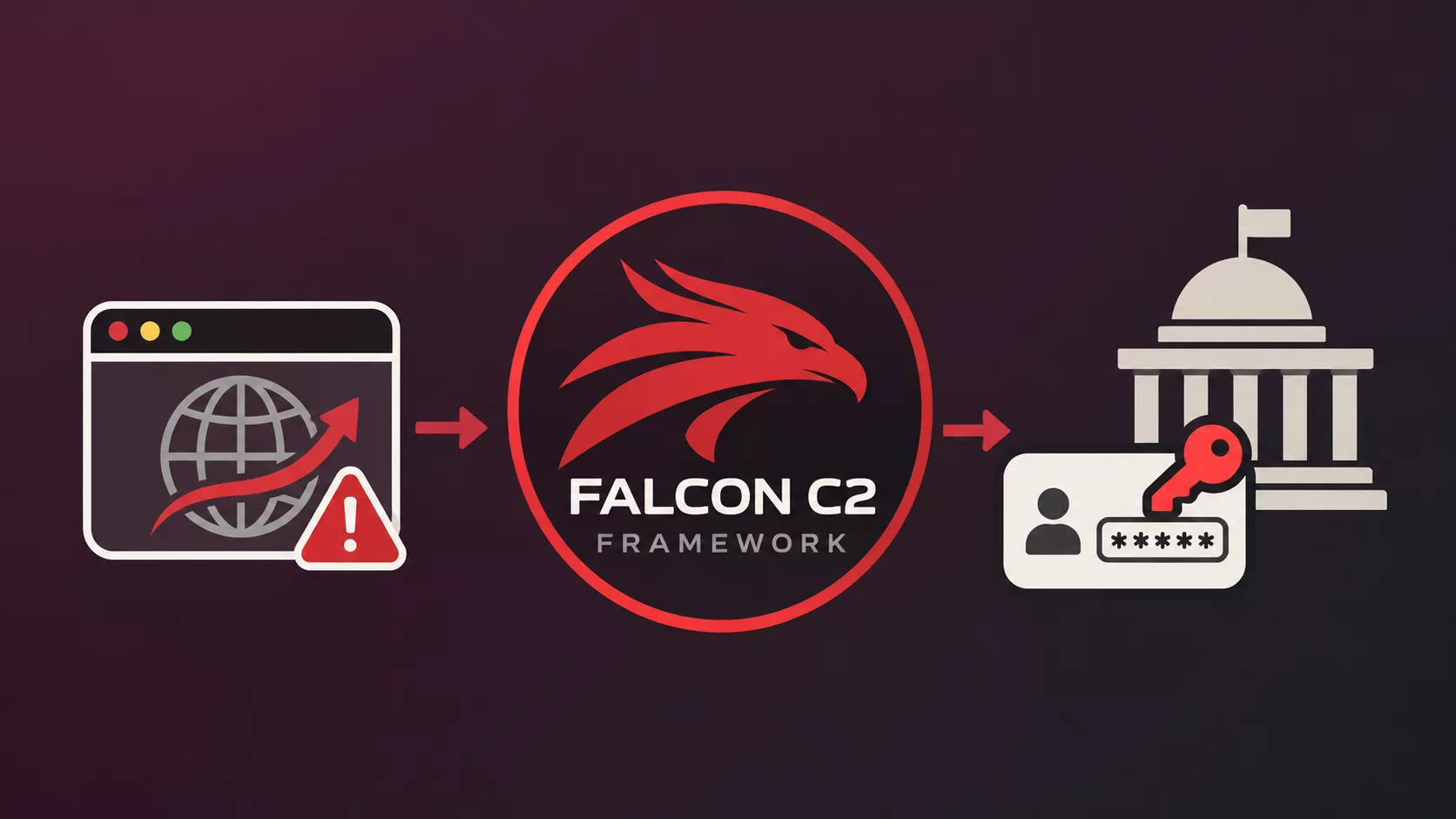


Cybersecurity Alert: Deployment of Falcon C2 Framework by Hackers Targeting Government Entities
In a concerning escalation of cyber threats, an advanced group of hackers has unleashed a Node.js command-and-control framework known as Falcon, also referred to as XG or Xiàng Gē, targeting government entities across one Middle Eastern nation and four countries in Southeast Asia. The offensive operation took place between March and May 2026, marking a significant threat to national security and data integrity in the affected regions.
Unit 42, the threat intelligence division of Palo Alto Networks, has highlighted the strategic nature of this attack. The identified targets span crucial sectors, including foreign affairs, defense, interior, and law enforcement organizations. Such a breadth of targets indicates that the attackers are likely interested in collecting strategic intelligence that could be exploited for various malicious objectives.
The Falcon framework operates by executing malicious JavaScript within compromised web browsers, allowing the attackers to intercept credentials and facilitate surveillance activities. This sophisticated method grants authenticated access to sensitive government applications without the immediate need for traditional endpoint implants. The implications of such attacks are severe, as they can lead to unauthorized access to classified information and critical government resources.
A peculiar characteristic of the Falcon framework is its deceptive management interface, which is ingeniously concealed behind a blank web page. This interface is designed to disable right-click functionality, making it difficult for users to detect malicious activity. However, pressing the F9 key three times consecutively reveals the login form, a clever ruse that could easily ensnare unsuspecting targets.
The operational structure of Falcon further exhibits sophistication. The framework’s administrative panel listens for commands on TCP port 8080, while victim-facing communications are managed through port 443, camouflaged as interactive games such as JavaScript Tetris or Snake. This unique approach enhances the stealth of the malware, masking its true intentions from both users and security systems.
To facilitate its nefarious activities, operators introduce script tags into compromised webmail portals and government applications. Each new session is implanted with obfuscated code utilizing single-byte XOR encoding, effectively obscuring the malware’s signature and aiding its persistence. Furthermore, shared loaders, URL patterns, and identifiers similar to those found in Baidu rely on a shared infrastructure, linking Falcon to another threat known as PeckBirdy.
This malware establishes a secure, TLS-protected WebSocket C2 connection and negotiates AES-256-CBC encryption for its communications. A robust 2048-bit RSA public key safeguards the exchange of the 32-byte AES key and initialization vector, providing a higher degree of protection against detection.
Once the connection is established, operators can execute various JavaScript commands and retrieve information using specialized framework APIs. The connection remains active while the infected browser tab is open, with frequent heartbeats ensuring session continuity. However, not all communications are encrypted; Falcon does include an unencrypted Comet fallback for instances where Web Crypto functionalities are unavailable, allowing the malware to operate under less secure arrangements.
To extend its reach, Falcon offers both Chrome and Firefox browser extensions. The Chrome extension, disguised as “PDF Viewer,” is particularly insidious, comprising a configuration that requests forty different permissions, including access to all websites, raising red flags about potential vulnerabilities.
According to Unit 42, background components embedded within the malware work diligently to collect credentials, cookies, browsing history, and downloads. The analytics-core.js module facilitates the tracking of user activity, ensuring that attackers have a comprehensive view of the victim’s online behavior. Additionally, reverse-proxy capabilities allow these criminals to send requests while utilizing existing legitimate credentials and session cookies from victims’ browsers.
Shockingly, one incident at a police entity in Southeast Asia saw hackers gather usernames before tricking targeted users into accepting fraudulent Adobe Flash Player update prompts. These deceptive prompts delivered a Rust-based implant named Antino, confirmed by traces indicating compilation timestamps as early as October 2025. Antino embarks on further obfuscating tactics by decoding configurations using an XOR key and establishing Registry Run persistence to maintain an enduring presence.
The Antino implant leverages Microsoft Graph API communications with OneDrive, enabling it to handle command execution, file operations, and transfers securely. A total of ten commands are available to operators, allowing for a broad array of malicious activities.
In response to this rising threat, cybersecurity experts urge defenders to conduct thorough investigations for unauthorized developer-mode extensions and assess permissions that seem excessive for their purposes. Special attention should also be paid to injected webmail scripts and unexpected artifacts related to Hmlvt storage.
To combat these threats effectively, investigations must also correlate browser WebSocket activity with any foreign OneDrive tenant authentications and monitor directories for anomalous write operations. Notably, one extension in the justice sector remained active for over three weeks, successfully harvesting plaintext credentials and capturing screenshots from internal document systems, illustrating a sustained and concerning breach of operational integrity.
As this cybersecurity alert underscores, vigilance is paramount. Effective monitoring, swift response strategies, and a strong understanding of the threat landscape will be essential in protecting sensitive government operations from increasingly sophisticated cyber-attacks.
Indicators of Compromise (IOCs)
| Category | Indicator / SHA-256 Hash | Filename |
|---|---|---|
| Falcon C2 domain | fonts.tarotfree101[.]top |
— |
| Falcon C2 domain | fonts.chrorne[.]com |
— |
| Falcon C2 domain | robot.avbliud[.]com |
— |
| Chrome extension ID | mbidcmlcbgbphpoacojjbmfpohcimjji |
— |
| Chrome extension file | 3e535d63af8a95221fb517fa1b3e4a0029d3463d8b767443abdff385ee8cb6e9 |
analytics-core.js |
| Chrome extension file | f8b86238e179d88a9979b6f97750a39dda1d07b54d634bc1348fdfb0944a3b92 |
background.js |
| Chrome extension file | 88e8b07bdf294ace0357d35acb7e108c66ba65a2c4ad66351fb8f7806dae0862 |
content-script.js |
| Chrome extension file | 065d18fcfeddbd718c054f4b21c3cde5b9291db921d01f343d7ac0d4b41f29ce |
icon128.png |
| Payload delivery domain | microsoft-flash[.]com |
— |
Note: IP addresses and domains have been intentionally obfuscated (e.g., [.]) to prevent accidental resolution or hyperlinking. Only use these identifiers within controlled threat intelligence platforms.