
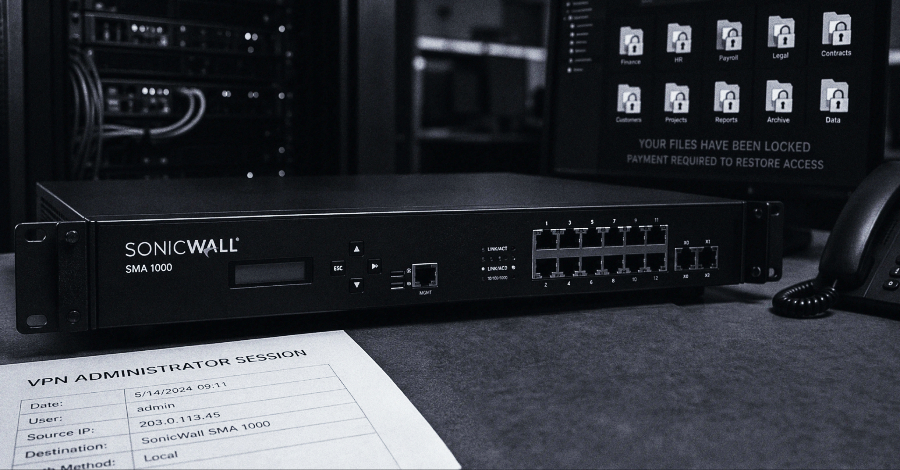
The recent emergence of the INC Ransomware operation has positioned itself as a leading threat actor by taking advantage of critical security vulnerabilities found in SonicWall’s Secure Mobile Access (SMA) 1000 series VPN appliances. This development has raised significant alarm in the cybersecurity landscape, particularly following a report released by Resecurity, which documented an alarming uptick in the ransomware group’s activities since early August 2026.
According to data from Ransomware.Live, INC Ransomware has claimed responsibility for an extensive array of cyberattacks, with an astonishing total of 885 victims reported as of early August. Interestingly, the last recorded victim was listed on August 2, 2026. This suggests a consistent and ongoing campaign that has been orchestrated by the group, revealing their strategic advantage in exploiting security weaknesses.
The exploits are believed to be centered around two significant vulnerabilities identified as CVE-2026-15409 and CVE-2026-15410. These vulnerabilities have the potential to be chained together, allowing for arbitrary command execution and full control over vulnerable devices. SonicWall disclosed fixes for these critical vulnerabilities in mid-July 2026, but it appears that many organizations may not have acted swiftly enough to mitigate the associated risks.
An analysis by Rapid7 regarding these vulnerabilities indicated that they were weaponized as zero-day exploits. The ransomware attackers reportedly used these exploits to gain initial access to networks, enabling them to extract invaluable credentials, access active session databases, and secure Time-Based One-Time Password (TOTP) multi-factor authentication seed configurations. The attackers’ ultimate goal appears to be ensuring long-term access to systems and facilitating lateral movement deeper into corporate networks.
A follow-up investigation conducted by Volexity pointed to an organized threat cluster labeled as UTA0533, which has been attributed to the early exploitation of these vulnerabilities starting on June 22, 2026. The attackers deployed a Python script referred to as KNUCKLEBALL, which launched Suo5, an open-source HTTP proxy. In addition to this, they utilized a custom Java web shell dubbed ORANGETAIL that bore similarities to previous threats in the cybersecurity landscape.
Douglas McKee, the director of vulnerability intelligence at Rapid7, noted the strong technical correlation in the attacks, indicating that either a single threat actor or a coordinated group was behind the exploitation of the zero-day vulnerabilities. He stated, “More recently, INC Ransomware has emerged as the dominant threat actor actively weaponizing this vulnerability chain.”
The new victims reported by Resecurity between July 17 and August 1 encompass a diverse range of private sector and government organizations from multiple countries, including Australia, the United States, the United Arab Emirates, Colombia, and Switzerland. This international reach underscores the far-reaching implications of the INC Ransomware campaign and highlights the vulnerability of organizations worldwide to such attacks.
Adding another layer of complexity to the situation, Resecurity reported that many of the newly impacted entities received unsolicited communications from unknown organizations claiming to provide assistance with ransomware-related issues. Several individuals, reportedly identifying themselves as part of a hacking group, have reached out to the victims, pressuring them into engagements on the pretext of restoring compromised networks.
This pattern of manipulation, including calls from an individual identifying himself as “Andrew,” is emblematic of the tactics employed by ransomware groups to leverage psychological pressure on victims. The reported use of an email address, info@helprans[.]com, further exemplifies the coordinated strategy these cybercriminals employ to instigate ongoing negotiations.
In response to these alarming developments, cybersecurity experts are urging organizations to prioritize the immediate patching of their SMA 1000 appliances to the latest software version. The advice extends further, encompassing comprehensive threat hunting initiatives, credential rotation, and integrity verification — all essential measures to fortify defenses against the debilitating threats posed by cybercriminals.
Additionally, organizations are advised to monitor for external source addresses interacting with vulnerable points like /wsproxy, particularly if there are unusual parameters or security concerns. This vigilance is crucial in uncovering and mitigating potential threats before they escalate, further emphasizing the ongoing vulnerability prevalent in many digital infrastructures today.
In summary, the rapid escalation of the INC Ransomware operation and its adept exploitation of serious vulnerabilities indicates a concerning trend in cyber threats. Organizations must take proactive steps to protect their assets, demonstrating that cybersecurity remains a paramount concern in today’s interconnected world. The implications of these attacks are vast, affecting not only individual organizations but also the broader landscape of cybersecurity protocols and practices.