
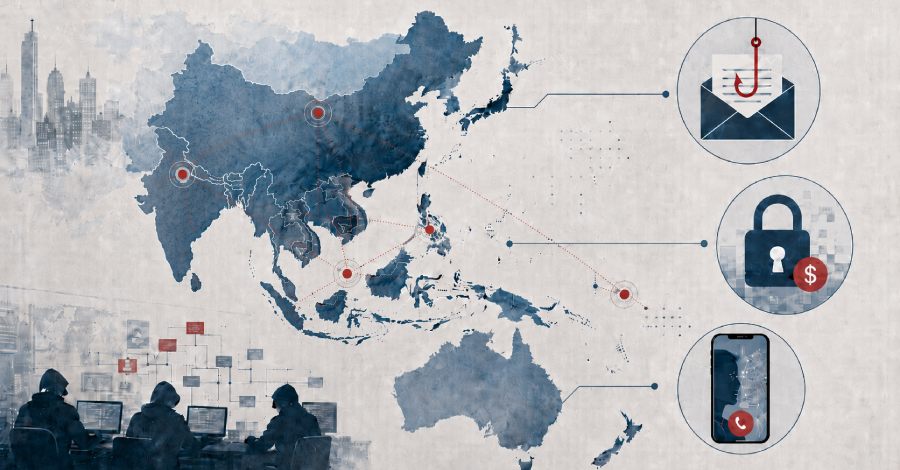


Dramatic Rise in Cybercrime in Asia and the South Pacific, Reports INTERPOL
In a newly released report, INTERPOL has highlighted a significant surge in cybercrime within Asia and the South Pacific, attributing this alarming trend to rapid digitalization, increased internet access, emerging technologies, organized criminal networks, and a noticeable gap in cybersecurity preparedness among nations.
Titled the 2025/2026 Asia and South Pacific Cyberthreat Assessment Report, the document reveals that phishing has emerged as the most prevalent and financially damaging form of cybercrime across the region. A staggering one-third of countries reported over 10,000 phishing incidents between January 2024 and March 2025, underscoring the scale of the problem. Alarmingly, more than half of INTERPOL’s member countries indicated that cybercrime constituted at least 30% of all crimes documented within their borders.
Neal Jetton, INTERPOL’s Cybercrime Director, expressed concerns about this trend, stating, “The findings in this report highlight a rapidly evolving cyber threat landscape across Asia and the South Pacific.” He emphasized that cybercriminals are capitalizing on advanced technologies, including artificial intelligence and ransomware-as-a-service models, to mount sophisticated operations. He noted the importance of enhancing operational collaboration, information exchange, and overall cyber resilience to safeguard communities and vital infrastructure.
The rise in cybercrime is manifold, characterized by increasingly sophisticated methods employed by cybercriminals. The report points out a dramatic uptick in ransomware attacks, which have proliferated alongside scams utilizing deepfake technology. These scams often involve impersonating business executives, granting unauthorized access to funds and resources. In 2024 alone, the region is estimated to have experienced over 135,000 ransomware-related incidents, predominantly affecting the real estate, manufacturing, and financial sectors.
Additionally, there is a troubling trend of organized crime syndicates in countries such as Cambodia, Laos, Myanmar, and the Philippines industrializing cyber-enabled fraud. These criminal networks have established extensive centers designed to perpetrate scams through forced labor, often involving establishing deceptive relationships with victims. As noted by INTERPOL, “Organized crime in Myanmar, Cambodia, and Laos used deepfakes in ‘romance baiting’ scams, blending AI personas and social engineering to fuel $37 billion in regional cybercrime losses.”
The report outlines several specific trends in regional cybercriminal activities. Banking trojans and information stealers, notably malware families like RedLine, Lumma, LokiBot, Negasteal, and ZBot, have gained notoriety and rank as the second most common type of cybercrime reported. Approximately 5.5 out of every 1,000 individuals in the Asia and South Pacific region clicked on phishing links monthly, nearly twice the global average of 2.9 per 1,000 users.
Moreover, the report details that distributed denial-of-service (DDoS) attacks saw a staggering 92% increase in 2024 relative to the previous year. In terms of data breaches, system intrusions represented roughly 80% of all incidents reported in 2024. The misuse of deepfake technology has also spiked for purposes such as sexual exploitation, blackmail, and coercion.
Intrusions frequently exploit vulnerabilities such as misconfigured systems, weak encryption, insecure APIs, and inadequate monitoring protocols to compromise targeted networks. A notable strategy employed by ransomware groups involves leveraging companies’ regulatory obligations to intensify the pressure during extortion negotiations.
In light of these alarming trends, INTERPOL has reported that law enforcement agencies across the region are amplifying their efforts to combat cybercrime. This collaborative approach encompasses coordinated operations targeting cybercriminal infrastructure, joint investigations, specialized training programs, and the development of policies aimed at enhancing cyber resilience. The commitment implies a collective acknowledgment among nations that the complexities of cyber threats require a unified response.
As the digital landscape continues to expand and evolve, the implications of these findings are clear. Governments and organizations must proactively strengthen their cybersecurity frameworks to protect their citizens and vital infrastructure from the relentless advance of cybercriminals.