


Israel Claims Successful Strike on Iran’s Cyber Warfare Headquarters; Impact Remains Uncertain
Israel has announced that it has successfully conducted a strike on a Tehran-based compound believed to be housing key elements of Iran’s cyber warfare capabilities, including the “cyber warfare headquarters” and the “Intelligence Directorate.” However, the broader implications of this military action for Iran’s cyber capabilities remain ambiguous.
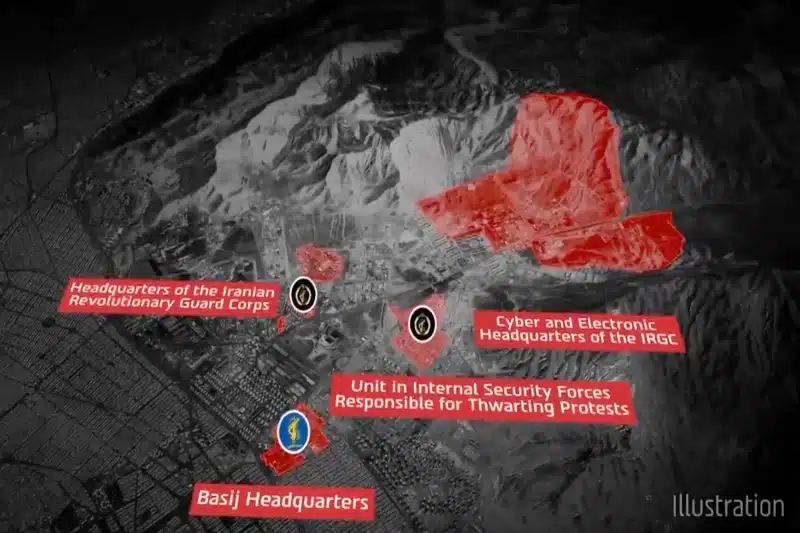
In an update released on Wednesday, the Israel Defense Forces (IDF) detailed that the airstrike targeted the eastern front of Iran, which allegedly contains several critical military and intelligence units. Among the seven principal agencies cited were the headquarters of the Iranian Islamic Revolutionary Guards Corps (IRGC) and the crucial cyber and electronic warfare divisions.
However, comments regarding the operation’s specifics have not been shared by either Israeli or U.S. officials, who are coordinating their efforts against Tehran. Notably, the IDF has released a digital rendering of the compound that was struck, providing visual documentation of the operation.
Adding further complexity to the situation, cyber operatives associated with the IRGC have previously made attempts to interfere with the upcoming 2024 U.S. elections. For this reason, the U.S. government has publicly identified certain individuals involved and even placed bounties on their heads to gather information.
Cyber Warfare Continues Amidst Physical Strikes
Israel’s claims regarding the destruction of Iran’s cyber warfare headquarters occur against a backdrop of increased threat intelligence monitoring that indicates a rise in cyber operations attributed to Iranian-aligned actors. According to cybersecurity firm Cyble’s reports, which examine the ongoing conflict, the relationship between physical strikes and the operational efficacy of cyber capabilities remains uncertain.
Interestingly, following the joint U.S.-Israeli strikes on February 28, Iran experienced a dramatic drop in internet connectivity, plummeting to roughly 1-4% of normal levels. This near-total blackout endured for over 120 hours, primarily as a result of coordinated cyber-kinetic actions that aimed at disrupting Iran’s communications infrastructure. The operation included simultaneous kinetic strikes, which targeted the physical infrastructure rather than focusing solely on the compound linked to cyber warfare.
Researchers specializing in cybersecurity believe the degraded internet connectivity is likely damaging to Iranian state actors operating within the country more so than the actual destruction of physical structures. The blackout notably limits the command-and-control capabilities essential for Advanced Persistent Threat (APT) groups based in Iran, although pre-positioned capabilities and foreign-operating assets remain active.
Pre-Positioned Threats and Ongoing Risks
Despite the blow to Iran’s infrastructure, multiple state-sponsored hacking groups had established operational footholds before the recent kinetic strikes commenced. Cybersecurity firm Anomali has reported that, in the lead-up to the February 28 offensive, some Iranian state-backed groups executed wiper attacks intended to erase data on Israeli targets. Such preparatory actions indicate that pre-positioned capabilities may still be live on compromised networks, awaiting activation through external triggers.
Advanced Persistent Threat groups, including MuddyWater, APT42, Prince of Persia, and CRESCENTHARVEST, were already targeting Israeli and regional institutions in the months leading to the increased hostilities. The preemptively established capabilities of these actors could spring into action without needing new command-and-control structures, potentially exploiting Iran’s currently compromised internet environment.
Within this timeframe, one significant operation identified involved Unit 42 researchers at Palo Alto Networks, who uncovered an active phishing campaign that used weaponized replicas of Israel’s RedAlert missile warning application. This sophisticated Android malware trawled for sensitive information such as contacts, call logs, SMS messages, and account details, illustrating the high level of state-sponsored cyber tactics in play.
Hacktivist Activity Surging Amidst State Silence
Post-strike, the cybersecurity landscape has shifted focus toward hacktivist operations, overshadowing state-sponsored campaigns. As of early March, over 70 individual hacktivist groups had engaged in operations, with Iraqi-aligned actors forming an “Electronic Operations Room” to coordinate pro-Iranian initiatives across various factions.
Despite these hacktivist claims primarily comprising DDoS attacks, website defacements, and unverified assertions regarding access to industrial control systems, the actual destructive capabilities exhibited by Iran’s state-sponsored cyber units remain significantly different. Reports indicate a disparity between the number of hacktivist claims and the real operational effectiveness of the country’s more sophisticated threats.
Analysts have raised concerns over the escalating convergence between existing Advanced Persistent Threat capabilities and disruptive activities against Israeli and regional digital assets. The gradual restoration of Iranian internet connectivity could re-enable comprehensive coordination of state-level operations. Additionally, a notable shift in the hacktivist ecosystem has seen pro-Russian groups transitioning their focus from Ukraine to anti-Israel campaigns, further complicating the cyber threat landscape.
Assessment: Balancing Capability and Infrastructure
Cybersecurity experts posit that targeting physical headquarters does not conclusively neutralize cyber operational capabilities. Modern hacking operations depend on distributed infrastructures and encrypted communication channels, with many operatives potentially working from remote locations beyond Iran’s borders.
While the Israeli strikes may have hampered certain operations temporarily, the current phase of cyber activities appears primarily anticipatory rather than destructively inclined. Experts urge vigilance in monitoring the unfolding gap between activity levels and the capabilities recognized among state-sponsored actors.
The UK’s National Cyber Security Centre has provided an advisory indicating “no significant change” in the direct cyber threat from Iran to the UK, yet has cautioned about an “increased risk of indirect cyber threats” for organizations engaged in Middle East operations or those with Middle East supply chain links.
Organizations face persistent risks from pre-positioned malware, external command infrastructures, and independently operating hacktivist campaigns. As Iranian internet connectivity begins to restore, there is an anticipation of a potential spike in cyber operations directed by state agencies.
Ultimately, the full ramifications of Israel’s strike on Iran’s cyber warfare capabilities could take weeks or even months to unveil. Observers and analysts continue to monitor the situation closely to discern whether Iranian APT campaigns will resume at their previous operational tempo or if the recent disruptions will create lasting damage to Tehran’s cyber offensive capabilities.