
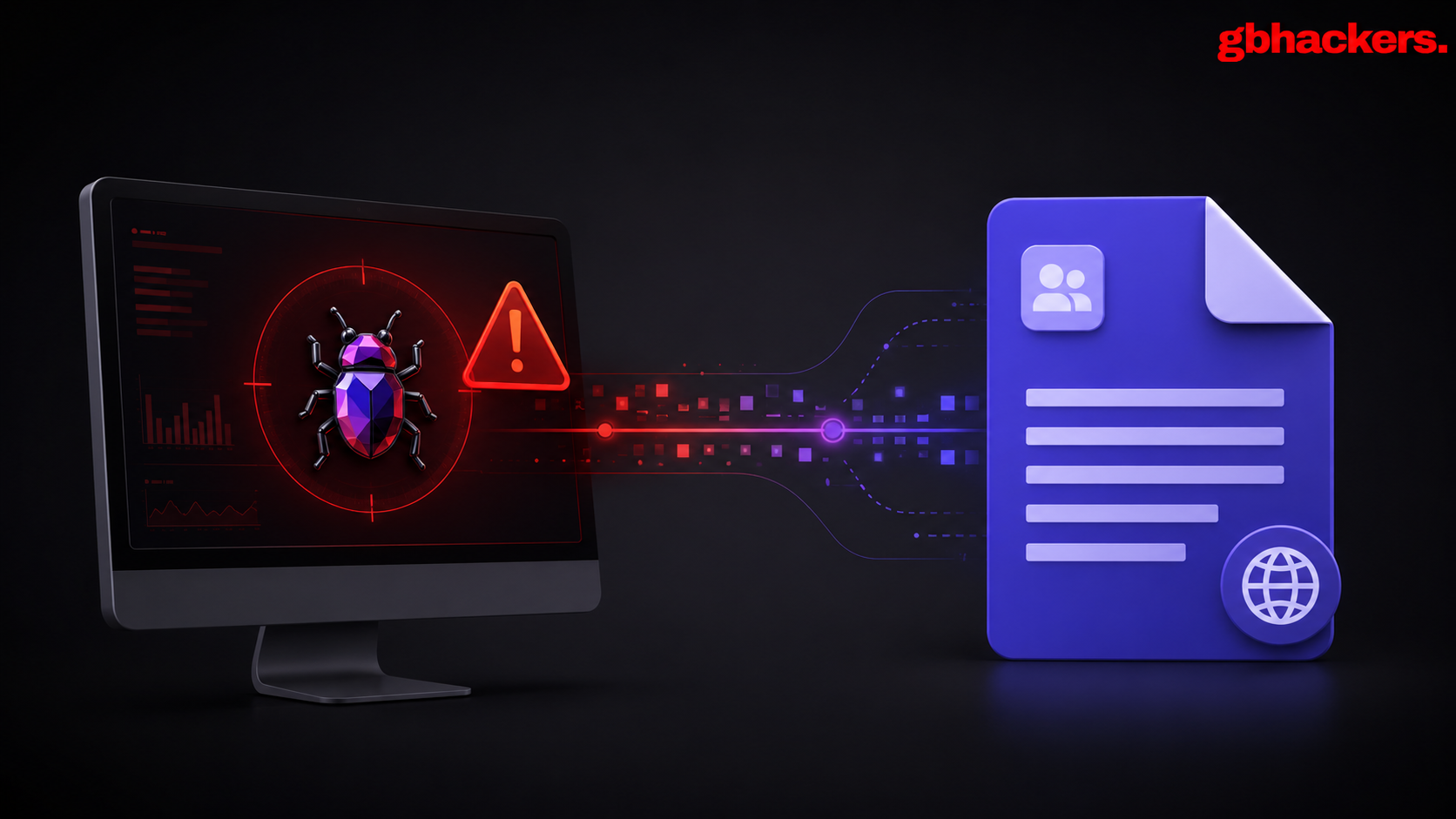


In recent developments, cybersecurity experts have uncovered a novel technique employed by a threat group associated with China, known as Jewelbug. This group has innovatively leveraged public Google Docs to serve as a stealthy command-and-control channel, embedding newly obscured malware payloads within documents. These payloads are subsequently retrieved and executed by infected systems, marking a significant evolution in the landscape of cyber threats.
This emerging tactic enables malicious traffic to be routed through Google’s infrastructure, allowing its operators to cloak their activities within seemingly legitimate web traffic. By doing so, they increase the chances of evading detection mechanisms that rely on reputation-based filtering, which typically monitor for suspicious web activity.
Jewelbug, also identified by various aliases including Earth Alux, REF7707, and CL-STA-0049, operates with a dual focus. On one hand, it engages in cyber espionage targeting governmental entities, while on the other, it runs a commercial operation for cryptocurrency fraud. Investigations have revealed that both facets of their operations utilize shared infrastructure, overlapping strategies, and a cohesive operator platform referred to as XG-Web.
XG-Web represents a sophisticated framework that combines remote access capabilities with information stealing functionalities. Built on a React front end and a Node.js backend, it is supported by a MySQL database dedicated to tracking victims. This robust platform empowers Jewelbug’s operators to oversee various campaigns, collect pilfered data, issue commands, and deliver malware payloads across a range of compromised systems, including Windows machines, Linux servers, and network devices.
Though internally characterized as a “penetration-testing platform,” XG-Web incorporates modules specifically designed for browser hijacking, credential theft, and conducting man-in-the-middle attacks. The group’s strategy of using Google Docs to transmit payloads appears primarily aimed at circumventing blocking measures, thus enhancing their operational efficacy.
When a campaign is initiated, the backend of XG-Web generates a publicly accessible Google Document and embeds an obfuscated payload within its contents. This setup permits compromised systems to fetch the document, decode its content, and execute the contained code. A crucial aspect of this delivery mechanism is that each payload is XOR-encoded with a randomized key, ensuring that identical downloads cannot be generated, thus complicating detection efforts.
Researchers noted the existence of at least 13 active Google Docs linked to ongoing campaigns run by Jewelbug. Furthermore, the group employs typosquatted domains that mimic trusted resources, including infrastructure resembling Google Fonts, to enhance their deception capabilities. This tactic prominently featured in a large-scale watering-hole attack directed at a webmail service utilized by a Middle Eastern government.
According to findings reported by Symantec researchers, Jewelbug managed to compromise a shared hosting platform, operated by a state telecommunications provider. They inserted a malicious script into a common webmail template, effectively exposing over 15 government tenants simultaneously. When users accessed their webmail, the malicious script established a WebSocket connection to Jewelbug’s command-and-control infrastructure, harvesting browser cookies and singularly identifying victims through their government email addresses.
In an audacious move, selected users encountered a counterfeit prompt for an Adobe Flash update, which initiated the download of the Antino Windows backdoor. Notably, Antino utilizes the Microsoft Graph API for command-and-control operations, routing communications through legitimate cloud-service traffic, thereby obscuring its malicious intentions even further.
The malware distributions were cleverly disguised as politically relevant HTML Application downloaders and fraudulent Adobe installers, strategically mimicking events associated with reputable institutions such as the Center for Strategic and International Studies.
Once successfully installed on a victim’s machine, Antino has the capability to sideload a malicious browser extension termed “PDF Viewer,” compatible with both Chrome and Firefox. This extension demands extensive permissions, including access to cookies, scripting capabilities, debugging controls, web-request interception, and native messaging. Consequently, it can gather sensitive information including credentials, browser history, bookmarks, screenshots, clipboard contents, and live session cookies.
Moreover, Jewelbug extends its arsenal to include ClientKing, a Rust-based implant targeting Linux servers, routers, and various network devices. ClientKing’s functionalities encompass DNS tunneling, interactive shell access, SOCKS proxying, and the loading of in-memory kernel modules. Alarmingly, some configurations of ClientKing have been identified communicating through the internal proxy of a major U.S. aerospace and industrial manufacturer, highlighting the group’s focus on achieving network-level persistence and lateral movement.
The scale of Jewelbug’s operations is indeed remarkable. Reports indicate that the group’s victim database has amassed over a million implant check-ins, more than 580,000 stolen browser cookies, thousands of compromised credentials, and over 2,300 exfiltrated email bodies—all within a three-month timeframe.
This extensive campaign underscores the potential of harnessing trusted Software as a Service (SaaS) platforms, browser extensions, and shared web infrastructure to construct a highly scalable espionage delivery model. Following advancements in this threat landscape raises significant concerns for individuals and organizations alike, emphasizing the need for heightened vigilance and robust cybersecurity measures to counter such sophisticated attacks.