
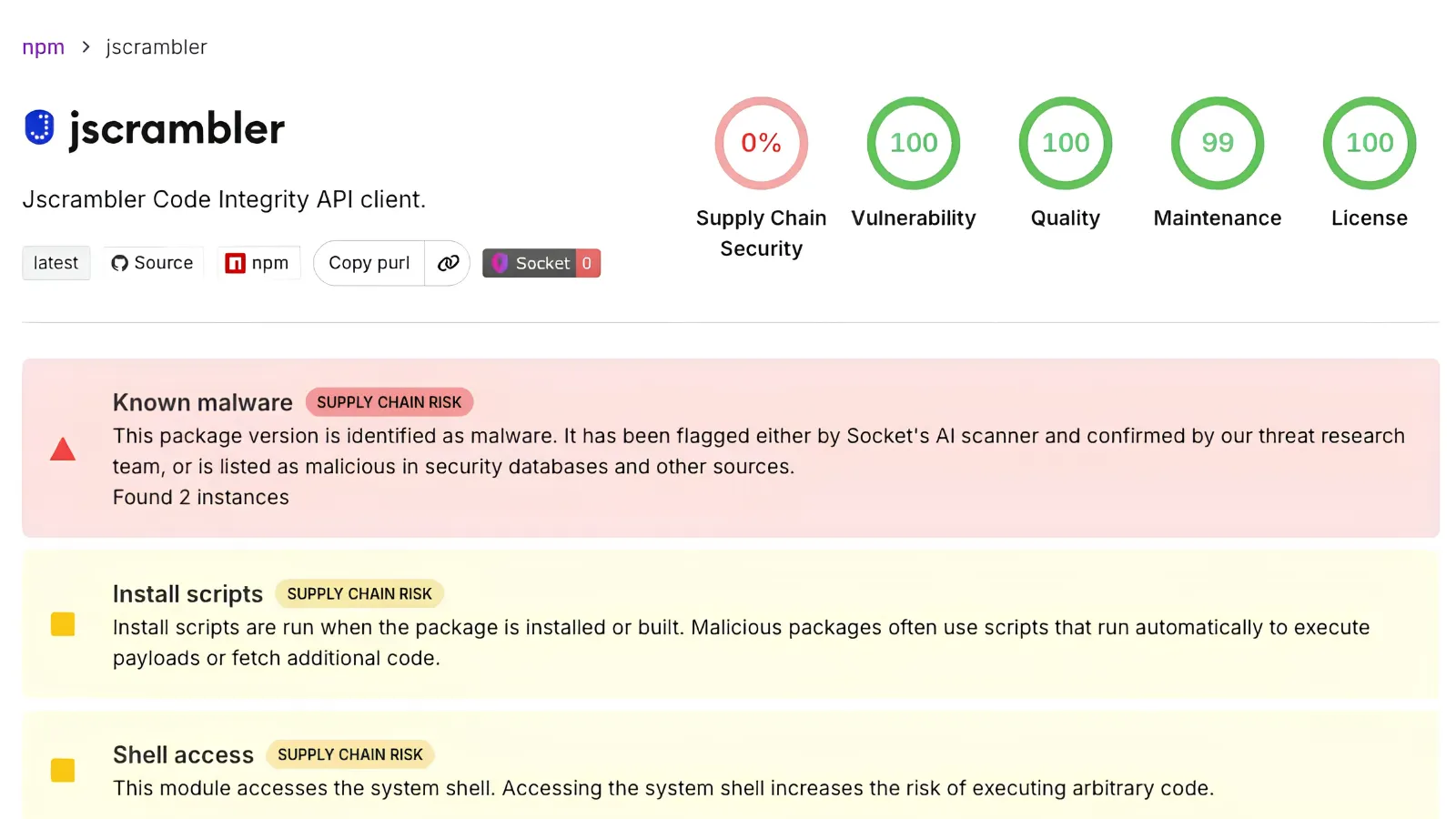


Supply Chain Compromise: Jscrambler npm Package Under Siege
In a recent cybersecurity incident, a malicious actor successfully infiltrated the Jscrambler npm package, releasing multiple trojanized versions that included a concealed, cross-platform credential-stealing payload. This incident highlights a significant risk to developers, particularly as the attack jeopardized build pipelines and CI/CD systems where npm installations might access critical source code, cloud credentials, deployment tokens, and sensitive environment variables.
Early Detection of the Breach
The initial malicious release was detected by Socket’s Research Team just six minutes after it was published on July 11, 2026. This particular package, which garners approximately 15,800 downloads weekly, introduced an undocumented preinstall lifecycle hook. This hook automatically executed node dist/setup.js during the npm installation process, effectively enabling the payload to run without requiring the victim to explicitly import the package or invoke the Jscrambler command-line tool.
Mechanisms of Attack
The hostile loader demonstrated a sophisticated approach in its operation by reading a disguised binary container known as dist/intro.js. Depending on the targeted operating system of the victim, the loader selected an embedded executable and discreetly launched it from a hidden file with a random name located in the temporary directory. This binary container held native payloads tailored for Linux x86-64, Windows x86-64, and Apple Silicon macOS systems.
As the attack evolved, subsequent versions of Jscrambler (specifically 8.16.0, 8.17.0, 8.18.0, and 8.20.0) were affected. In earlier versions, the malicious preinstall hook was utilized, but the later releases transitioned to more sophisticated delivery methods. Starting with version 8.18.0, the attackers eliminated this installation hook and instead integrated a self-executing dropper within dist/index.js and dist/bin/jscrambler.js. This adjustment allowed the malware to execute whenever an application imported the dependency or invoked its command-line interface (CLI), effectively circumventing security controls such as npm install --ignore-scripts, which is often employed to avoid running lifecycle scripts.
Further deepening concerns, versions 8.18.0 and 8.20.0 introduced a self-dependency on a compromised Jscrambler release, providing potential for transitive payload delivery.
Targeting Sensitive Data
The malware was engineered to search for cloud metadata-service tokens, local CLI credentials, service account files, AWS Secrets Manager data, SSM Parameter Store values, and Azure management tokens. The attackers devised a Rust-based payload that used individually encrypted ChaCha20-Poly1305 strings to obscure its configurations and targets, with around 2,421 encrypted strings recovered by the Socket team revealing its extensive data-theft capabilities.
Moreover, the malicious software specifically aimed to extract data from cryptocurrency wallets associated with popular platforms such as MetaMask, Trust Wallet, Coinbase Wallet, Phantom, and Exodus. The malware sought valuable artifacts, including wallet seed phrases, recovery phrases, vault data, and key-derivation parameters.
In a particularly concerning aspect, the malware also targeted configuration files linked to AI coding assistants and Model Context Protocol (MCP) servers in various development tools, including Claude Desktop, Cursor, Windsurf, Factory, Zed, and VS Code. Such files can contain API keys, internal service URLs, and sensitive credentials, thereby heightening the risk for developers.
Extensive Data Exfiltration
Additionally, the malware was programmed to harvest browser data and extract information from applications such as Discord, Slack, Telegram, and Steam. It scrutinized Firefox and Chromium-based browser profiles, system keyrings, and developer secrets. Through static analysis, investigators identified that data exfiltration was executed using a TLS-based multipart POST request directed at an /upload endpoint.
Urgent Recommendations for Organizations
In light of this alarming development, organizations are urged to promptly identify and remove any installations of the affected Jscrambler versions and to rotate any secrets that may have been compromised on developer endpoints or CI systems. Critical items include npm tokens, cloud keys, GitHub tokens, deployment credentials, API keys, and cryptocurrency wallet credentials.
Jscrambler has confirmed the unauthorized publishing by an npm publishing credential and has since revoked and rotated the affected credentials. The company deprecated the malicious versions and released a safe update, urging users to upgrade to version 8.22.0 or to pin to another verified safe release.
Indicators of Compromise
For those monitoring or remediating this situation, certain indicators of compromise (IoCs) have been identified, including specific malicious package versions and associated SHA-256 checksums which can be utilized for further investigations.
This incident serves as a cautionary tale in the landscape of software supply chain security, underscoring the need for vigilant scrutiny of dependencies and automated tools in the pursuit of secure software development.