
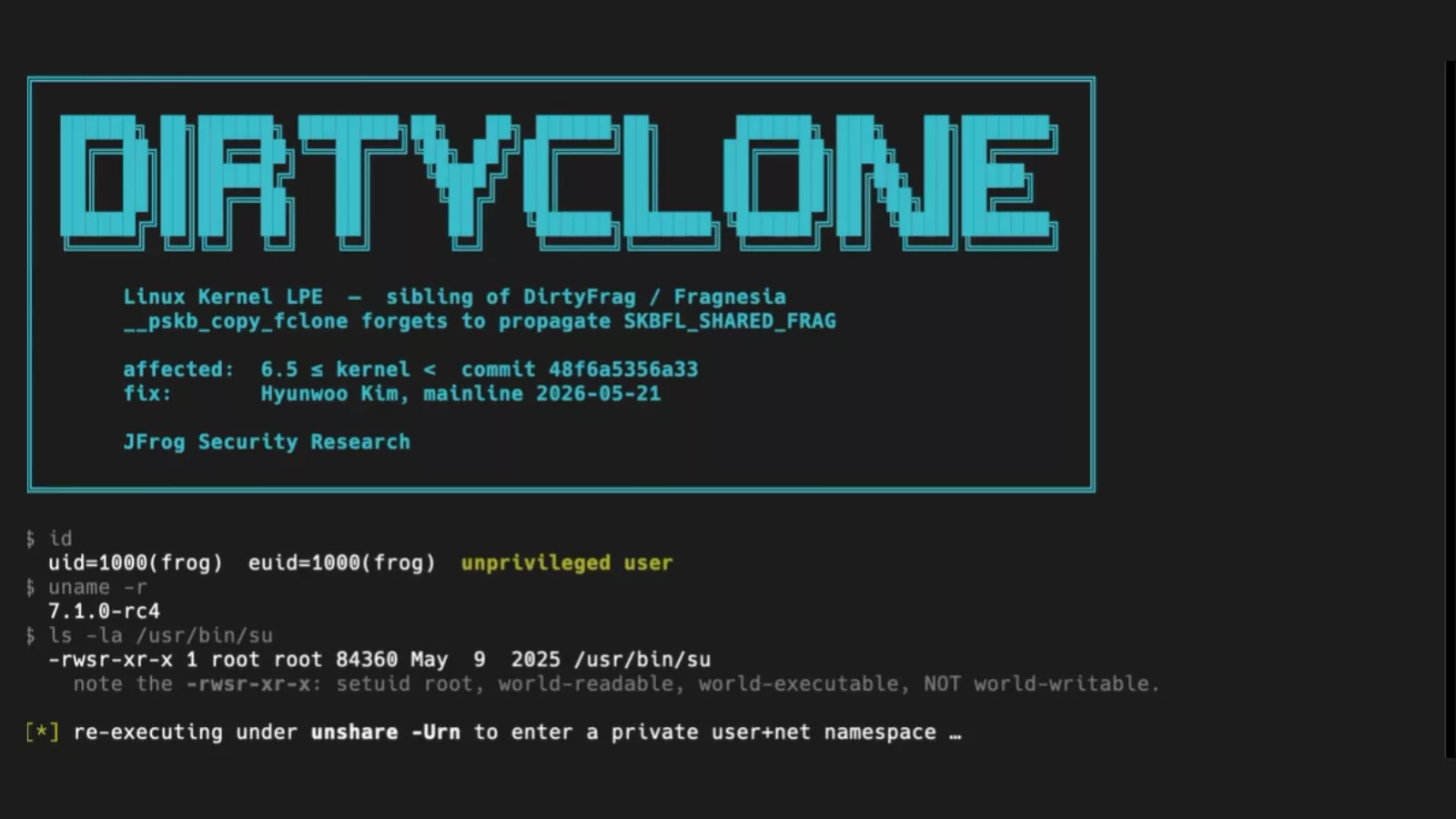
A critical vulnerability, identified as CVE-2026-43503, has emerged within the Linux kernel, raising alarms among cybersecurity experts due to its potential for enabling unprivileged local users to gain root access through manipulation of the system’s page cache. This flaw, situated in the XFRM/IPsec subsystem’s packet-processing path, represents a significant oversight in previous security mitigations, allowing attackers to silently compromise systems without leaving a trace in kernel logs or audit records.
The vulnerability, which the JFrog Security Research team has labeled “DirtyClone,” carries a high-severity Common Vulnerability Scoring System (CVSS) score of 8.8. The presence of such a flaw necessitates immediate action and vigilance from system administrators to secure their systems against possible exploitation.
The discovery of DirtyClone exemplifies a wider trend in cybersecurity threats, illustrating how multiple socket buffer processing paths can be exploited, thereby broadening the attack surface considerably beyond a single vulnerable code path. This strategy indicates that hackers may leverage interconnected vulnerabilities within the Linux environment, creating a complex array of potential exploits that can result in severe system compromises.
Specifically, DirtyClone is part of a broader family of vulnerabilities known as DirtyFrag, which focuses on how socket buffers manage references to shared page-cache memory. Other notable variants in this family, such as DirtyFrag itself and Fragnesia, exploit a common technique of coaxing the Linux kernel into interpreting read-only, file-backed page cache memory as writable network buffers. Each of these vulnerabilities poses unique risks, particularly as they can lead to unauthorized access and exploitation.
The implications of DirtyClone are particularly dire for multi-tenant cloud environments, Kubernetes clusters, and containerized workloads, especially in scenarios where user namespaces are enabled. Any mainline, stable, or Long-Term Support (LTS) kernel branch that had applied initially intended security mitigations but did not follow up with additional patches remains susceptible to these bypass methods.
For a local user to execute the DirtyClone mechanism, they must either possess or obtain the CAP_NET_ADMIN capability, which is often accessible through unprivileged user namespaces. The attack begins when the user maps a privileged binary, such as /usr/bin/su, causing it to load directly into the host’s page cache. Following this, the attacker uses system calls like vmsplice and splice, allowing the kernel to attach this page cache-backed memory into a socket buffer without performing the necessary safe memory copying protocols.
Subsequently, the attacker sets up a loopback-based IPsec tunnel and configures a netfilter rule that utilizes the TEE target to duplicate outgoing packets. This precise network routing triggers the nf_dup_ipv4 function, leading to socket buffer cloning via the __pskb_copy_fclone method. During this cloning process, the cloned buffer fails to properly retain the SKBFL_SHARED_FRAG flag, a crucial kernel safety marker that indicates the buffer references shared page memory.
As the cloned packet navigates to the IPsec receive path for in-place decryption, the kernel inadvertently writes the decrypted data directly onto the file-backed page. By manipulating cryptographic parameters—such as the AES-CBC key—an attacker can exploit the decryption routine to effect controlled writes into the page cache. This manipulation allows modification of small instruction sequences in the cached binary while leaving the actual file on the disk untouched. Consequently, the next time the compromised binary is executed, the altered logic grants the attacker root privileges over the affected system.
The timeline for disclosing and patching this serious vulnerability unfolded rapidly throughout May 2026. Following the initial patch for DirtyFrag on May 4, related variants like Fragnesia were revealed shortly thereafter. A comprehensive report detailing lingering gaps in the networking stack was filed by primary researcher Hyunwoo Kim on May 16. JFrog subsequently rediscovered the DirtyClone variant and reported it to Linux maintainers on May 19, leading to a patch being successfully merged into the mainline kernel by May 21 under version v7.1-rc5.
To protect systems from this intricate threat landscape, administrators are strongly urged to either update their Linux kernels to the patched version or implement backported patches urgently. In cases where immediate patching is unfeasible, a temporary mitigation can be achieved by disabling capability acquisition via the setting kernel.unprivileged_userns_clone=0. This measure effectively helps to eliminate the risk posed by such vulnerabilities until a complete patch can be applied.