
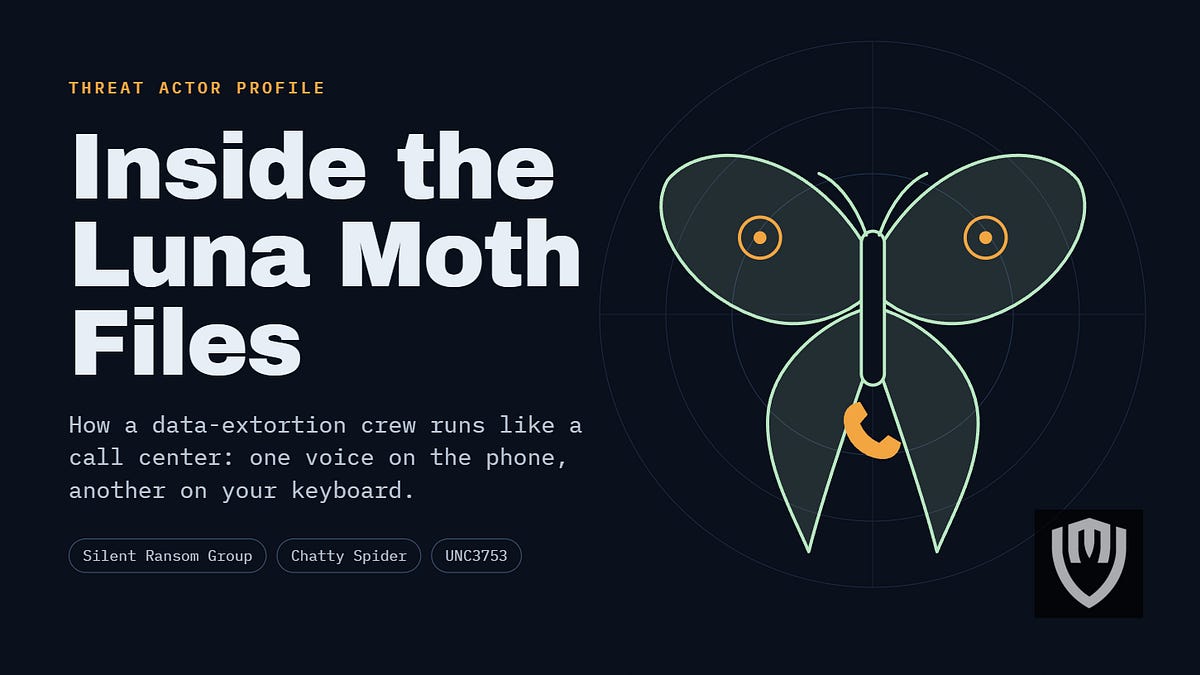


Silent Ransom of Luna Moth: Extortion Without Malware
Recent revelations stemming from a leaked archive indicate the operational tactics of a highly effective extortion group known as Luna Moth. Unlike the traditional cybercriminals who rely on malware and aggressive hacking methods, this group demonstrates a strikingly different approach to extortion. By employing social engineering techniques, they effectively manipulate individuals to gain access to sensitive information without the need for sophisticated digital tools. This emerging strategy offers an unsettling glimpse into the evolution of cybercrime.
Luna Moth operates under several aliases, including Silent Ransom Group (SRG) and Chatty Spider, with the designation UNC3753 also attributed to their activities. Despite the various names, their modus operandi remains consistent, focusing on financial gain through data extortion. This group typically bypasses complex encryption processes, opting instead for a straightforward approach that relies heavily on human interaction and psychological manipulation.
The leaked documents provide an essential insight into the inner workings of the group, revealing a meticulously organized structure akin to a traditional business. The operation comprises various roles, including researchers who gather information on potential victims, callers who engage in conversations, technicians who navigate the technicalities of accessing data, and negotiators who finalize deals. This division of labor enables Luna Moth to efficiently navigate their extortion attempts, ensuring that each participant plays a crucial role in the overall process.
One of the most striking aspects of Luna Moth’s tactics is their reliance on a simple yet effective technology setup. Unlike teams that deploy elaborate malware to breach security systems, Luna Moth teams require little more than a phone and a well-crafted script. The simplicity of this approach does not diminish its effectiveness. By having a second person quietly typing on a victim’s laptop while one individual engages with the victim over the phone, they create a seamless and convincing façade. This dynamic enables them to extract sensitive information, much like traditional thieves, but without physically breaking into a location or deploying malicious software.
Their methodology emphasizes psychological manipulation, consistent with broader trends in cybercrimes where human factors are stronger than technological barriers. This strategic approach allows them to exploit vulnerabilities—such as a lack of training in cybersecurity among employees—transforming otherwise secure environments into accessible targets for data theft and financial extortion. By building rapport with victims and establishing trust, they skillfully maneuver situations to their advantage.
Moreover, this group’s ability to adapt and refine their techniques has kept them on defenders’ radar for years. The absence of malware doesn’t imply a lack of threat; rather, it highlights a new frontier in cybercrime where human interaction can override sophisticated security protocols. Rather than relying on brute force attacks, Luna Moth exemplifies a more nuanced understanding of human behavior, allowing them to penetrate defenses in situations where technical safeguards might appear robust.
As organizations become increasingly aware of such risks, the necessity for comprehensive cybersecurity training has never been more evident. Employees must be educated not only on technological defenses, such as firewalls and antivirus programs, but also on the psychological techniques employed by groups like Luna Moth. Understanding social engineering tactics—including impersonation, phishing, and manipulation—can equip individuals to recognize and resist these sophisticated attacks.
The revelations regarding Luna Moth also pose critical questions about the nature of cybersecurity today. As criminals continue to develop socially driven approaches to exploitation, traditional defenses must evolve. Examining the psychological components of cyber threats will be essential to bolster defenses against extortion attempts that lack the telltale signs of malware, affirming that human awareness is the frontline defense against these evolving tactics.
In summary, the leaked archive of Luna Moth illustrates a significant shift in the realm of cybercrime, wherein extortion methods are propelled by social engineering rather than technological exploits. Organizations and individuals alike must be vigilant, adapting their strategies to counteract this new breed of extortion that capitalizes on human interaction and trust, reinforcing the importance of education and awareness in preventing such attacks. As cybercriminals continue to innovate, so too must the defenses that protect sensitive data and uphold security integrity.