
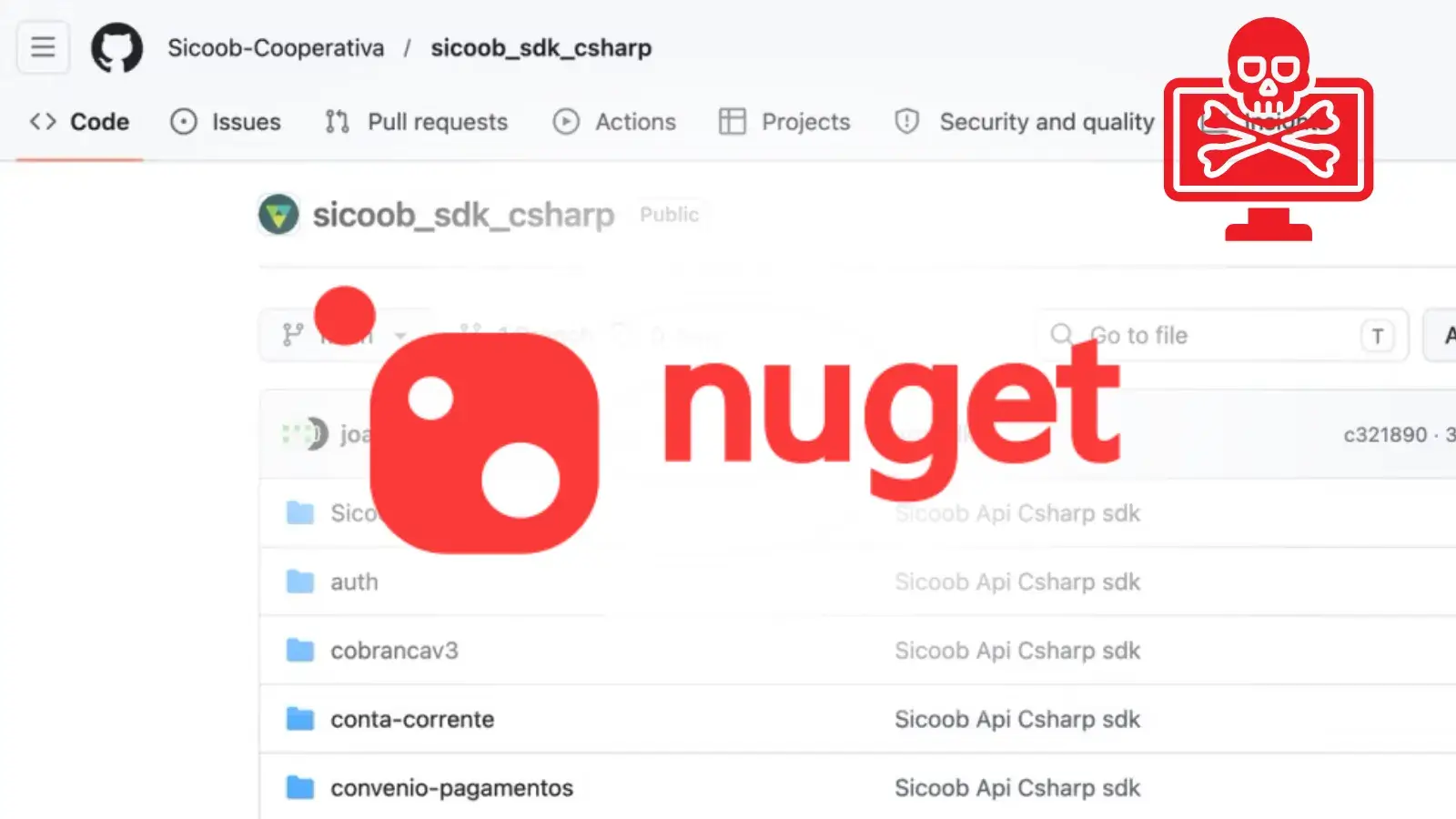


A recent discovery involving a malicious NuGet package masquerading as a legitimate software development kit (SDK) for Brazil’s Sicoob banking system has raised alarms in the cybersecurity community. This incident underscores the alarming trend of sophisticated attacks on software supply chains that jeopardize both sensitive data and developer trust.
The dubious package, identified as “Sicoob.Sdk,” was revealed by security researchers from Socket, who noted its alarming capacity to exfiltrate sensitive banking credentials. Intended to assist developers in integrating with Sicoob’s banking APIs, the disguised SDK took cunning steps to undermine its users by stealing authentication data from organizations and individuals.
The malicious package made its debut on NuGet in early May 2026 and quickly released several iterations (versions 2.0.0 through 2.0.4) before being taken down. It touted compatibility with .NET 8 and boasted features for handling secure API communications, including support for mutual TLS (mTLS) authentication. However, this veneer of legitimacy concealed destructive intent, as the package embedded harmful code specifically designed to extract crucial data such as client IDs, PFX certificate files, and associated passwords.
When developers followed the standard procedures to utilize the SDK—initializing a client using a client ID, PFX certificate path, and password—they unwittingly opened themselves up to attack. The malicious code exploited this process by reading certificate files directly from the disk, encoding them in Base64, and then transmitting them—along with the plaintext password and client ID—to a predefined external endpoint leveraging Sentry, an error-monitoring tool typically used for legitimate debugging.
The attackers’ misuse of Sentry as a covert channel for data exfiltration highlights a worrying trend in which established tools are weaponized against their intended purposes. Instead of functioning as a debugging aid, Sentry was used to stealthily siphon off sensitive data, complicating detection efforts. This insidious operation executed during the routine initialization of the SDK ensured that the theft occurred quietly, without triggering immediate alarms.
Furthermore, the design of the malicious package was particularly deceptive; its exfiltration mechanisms were activated solely in production environments. This clever tactic effectively circumvented detection in testing environments, making it even more challenging for organizations to identify compromised systems.
Upon delving deeper into the situation, investigators uncovered a broader impersonation campaign associated with the NuGet publisher account and a related GitHub organization. These entities closely mirrored official Sicoob developer resources, which contributed to the confusion surrounding the package’s legitimacy.
The GitHub repository linked to the malicious package initially appeared innocuous, featuring clean source code that didn’t exhibit any overtly malicious behaviors. However, after building the package, hidden and harmful code emerged—representing a deliberate source-to-package mismatch that many supply chain attacks have increasingly employed.
The implications of this breach are dire, particularly given that PFX certificates often harbor private keys essential for secure authentication. When combined with client IDs and passwords, the potential for attackers to impersonate legitimate banking applications becomes frighteningly tangible. Such impersonation could grant unauthorized access to financial data, facilitate unlawful transactions, and exploit services like Pix payments and boleto processing within the Sicoob environment.
While the malicious package recorded under 500 downloads, the potential exposure of sensitive data within development pipelines, continuous integration and deployment (CI/CD) environments, and production systems cannot be understated. Developers relying on search engines or automated recommendations may have inadvertently installed the malicious dependency, amplifying the threat further.
In light of these events, security experts urge organizations to treat any interaction with the compromised package as a severe credential compromise. Prompt actions should include revoking and rotating certificates, updating passwords, and scrutinizing API activities for any suspicious behavior. Organizations must also conduct thorough audits of their logs to detect any unauthorized connections to the compromised Sentry endpoints associated with the attack.
This incident serves as a stark reminder of the escalating risks found within open-source ecosystems, especially in libraries managing authentication or cryptographic materials. As a preventive measure, developers are advised to authenticate package legitimacy, rely strictly on official vendor sources, and implement rigorous dependency validation protocols to mitigate exposure to similar threats in the future.
In summary, the emergence of the malicious Sicoob SDK illustrates a worrying escalation in the complexity and cunning of software supply chain attacks. The incident not only poses a threat to individual developers and organizations but also serves as a cautionary tale for the wider software development community, emphasizing the need for vigilance and stringent security measures.