
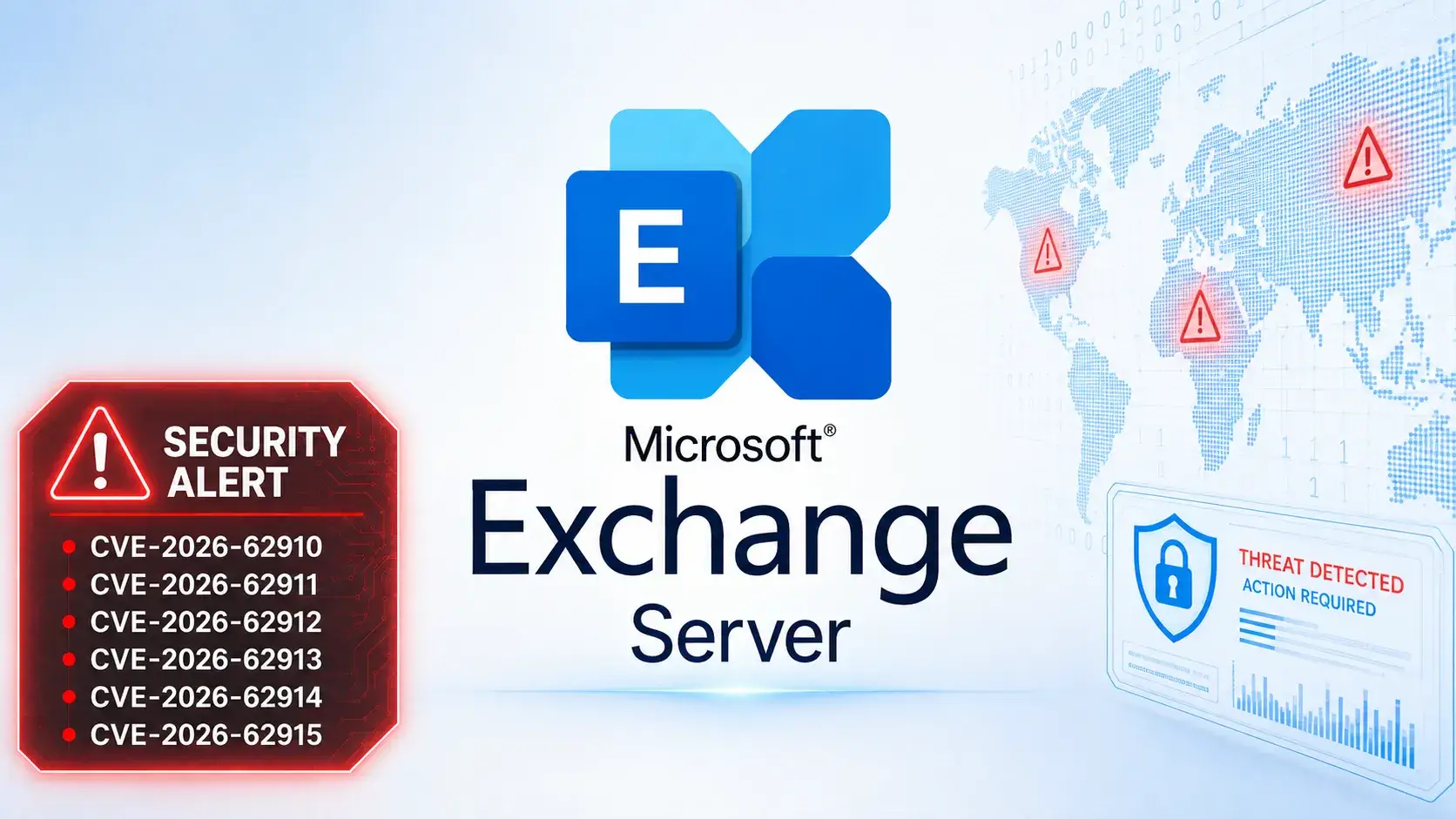


Microsoft has recently announced critical security updates aimed at addressing six distinct vulnerabilities found in the Exchange Server. These vulnerabilities pose significant risks to users and organizations, as they include issues that could enable remote code execution (RCE), privilege escalation, denial-of-service (DoS), spoofing, and the circumvention of security features. The release of these updates follows a disclosure made on August 11, 2026, with one of the highlighted vulnerabilities, known as CVE-2026-62913, receiving an immediate update the very next day.
Overview of Microsoft Exchange Server Vulnerabilities
Among the vulnerabilities identified, CVE-2026-62913 stands out as particularly severe. This remote code execution vulnerability has been assigned a CVSS 3.1 score of 8.8, placing it in the critical category of security threats. The flaw arises due to a heap-based buffer overflow, specifically categorized as CWE-122. Remarkably, this vulnerability can be exploited by an authenticated attacker with minimal privileges over the network without requiring any user interaction. Should this vulnerability be exploited, it could lead to the degradation of the confidentiality, integrity, and availability of the affected Exchange Server.
Another noteworthy vulnerability falls under CVE-2026-62911, which is classified by Microsoft as an elevation-of-privilege vulnerability and has also been rated as Critical. This issue carries a CVSS score of 8.0 and is related to CWE-294, referring to Authentication Bypass by Capture-Replay. Exploiting this vulnerability necessitates low privileges in addition to user interaction, making it a complex but dangerous avenue for attackers. If successfully executed, those looking to exploit this vulnerability would gain higher privileges, enabling them to exert broader control over Exchange resources and associated environments, potentially leading to devastating breaches.
The Importance of Prompt Action
In light of these critical vulnerabilities, organizations are urged to prioritize the immediate updating of their Exchange Server frameworks. The inherent vulnerabilities not only affect the security architecture but can also be exploited in targeted attacks, making the Exchange infrastructure an attractive target for adversarial entities. The Exchange Server manages a multitude of sensitive information, including enterprise emails, identity workflows, internal communications, and confidential attachments, emphasizing the necessity of safeguarding this platform effectively.
Detailed Perspectives on the Affected CVEs
The communication regarding these vulnerabilities details several specific CVEs, each contributing to the overall risk profile of the Exchange Server:
-
CVE-2026-62910: Rated Important, this elevation of privilege issue arises from improper control over resource identifiers (CWE-99), holding a CVSS score of 7.2. Exploitation requires elevated privileges and poses a risk to information confidentiality, integrity, and availability.
-
CVE-2026-62912: This denial-of-service vulnerability, marked as Important, stems from a flaw in the deserialization of untrusted data (CWE-502) and has a CVSS score of 6.5. An attacker with low privileges can exploit this flaw to disrupt service without user interaction.
-
CVE-2026-62914: Classified as Important, this spoofing vulnerability is linked to cross-site scripting (CWE-79) and has a CVSS score of 7.3. It requires low privileges and user interaction for exploitation, threatening both confidentiality and data integrity.
- CVE-2026-62915: This security feature bypass vulnerability, rated Important, involves a missing authorization flaw cataloged as CWE-862 and has a CVSS score of 6.5. It allows low-privileged attackers to bypass authorization measures without requiring user interaction, thereby compromising data integrity.
Best Practices for Security Teams
In light of the potential impacts outlined, IT administrators and security teams are strongly encouraged to review Microsoft’s security guidance issued in August 2026. Organizations should facilitate the deployment of necessary updates following established change management protocols and verify that updates are installed successfully across all Exchange roles.
Additionally, security teams are advised to monitor Exchange logs for any anomalous authenticated activities, unexpected changes in privileges, and unusual access patterns to mailboxes or administrative endpoints. Vigilance in the wake of these vulnerabilities is essential, as proactive measures can help thwart potential exploits and enhance the security resilience of the organization.
In conclusion, the alert from Microsoft serves as a critical reminder of the evolving landscape of cybersecurity threats and the necessity for robust and immediate responses to protect valuable enterprise assets. Organizations must remain diligent, regularly update their software, and maintain vigilance against emerging security challenges.