
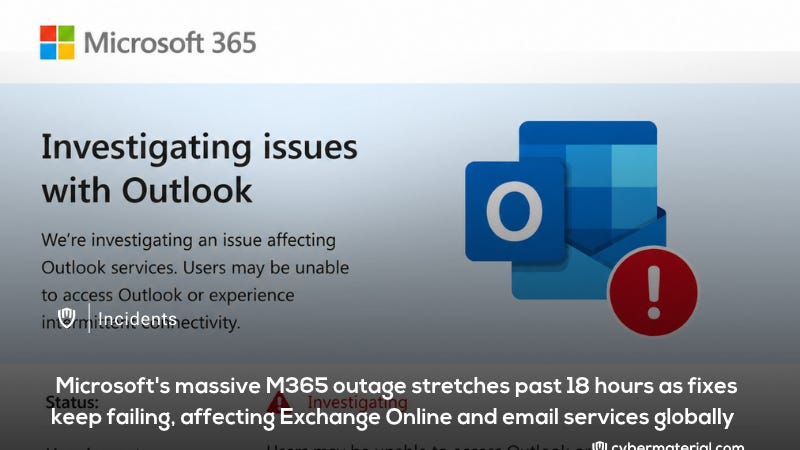
Microsoft 365, a widely used suite of productivity tools, experienced a significant service disruption that lasted over 18 hours, commencing on Thursday at approximately 18:00 UTC and extending through Friday. The outage predominantly impacted Exchange Online and any applications reliant on this service, including popular tools like Teams meetings and cloud PCs. As a result, many organizations, particularly in Australia, termed the incident the “Microsoft long weekend,” given that the usual productivity during the Friday workday was severely hampered, leaving many businesses unable to operate effectively. However, it is worth noting that services that did not require Exchange Online integration continued to function normally.
Initially, Microsoft provided an explanation attributing the outage to server failures linked to automated health checks, rendering these servers unavailable. Following the onset of the issue, the tech giant attempted to implement an early fix; however, it quickly became evident that these interventions did not yield the expected outcomes. As the situation unfolded, Microsoft modified its public statements regarding the possibility of a cyberattack being the cause of the disruption. At around 04:11 UTC, the company asserted that there was no indication that the incident was the result of malicious activity. Yet, less than an hour later, this position was adjusted to reflect that while it was “not aware of any malicious activity,” the investigation was ongoing.
The technical intricacies involved in addressing the outage were unveiled through Microsoft’s status updates, highlighting a complex recovery initiative. The company’s engineers endeavored to enhance infrastructure capacity while optimizing traffic routing across various regions. This involved scaling up virtual machines to not only increase system capacity but also to alleviate the load on the affected systems. Despite these diligent efforts, Microsoft’s team encountered significant challenges, as certain machines became stuck in a suboptimal state, hindering the expected synchronization of configuration changes. Though some regions displayed signs of partial recovery, these improvements were not sufficient to restore services comprehensively.
The repercussions of the outage reverberated throughout the global business landscape, particularly affecting companies functioning within time zones that coincided with traditional working hours. Organizations located in Australia were among the first to feel the impact, with many effectively sidelined on Friday due to the unavailability of Microsoft 365 services. This incident has drawn attention to the inherent risks associated with cloud service dependencies—an essential consideration for users who found themselves unable to access critical functionalities, including email services, virtual meetings, and additional vital applications, for an extended timeframe.
As of 12:00 UTC Friday, Microsoft acknowledged that users were still encountering difficulties connecting to a multitude of services. Approximately an hour later, the company provided an update indicating continued progress in recovery, with signs of broader improvements noted in North America and more consistent service across much of Europe. Additionally, the Asia Pacific regions began showing promising recovery signals, although some users continued to experience intermittent connectivity issues and delays in email deliveries.
In light of the significant disruptions caused by this outage, organizations relying on Microsoft 365 are urged to monitor the company’s status page for ongoing updates. Furthermore, it is prudent for businesses to review and revise their business continuity plans in response to this event, considering strategies to safeguard against future extended interruptions in cloud services. The incident serves as a crucial reminder of the potential vulnerabilities that can arise from a reliance on cloud infrastructures, emphasizing the necessity for preparedness in the face of unforeseen disruptions.
The Microsoft incident illustrates not only the fragility sometimes inherent in even the largest technological systems but also the vital role such platforms play in the everyday functions of businesses worldwide.