
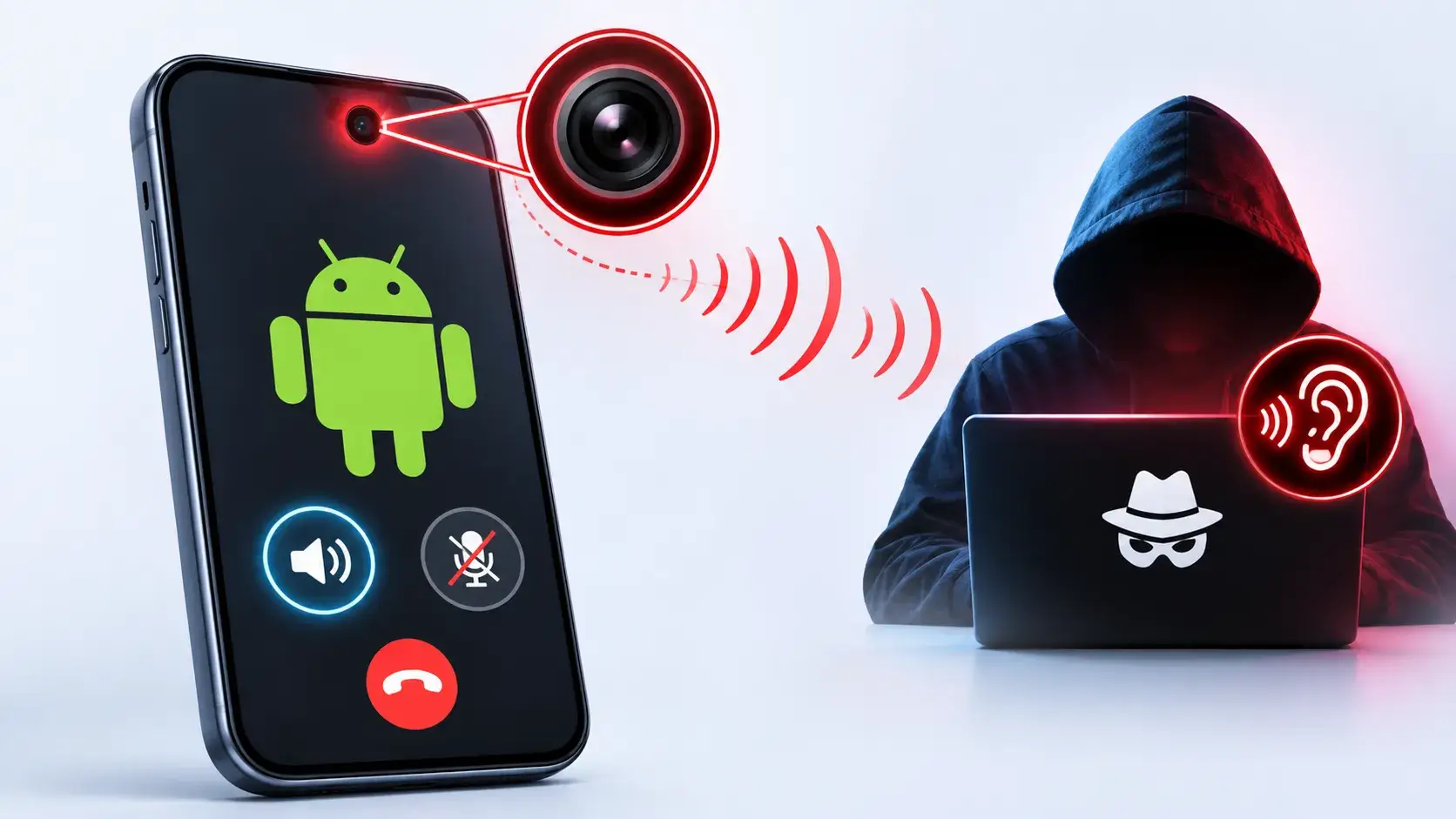
Security researchers have unveiled a concerning vulnerability in Android applications associated with camera permissions. Their findings indicate that an app with these permissions can potentially recover segments of speech emitted through a smartphone’s integrated loudspeaker, all without needing to access the device’s microphone. This revelation raises significant questions about privacy and security in mobile technologies.
The attack method, aptly termed CAMEAR, diverges from traditional techniques, leveraging motion data that is accessible through Android’s Camera2 interface, rather than relying on video feeds or sound recordings. This innovative loophole exposes a critical inconsistency between the permissions granted by users and the data that applications can extract from the device. As such, the work illuminates a significant gap in user awareness regarding the boundaries of app functionality governed by permissions.
The research builds on earlier studies, notably one called EarSpy, which demonstrated that smartphone motion sensors could detect vibrations emanating from earpiece speakers. In contrast, the CAMEAR attack opens a new front in similar privacy-related risks, revealing how devices may still expose sensitive data, even through unexpected channels.
For context, image stabilization technologies within smartphones use a gyroscope to track various movements. The speech generated through the loudspeaker also creates vibrations in the phone’s chassis, which can inadvertently be picked up. In many devices, the Camera2 interface transmits these measurements as metadata to applications, presenting an unintended avenue for extracting potentially sensitive information beyond mere camera movement.
Compounding the issue, starting from Android 12, the standard SensorManager framework limits the delivery of motion sensor information to 200 Hz by default. This modification was aimed at restricting microphone access, thus enforcing data limits across applications seeking motion sensor input. However, research indicates that the Camera2 and SensorManager interfaces utilize the same underlying gyroscope, yet the camera interface does not impose identical restrictions on data transmission.
In a comprehensive study detailed in their November 20 research preprint, researchers Guangyuan Ji, Wenjing Wang, and Bingsheng Zhang conducted testing on 50 smartphone models launched between 2020 and 2026, spanning various manufacturers. Out of these, a staggering 37 models revealed gyroscope metadata through the Camera2 interface, with 26 devices exceeding the aforementioned 200 Hz threshold. Some phones reportedly generated an impressive 800 to 1,000 samples per second.
The investigation further revealed trends among those high-rate devices equipped with privacy controls. When users turned off camera access, the video output ceased; however, the motion data continued to flow unabated. Similarly, disallowing microphone access failed to reduce the motion data stream. This disconnect signifies a troubling potential for misuse in the absence of proper safeguards.
To assess the implications of their findings, the researchers developed a speech recognition model based solely on simulated sensor data, without gathering actual measurement data from the targeted phones. When tested on the six high-rate models, the average word accuracy stood at 52.1%, while character accuracy achieved 74.3%. The most effective device in the study reached an impressive word accuracy rate of 61.8%. These measurements were recorded in controlled settings where the devices were positioned on sturdy surfaces, playing sound at maximum volume.
Unlike traditional Android spyware that directly records calls or streams audio from the microphone, this novel attack method poses a uniquely indirect threat by targeting the audio generated by the phone itself. This could encompass situations such as hearing a remote participant during a speakerphone call or listening to a voice message while the camera is engaged.
However, the study clarifies that it does not reliably capture conversations happening in close proximity nor document real-world attacks, ultimately yielding partial transcriptions rather than pristine audio recordings.
To address these vulnerabilities, the authors recommend the retention of raw stabilization data within the camera subsystem itself, advocating for the application of existing sensor restrictions and privacy measures on motion metadata accessible to applications. Their results showed that limiting the data flow to between 160 and 200 Hz drastically reduced word accuracy to a mere 2.3%. This underlines the necessity of restricting app data access without undermining the camera hardware’s performance.
For users, a crucial takeaway is that merely toggling the system camera switch does not equate to revoking application camera permissions. The demonstrated Camera2 attack remains contingent upon granting that permission. Therefore, users are urged to review which applications possess camera access and revoke permissions where unnecessary to mitigate this vulnerability.