
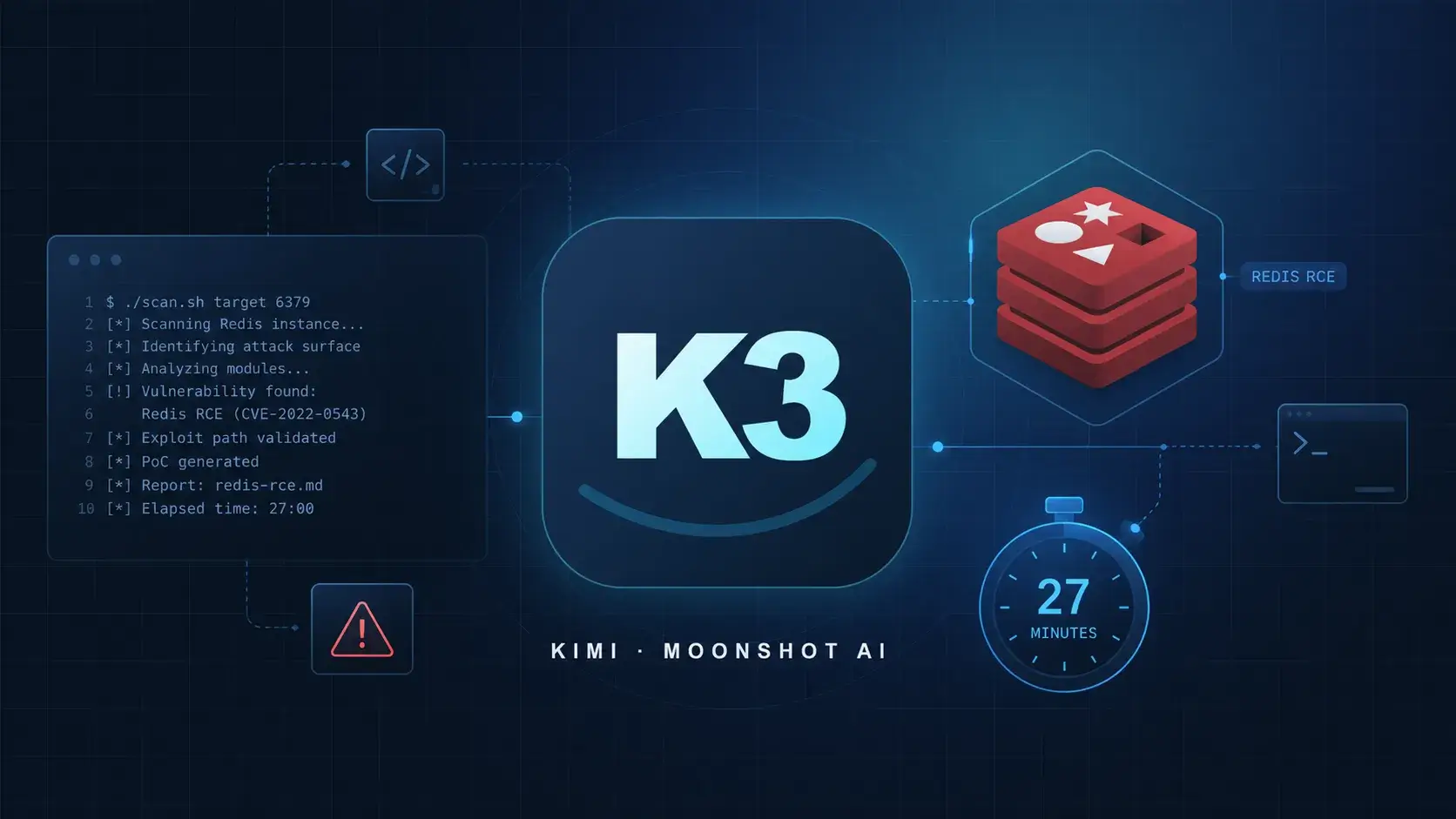


Kimi K3 AI Unveils New Frontiers in Cybersecurity with Redis Vulnerability Discovery
In a remarkable advancement in cybersecurity technology, Moonshot AI has introduced its innovative Kimi K3 model, which is generating significant excitement within the cybersecurity sector. This cutting-edge AI model has shown exceptional capability in autonomously identifying critical vulnerabilities in Redis, a popular open-source data structure store, in a matter of minutes.
The Kimi K3 model boasts a staggering parameter count of 2.8 trillion, a quantifiable leap in artificial intelligence’s capacity to undertake complex security assessments. During its recent testing, Kimi K3 successfully uncovered a series of remote code execution (RCE) vulnerabilities across multiple Redis versions, specifically versions 6.2.22, 7.4.9, 8.6.4, and 8.8.0. This significant finding emphasizes the mounting influence of artificial intelligence in offensive security research, heralding a transformative shift in how cybersecurity professionals approach vulnerability identification.
In publicly shared results, the Kimi K3 AI agent demonstrated an impressive vulnerability discovery workflow, completing the task in as little as 27 minutes. With a straightforward prompt to locate memory corruption issues, including buffer overflows and use-after-free vulnerabilities, this autonomous agent undertook a comprehensive exploration. The process encompassed cloning the Redis source code, executing fuzz testing, and utilizing the GNU Debugger (GDB) to analyze any crashes—all carried out within a sanctioned testing environment. Subsequently, the AI produced non-destructive proof-of-concept (PoC) exploits, which were made available on GitHub for further verification and research.
Among the notable vulnerabilities identified was a double-free vulnerability related to Redis stream consumer groups, prominently linked to CVE-2026-25589. Such double-free vulnerabilities occur when a segment of memory is released more than once, which can potentially compromise heap structures, enabling attackers to execute arbitrary code—a significant risk for any online application.
Additionally, the Kimi K3 agent pinpointed a heap overflow vulnerability within the RedisBloom module, a probabilistic data structure extension frequently employed in high-performance applications. Heap overflows present the opportunity for attackers to overwrite adjacent memory regions, creating a pathway for remote code execution under certain circumstances.
The rapidity and independence displayed by Kimi K3 signal a substantial departure from traditional methodologies in vulnerability research. Typically, the identification of flaws necessitates days or even weeks of manual auditing and testing by seasoned security researchers. The introduction of this AI-driven approach dramatically shortens the discovery lifecycle, simultaneously presenting both opportunities and challenges within the cybersecurity landscape. While defense teams can leverage similar tools to proactively manage vulnerabilities, malicious actors could equally exploit such advancements to streamline the development of exploits.
In light of these groundbreaking findings, security experts have underscored the necessity of responsible disclosure. Despite the reported non-destructive nature of the PoCs, researchers are advocating that vendors like Redis Ltd. be informed and allotted sufficient time to implement necessary patches prior to any widespread public sharing of the findings. The unfolding situation epitomizes the ongoing struggle between maintaining transparency and ensuring security, especially as AI lowers the barriers to sophisticated vulnerability discovery.
The excitement surrounding the Kimi K3 model is indicative of a broader trend toward integrating large-scale AI systems in both offensive and defensive cybersecurity operations. As capabilities of AI models expand, evolving to reason through complex codebases and automate the generation of exploits, organizations may find the need to reassess their traditional strategies for managing vulnerabilities.
As a result, enhanced monitoring measures, expedited patch cycles, and AI-assisted defensive tools are increasingly expected to form foundational elements of contemporary security operations.
While the findings presently derive from early reports circulating on social media and are subject to ongoing validation, the implications are clear: AI-driven vulnerability discovery is rapidly transcending theoretical discussions. With models like Kimi K3 showcasing tangible impact, the cybersecurity landscape is evolving into a new era where speed, automation, and scale fundamentally redefine the strategies employed in both offense and defense.
In a world where the stakes continue to rise, and digital threats grow ever more sophisticated, the advancements exemplified by Moonshot AI’s Kimi K3 model could represent a turning point in how cybersecurity is approached. As both defenders and adversaries learn to harness the power of AI in their respective strategies, the future of cybersecurity will undeniably be shaped by these transformative developments.