


Emergence of Panzer Ransomware: A Growing Threat to Global Cybersecurity
The Panzer ransomware has recently surfaced as a notable Ransomware-as-a-Service (RaaS) operation, catching the attention of cybersecurity experts worldwide. It has published information regarding 16 alleged victims across 11 different countries, simultaneously engaging in both data theft and file encryption. This new strain represents an evolving threat in the realm of cybercrime, heightening concerns among organizations across various sectors.
According to reports documented by cybersecurity firm CyberXtron, the dedicated leak site associated with Panzer was first observed to be active on August 5, 2026. Initially, the ransomware targeted a diversified list of organizations hailing from a range of industries, including technology, manufacturing, government, agriculture, energy, education, and retail. The breadth of these targets suggests the group’s operational strategy is opportunistic rather than focused on any specific geographic or industry-based campaign.
The 16 victims displayed on Panzer’s leak site are distributed across multiple countries, including Thailand, Italy, Indonesia, Serbia, Curaçao, South Korea, Spain, the Czech Republic, Germany, Nigeria, and Switzerland. Thailand has recorded the highest number of victims, with three reported cases. Meanwhile, Italy, Indonesia, and Serbia have each reported two. Notably, the technology sector appears to have the largest representation among the victims, with four organizations affected, followed by the manufacturing sector, which has three reported incidents.
The broad distribution of the victims implies that the group does not confine its attacks to a specific region or industry, making it a more unpredictable and dangerous threat. Government and defense sectors, along with agriculture and food production, utilities, education, and commercial organizations, are also among the reported targets.
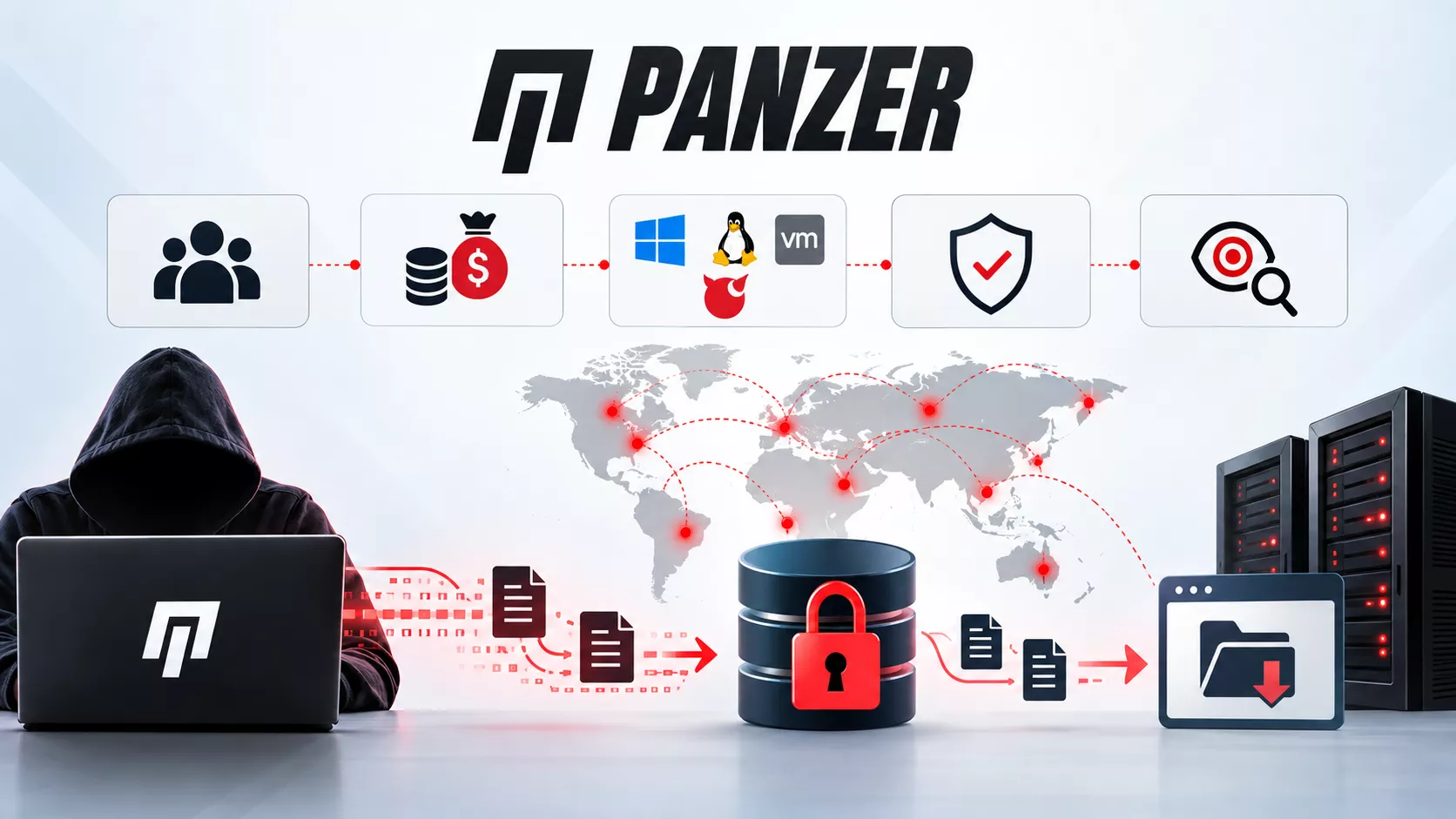
Panzer employs a semi-open affiliate program for recruiting prospective partners, allowing many to participate in its operations through a Tox-based application process. It requires prospective affiliates to pass a screening before gaining access to the dashboard. This model enables a wider net to be cast in the search for vulnerable targets.
Once accepted into the program, affiliates can benefit from an 80/20 revenue model, where they retain 80% of ransom payments, while Panzer retains a 20% platform fee. The appeal of such a model further incentivizes participation from cybercriminals, extending the group’s reach and increasing the variety of its attacks. The platform offers ransomware builds for various operating systems, including Windows, Linux, VMware ESXi, and FreeBSD. This cross-platform capability heightens the risk for enterprise environments, particularly those utilizing mixed server systems and virtualized infrastructures. Notably, attacks leveraging ESXi support could be particularly disruptive, given that a successful breach against a hypervisor may encrypt multiple virtual machines simultaneously, putting critical business operations at risk.
The architecture of Panzer’s affiliate dashboard underscores its intent to facilitate scalable criminal activities. It features tools for balance tracking, build management, support tickets, team sub-accounts, and a leak-publication workflow that necessitates approval before victim data is made public. Such organization and oversight indicate a serious commitment to maintaining an intricate criminal ecosystem.
CyberXtron further reported that the organization actively monitors new affiliates during their initial month, aiming to detect any signs of law enforcement or research interest in their activities. This precautionary measure suggests a level of sophistication and awareness within the group, further complicating efforts by law enforcement to penetrate their operations.
While there is no independently verified initial-access technique attributed to Panzer, related activities—assessed with medium-to-low confidence—include OS credential dumping, brute-force attacks, network service discovery, use of valid accounts for exploitation, remote lateral movement, and attempts to compromise security measures.
Panzer adheres to a double-extortion model, which entails exfiltrating sensitive corporate and customer data before encrypting systems. The group then applies public pressure through countdown timers and online posts on leak sites to coerce organizations into paying the demanded ransom. As of now, there are no publicly verified malware hashes, IP addresses, or sample data linked to Panzer.
In light of these emerging threats, experts urge organizations to prioritize cybersecurity measures. This includes patching internet-facing systems, implementing phishing-resistant multifactor authentication (MFA), segmenting critical infrastructure, monitoring for unusual outbound data transfers, and maintaining reliable, offline backups.
Cybersecurity teams are advised to stay vigilant in monitoring the evolving landscape of malware and phishing threats. Staying informed and proactive is critical in defending against opportunistic cybercriminals like those behind the Panzer ransomware.