
Next-Generation Technologies & Secure Development
Quantum Protocol Could Prevent Unauthorized Access to Banks and Data Centers
Recent advances by government researchers have shown that the enigmatic properties of quantum entanglement may play a crucial role in verifying an individual’s physical location. This groundbreaking development could pave the way for heightened security in digital transactions, specifically targeting unauthorized access to financial institutions and data centers.
The National Institute of Standards and Technology (NIST) has made waves in the scientific community with a recent publication, which details peer-reviewed research validating the technical feasibility of employing pairs of photons dispatched from two distinct locations to accurately triangulate the position of a third party situated between them. The implications of this research are significant, particularly for mitigating risks associated with digital fraud.
By accurately gauging precise location data, the potential to thwart fraudulent activities is enhanced. For instance, companies can verify commands for fund transfers to ensure they originate from legitimate locations, such as corporate headquarters, rather than from unauthorized devices infiltrated by cybercriminals. Furthermore, the research suggests that data access could be restricted to approved personnel based on their physical location, reducing the probability of data breaches significantly. However, agency officials acknowledge that the practical implementation of this technology may take at least another decade of intensive research before it is realized in the marketplace.
“Our results demonstrate how digital security can be closely tied to the physical realm,” explained Krister Shalm, a physicist at NIST who spearheaded the research. “Access to a system can only be granted to individuals who can substantiate their presence in a designated location, such as a bank, thereby impeding remote hackers from gaining entry.”
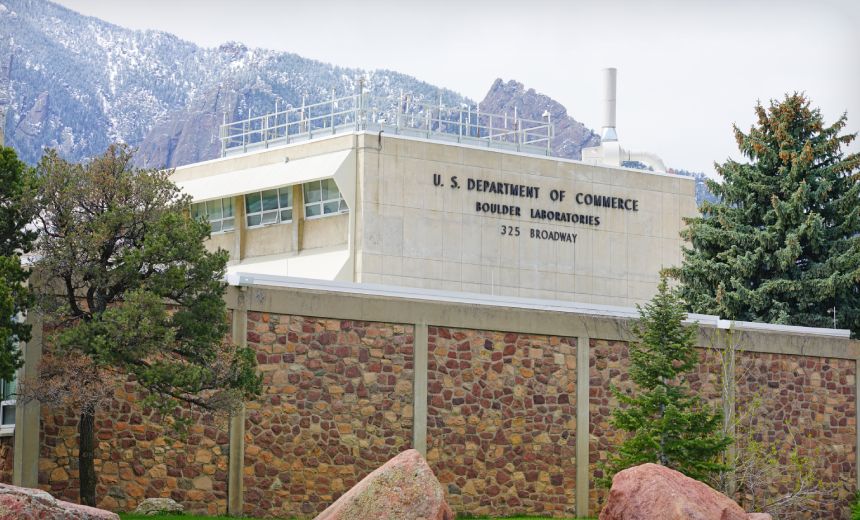
The process comprises the deployment of two specialized stations at secure facilities, termed verifiers, which transmit quantum information to the entity being assessed, known as the prover. In NIST’s setup, these verifiers were strategically placed approximately one-tenth of a mile apart on the agency’s Boulder, Colorado campus, interconnected via electrical cables and ultra-thin optical fibers.
At the heart of this procedure is an intriguing quantum phenomenon known as entanglement. This property allows two photons to share identical characteristics regardless of the distance separating them. Consequently, any alteration in the state of one photon elicits a corresponding change in the other. This remarkable trait renders attempts to interfere with entangled photons nearly impossible to accomplish without detection. Each verifier dispatches a photon from an entangled pair to the prover, retaining the other photon for further analysis.
Situated between the verifiers, the prover receives random numerical data and employs it to compute how to assess a specific characteristic of the entangled photon—in particular, the photon’s polarization, which pertains to the orientation of its oscillating electric and magnetic fields. The prover then relays the results back to the verifiers. The elapsed roundtrip time utilized to solve the challenge empowers the verifiers to triangulate the prover’s location. An unauthorized individual attempting to intercept the communication would face considerable challenges, as they would inevitably fail to complete the process within the predetermined time frame necessary for successful authentication.
“This procedure is executed millions of times within the span of a few minutes,” states NIST. “The verifiers subsequently analyze how frequently the polarization measurements recorded on their entangled photon correspond with those of the entangled photon delivered to the prover.”
An integral aspect of NIST’s experiment is the incorporation of a supplementary test known as a loophole-free Bell test. This test utilizes the correlations observed between the entangled photons to authenticate the location of a party without necessitating trust in the quantum equipment utilized. If the results succeed in passing this stringent test, the verifiers can conclusively authenticate the prover’s location, independent of the quantum devices’ security.
“Our method ensures that no assumptions are made regarding the internal mechanisms of the quantum devices employed, including both the quantum measurement apparatus and the source of entanglement,” the researchers assert. “This creates device-independent security that relies solely on the evaluation of the inputs to and outputs from the experimental devices.”
This innovative protocol effectively eradicates the opportunities for malicious entities to compromise quantum devices or exploit side-channel vulnerabilities, as articulated in earlier preprints of the research initially shared in January. However, it is vital to acknowledge that the approach employed by NIST necessitates sophisticated equipment and rigorous experimental conditions, which may pose challenges for practical implementation.
In a noteworthy development, quantum networking firm Qunnect announced the limitations of the protocol, highlighting that it can sustain a maximum loss of one-third of its photons during the Bell test. This constraint complicates deployment over existing fiber networks where significant signal loss can occur, especially over extensive distances. In a collaborative experiment revealed in September, Qunnect and JPMorgan Chase utilized commercially accessible hardware and a blend of quantum and classical stations spread across New York City, albeit with the caveat that users must explicitly trust the devices involved in the process.