
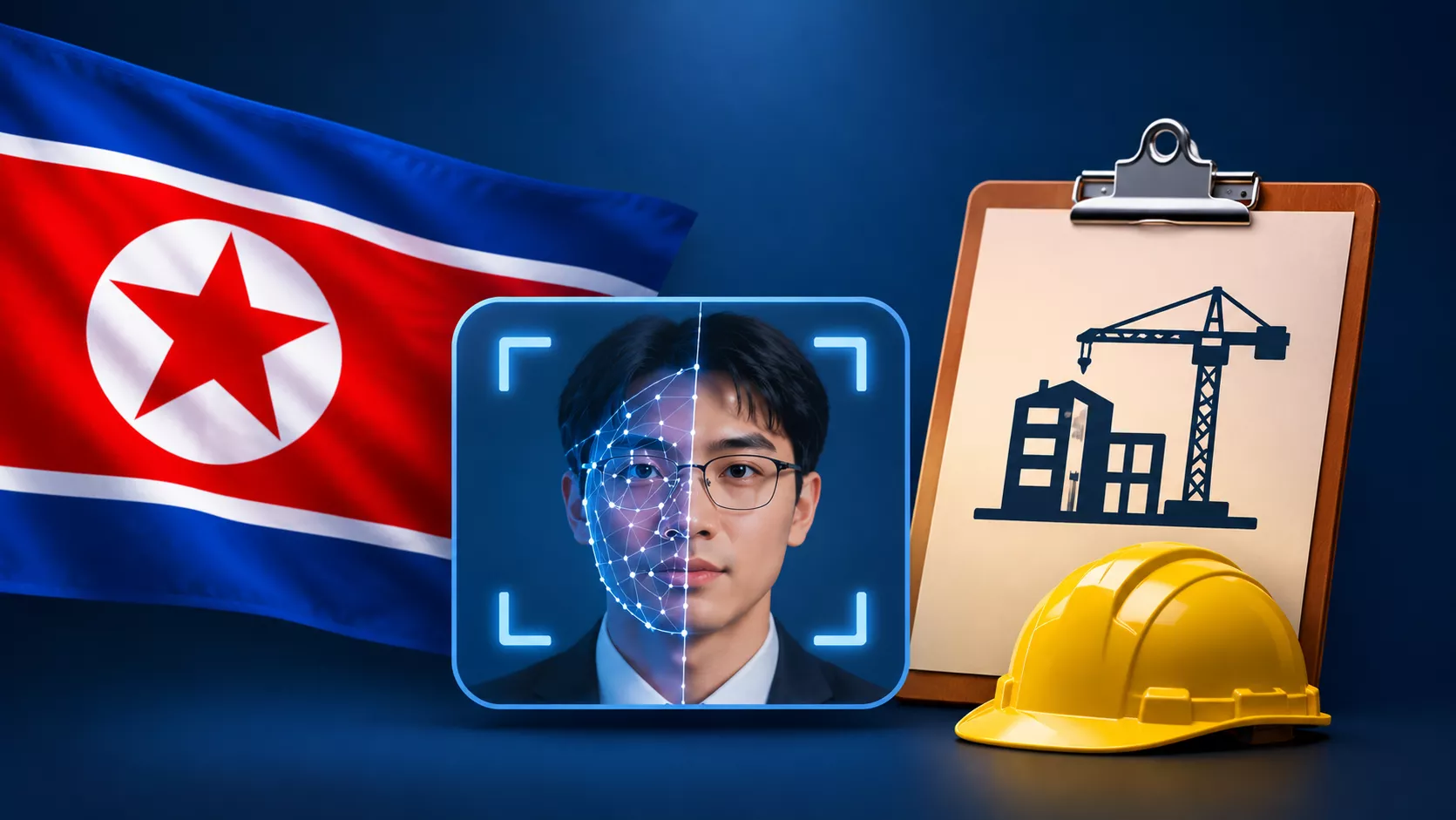
North Korean IT Workers Create Fake Construction Company
In a striking case of deception, analysts have uncovered that suspected North Korean remote workers have created a fake construction company in order to secure contracts with U.S. businesses. This operation involved the use of a bogus Virginia-based construction firm, known as The Great House, and sophisticated artificial intelligence techniques, including a real-time AI face swap. The intention behind this elaborate scheme is reportedly to generate revenue for the North Korean regime.
Investigators from Silent Push conducted a thorough assessment of The Great House, which advertised various residential and commercial construction and engineering services based in Lynchburg, Virginia. The findings from this investigation revealed that despite the ambitious marketing claims of the company, there were no awarded contracts or payments identified in relation to the firm.
In their efforts, analysts leveraged a WHOIS registrant pivot, tracking down the domain name thegreathouse.us. This pursuit became increasingly compelling as the investigators searched public domain registration records, pinpointing an email address that is part of a larger collection, allegedly linked to approximately 1,400 other addresses associated with North Korean IT operatives. The email devtop0109@gmail.com led the analysts to a domain that was registered on October 18, 2025. An in-depth analysis also included historical web scans and scrutinized the company’s presence on LinkedIn.
The website of The Great House boasted over a decade of experience, claiming to have completed projects for more than 200 clients and constructed over 60,000 square feet. However, the timing of the domain registration raised flags, urging procurement teams to independently verify the firm’s portfolio before any engagement.
Further scrutiny of the contact information displayed on the website revealed inconsistencies. Although a Virginia phone number with a 434 area code was listed, the associated tel: hyperlink directed users to an Arkansas number bearing a 479 area code. Additionally, the domain registration included yet another number from Massachusetts and a New York address, hinting at a broader scheme to mislead potential clients.
Posing as prospective clients, analysts engaged the company through a Telegram account linked to their website. During the first video call, an individual identifying himself as “Edward” maintained his camera off for the entire 25 minutes, frequently avoiding questions related to identity verification. On a subsequent call, where video was enabled, anomalies began to surface. Analysts noted distinct layering effects and facial distortions during the call, conditions indicative of a live facial overlay, which is often a telltale sign of deepfake technology in use. Throughout the conversation, this individual made a conscious effort to keep his mouth out of frame, allowing the inconsistency of facial articulation to become more apparent, particularly as he leaned back.
The investigators were particularly alert to the risk of “occlusion tests,” methods designed to unmask compositing errors inherent to real-time deepfake technology. Edward’s hesitance to participate in a basic occlusion test further raised red flags regarding the authenticity of his representation.
Comparing this front operation to others, Silent Push found parallels with malware delivery campaigns executed by Contagious Interview’s schemes, which employed false consulting firms and malicious repositories to entice job seekers, effectively delivering harmful software. However, the Great House attempted to invert the pitch by portraying itself as a vendor seeking paid projects rather than a traditional employer recruiting developers. Importantly, unlike FAMOUS CHOLLIMA, which operated through U.S.-based laptop farms managed by local facilitators, this tactic presented a different dynamic altogether.
For organizations working in procurement, the foremost line of defense lies in rigorous independent verification. Silent Push underscores the importance of checking contractor licenses with relevant state licensing boards and reconciling business addresses alongside phone numbers against registration records prior to onboarding any entity.
Video calls also present an opportunity for further scrutiny. Reviewers should encourage representatives to turn sideways or momentarily block their faces, closely observing for any distortions in edges or misalignment of lip movements with spoken words. A refusal to comply could be a major indication warranting a deeper investigation.
Organizations suspecting North Korean remote worker activity are advised to report any findings to the FBI’s Internet Crime Complaint Center (IC3). This ongoing concern highlights the significant lengths to which individuals may go in the pursuit of deceitful gains, emphasizing the need for vigilance and thorough verification practices in business dealings.