
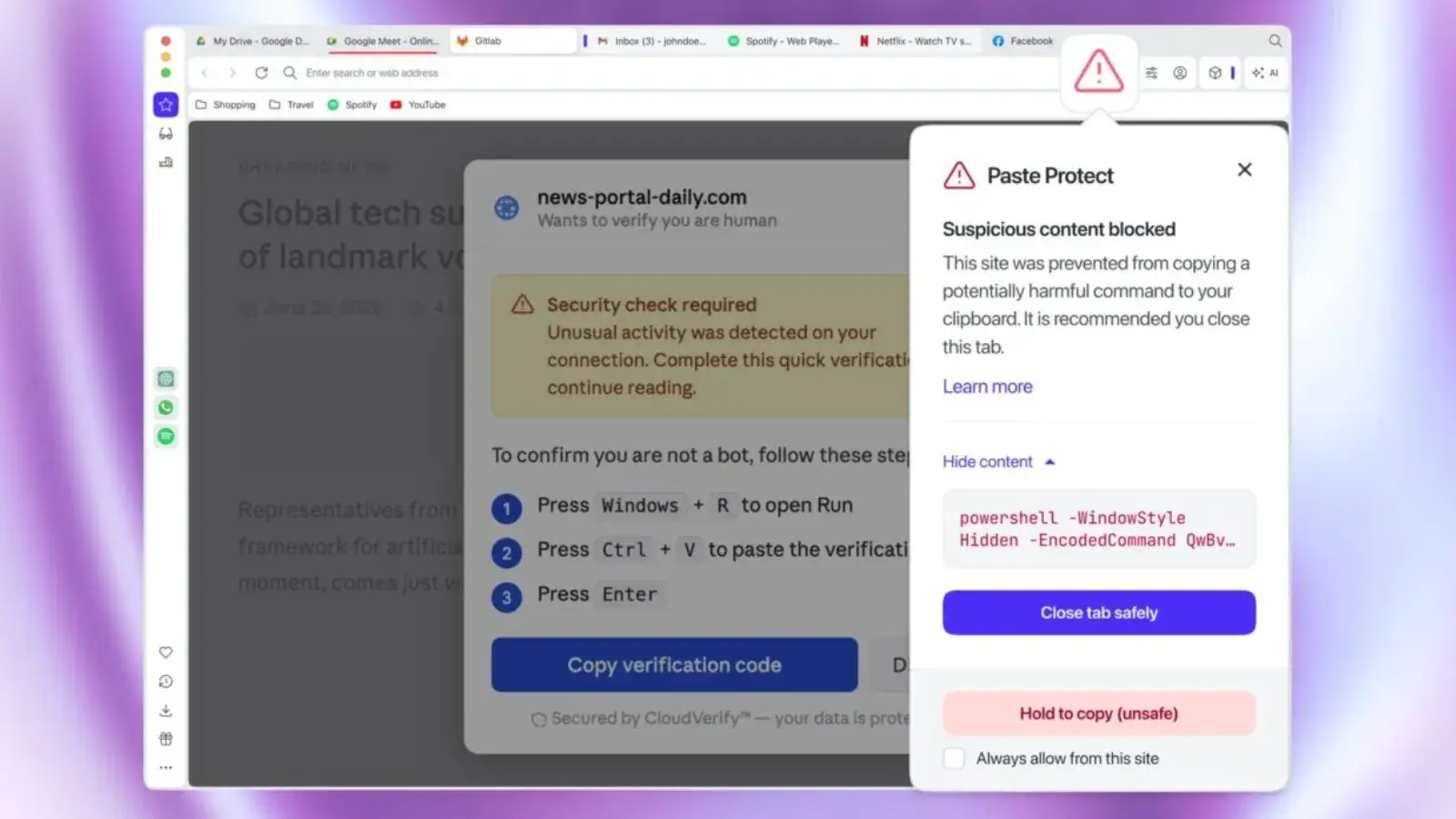


Opera Software has recently rolled out a new native security feature known as “Paste Protect,” designed to effectively counteract the rising threats of clipboard hijacking and command injection attacks within the browser environment. This innovative feature, which was introduced on July 2, 2026, is enabled by default, signifying a considerable leap forward in proactive endpoint security at the user interaction level.
The initiation of Paste Protect comes in response to an alarming increase in social engineering attacks, notably those categorized under “ClickFix”-style campaigns. Research provided by Huntress threat intelligence reveals that these types of campaigns constituted over 53% of malware loader activity in 2025, indicating a pressing need for enhanced security measures.
What distinguishes Opera’s approach is its focus on browser-level defenses, shifting away from traditional security paradigms that depend heavily on antivirus software or operating system-level warnings. By intercepting malicious clipboard activities before they can be executed—particularly in sensitive environments such as terminals or command-line interfaces—Opera aims to create a more secure browsing experience.
The Paste Protect feature employs two main mechanisms: the pre-existing “Hijack Protection,” which was introduced in 2021, and a new “Injection Protection” engine. The Hijack Protection system is aimed at thwarting unauthorized modifications of copied content, a common method used in various fraudulent schemes. For instance, attackers often utilize clipboard malware to stealthily replace crucial data, such as cryptocurrency wallet addresses or banking IBAN numbers, with their own values. This allows them to redirect funds without the user being aware of the changes. Opera’s browser is equipped to detect these tampering attempts, notifying users through secure copy alerts and thus safeguarding the integrity of clipboard data during sensitive transactions.
In addition to this, the newly introduced Injection Protection specifically targets command-based threats like ClickFix. Malicious actors often trick unsuspecting users into copying and executing harmful scripts through deceptive prompts on compromised websites. These prompts may masquerade as CAPTCHA verifications, browser error messages, or media playback issues, thereby luring victims into executing harmful commands under the guise of troubleshooting. The reliance on the clipboard as a trusted intermediary means that these actions can sometimes bypass conventional security protocols, making them particularly insidious.
To further address these emerging threats, Opera’s Injection Protection analyzes clipboard content in real time using heuristics tailored for Windows, macOS, and Linux systems. When a user or website attempts to copy potential harmful commands, the browser assesses the clipboard content against known malicious patterns associated with various command types. If a threat is identified, the copy action is halted, and a security alert is presented. This alert includes contextual information, such as a preview of the blocked content (limited to the first 120 characters), and a visual warning indicator in the browser’s address bar.
Understanding the need to balance usability with security, Opera has also introduced advanced user options. The “Hold to Copy” feature allows users to bypass a block after encountering a deliberate delay, and trusted domains can be whitelisted to minimize repetitive alerts when copying legitimate scripts from credible sources like GitHub. This adaptability is particularly beneficial for developers and system administrators who frequently work within command-line environments.
For those interested in managing their security preferences, Paste Protect can easily be accessed through the Privacy and Security settings of the Opera browser. This integration of clipboard monitoring—focused on offering a unified, native defense against clipboard hijacking and injection-based social engineering attacks—positions Opera as a trailblazer among major browser vendors.
Nonetheless, while the introduction of Paste Protect significantly reduces the potential attack surface, Opera stresses the importance of user vigilance. Attackers continuously evolve their techniques, and many clipboard-based threats still predominantly rely on user interaction. Therefore, users are urged to exercise caution when copying and executing commands, especially those sourced from unverified or malicious domains.
In conclusion, with its Paste Protect feature, Opera not only fortifies its commitment to user security but also enhances the overall safety landscape of web browsing. As threats grow in complexity and prevalence, such innovative solutions become essential in safeguarding users against emerging risks in the digital realm. Ensuring safety while promoting best practices will remain a crucial endeavor as the online landscape continues to evolve.