


Business Continuity Management / Disaster Recovery,
Governance & Risk Management,
Litigation
Appeal Faces Steep Statistical Odds Given Previous Court Rulings
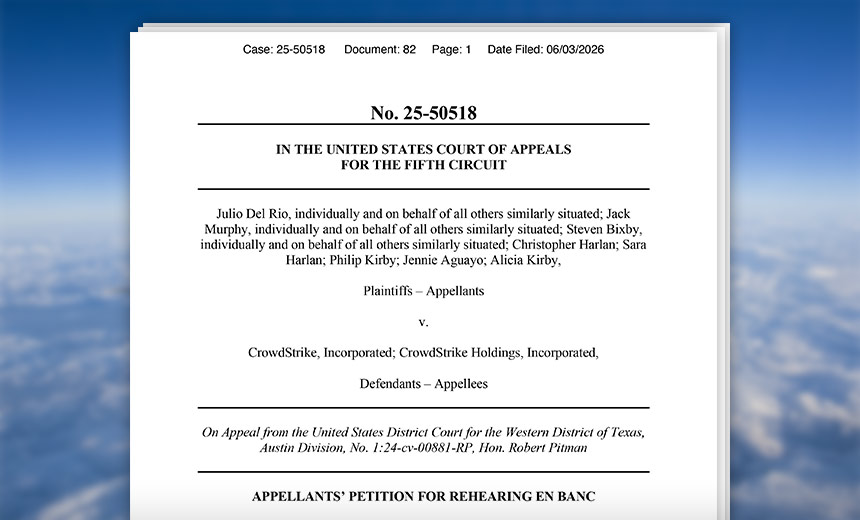
In a recent development concerning passenger rights and the accountability of technology firms, a group of airline travelers have approached the legal system with an ambitious plea. Specifically, they are urging the entire Appeals Court to hear their case against CrowdStrike, a cybersecurity vendor, which they accuse of negligence related to a software update that led to widespread airline disruptions.
This 18-page petition, submitted on a Wednesday, steps up the legal battle by asserting that the core of their claims is not tied to the economic transactions covered by the Airline Deregulation Act, but rather pertains to CrowdStrike’s responsibilities and conduct as a software developer. The legal friction began when a U.S. District judge previously ruled that the passengers’ claims were indeed precluded by this act, a decision that was subsequently upheld by a three-judge panel of the Appeals Court. Notably, this judicial review has significant implications for how such cases are approached in the future.
The passengers firmly maintain that their arguments focus on CrowdStrike’s role in software development. They assert that this aspect of CrowdStrike’s work is not encompassed by the economic relationship defined under the Airline Deregulation Act. “The claims at issue arose from CrowdStrike’s development and publication of a defective software update, conduct which is wholly outside the economic relationship between passengers and airlines,” argues the petition, asserting that the panel’s previous rulings have unduly broadened the definition of airline services.
From a statistical standpoint, the prospects for the passengers appear grim. The Fifth Circuit Court of Appeals has a historical record of rarely approving petitions for rehearing en banc, having granted only seven such petitions (3.3%) from July 2024 to June 2025. This past judicial history underscores the steep uphill battle that awaits these plaintiffs. The case, situated within the jurisdiction of the Western District of Texas, falls under the scrutiny of the Fifth Circuit, which oversees Louisiana, Mississippi, and Texas.
In an official response, a spokesperson from CrowdStrike conveyed confidence in the appellate court’s prior decisions, asserting their contentment with the dismissal of the passengers’ claims. This proposed class action lawsuit, embroiled in escalating legal discourse, follows a notorious incident in July 2024, when a problematic software update disrupted 8.5 million systems using CrowdStrike’s Falcon platform.
Passengers Advocate for Distinct Classification of CrowdStrike’s Work
At the heart of the passengers’ argument is a plea for recognizing a clear distinction between airline services and the operations of CrowdStrike. They contend that while airlines utilize CrowdStrike’s cybersecurity software, this should not lead to the erroneous classification of these services as part of the airlines’ contractual obligations to their passengers. By framing their claims within the context of negligence related to software development, the passengers aim to focus on the fundamental issues at hand, which they argue hinge on state tort law rather than airline-related matters.
“The panel’s affirmance of the dismissal of plaintiffs’ claims under the ADA [Airline Deregulation Act] conflicts with the court’s prior en banc decision in Hodges,” they state, suggesting that the case deserves to be re-evaluated in light of the principles established in previous rulings. They assert that this distinction is not merely academic; it fundamentally alters the basis upon which claims of negligence should be assessed when they involve third-party technology firms.
The passengers argue that their claims against CrowdStrike stem from the company’s failure to appropriately develop and deploy software updates, consequences of which severely affected airline operations and resulted in notable hardships for travelers. The assertion holds that these technological mishaps should not transform their grievances into matters of airline regulation simply because affected customers included airlines.
The Pursuit of Damages for Undeniable Hardships
The allegations extend beyond theoretical implications, as the passengers detail specific financial and personal hardships resulting from the incident. Additional costs for lodging, meals, and transportation, coupled with the emotional toll of missed events and reservations, form the basis of their pursuit for compensation. Historically, state tort law has provided remedies for such adversities, and the passengers caution that allowing preemption under the Airline Deregulation Act could substantially diminish the consumer’s ability to seek redress from third-party technology entities.
“Plaintiffs seek compensation for physical injuries sustained as a result of CrowdStrike’s negligence, not airline-related economic decisions,” they emphasize, arguing that the existing ruling by the appeals panel contradicts established legal principles that acknowledge the viability of personal injury claims irrespective of preemption arguments.
Passenger testimonies highlight the human aspects of this legal dispute. One individual reported suffering from neck and back pain after sleeping on an airport floor due to the disruptions, while another experienced severe migraines due to lack of sleep. Further, heightened anxiety and other physical stress responses were noted as direct consequences of the incident. The passengers argue that these personal injury claims unequivocally fall under state law protections, complicating the existing narrative around shared responsibilities in the airline industry.
In the final analysis, this case underscores critical questions regarding the intersections of technology, consumer rights, and legal frameworks. The decisions made in the courtroom could set significant precedents affecting not only the airline industry but also future interactions between consumers and tech companies within myriad sectors.