
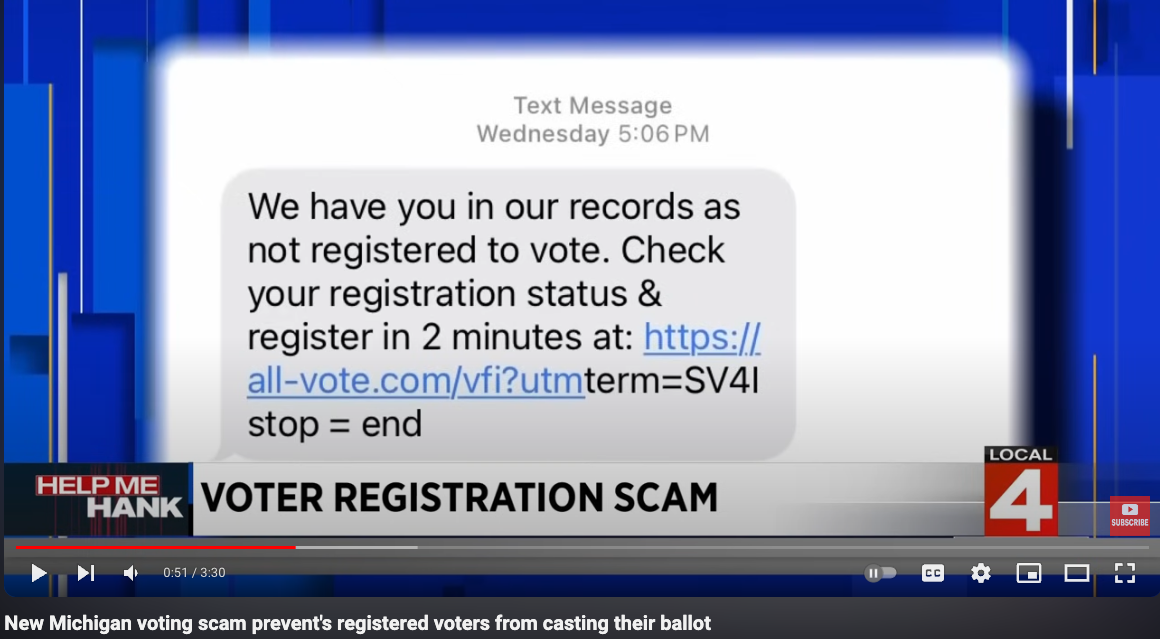


A recent phishing scam disguised as a voter registration campaign has sparked concerns among Americans this week. Reports from various media outlets shed light on a new text message scam that aims to deceive recipients into believing they are not yet registered to vote. Despite the well-intentioned efforts behind this campaign, it has raised red flags and caused confusion among those targeted.
The warning about this deceptive SMS campaign was first issued by local Channel 4 affiliate WDIV in Detroit on August 27. The message claimed, “We have you in our records as not registered to vote. Check your registration status & register in 2 minutes.” The link provided in the text message directed recipients to the website all-vote.com. However, as some recipients discovered, they were already registered to vote, leading them to suspect fraudulent activity.
Similar alerts were issued by ABC stations in Arizona and NBC affiliates in Pennsylvania, with election officials cautioning the public about messages originating from all-vote.com. The suspicious nature of the campaign prompted individuals to question its legitimacy, with some even receiving the messages despite not being eligible to vote in the first place.
To investigate the authenticity of all-vote.com, individuals could visit the main URL directly. However, doing so revealed that the website redirected them to a login page for an online service called bl.ink. Furthermore, domain registration details indicated that all-vote.com had been registered on July 10, 2024, raising doubts about its credibility.
Another version of the scam directed recipients to votewin.org, which also raised concerns due to limited information about its operators and a data collection form that requested personal details such as name, address, and mobile phone number. The Terms of Service on votewin.org linked it to a California-based voter engagement platform called VoteAmerica LLC, adding another layer of complexity to the situation.
Debra Cleaver, founder of VoteAmerica, revealed that the SMS campaigns were orchestrated by Movement Labs, a political consulting firm in San Francisco. While the firm claimed to target underrepresented groups in voter outreach efforts, some recipients found the messages alarming and off-putting. Cleaver emphasized the importance of accurate voter outreach practices and condemned the act of informing individuals about their voter status without verification.
Yoni Landau, founder of Movement Labs, defended the campaign as an attempt to assist unregistered individuals in the voter registration process. Despite the good intentions, the messaging approach employed by the campaign raised concerns and highlighted the need for more careful planning and execution in future outreach efforts.
In conclusion, the phishing scam disguised as a voter registration campaign has underscored the importance of conducting thorough verification and maintaining transparency in voter outreach initiatives. To register to vote or update voter registration details, individuals are advised to visit vote.gov and select their respective state or region for accurate information. The incident serves as a cautionary tale for political consulting firms and organizations involved in voter mobilization efforts to prioritize accuracy and integrity in their campaigns to uphold the democratic process.