
Delaware Complaint Targets Two Patents Covering Digital Identity Authentication
By Michael Novinson
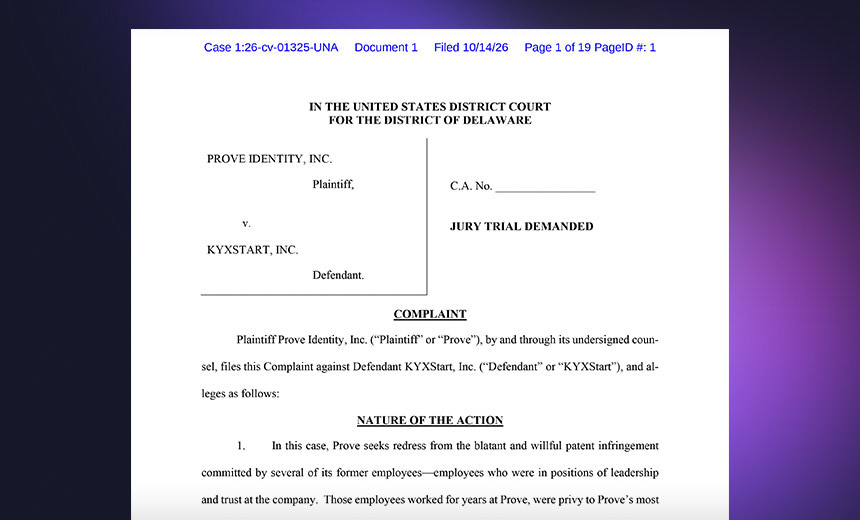
In a significant development in the world of digital identity technology, Prove Identity has initiated a federal lawsuit against the rising competitor KYXStart, alleging willful infringement of two patents integral to digital identity verification and authentication. This lawsuit was filed in the U.S. District Court for the District of Delaware and signals escalating tensions in the competitive landscape of digital identity services.
The New York-based firm Prove Identity contends that former employees played a pivotal role in leveraging proprietary insights to establish competing products at KYXStart. According to Prove’s allegations, ex-senior executives who transitioned to KYXStart utilized their extensive knowledge of Prove’s proprietary technologies to create a direct competitor, thereby undermining their previous employer. In its complaint, Prove stated, "Those employees worked for years at Prove, were privy to Prove’s most proprietary technology, and surreptitiously made off with Prove’s inventions to build a direct competitor – KYXStart – on a corrupt foundation of patent infringement."
KYXStart, founded in 2024 and currently employing a team of 13, is led by Ravindra Bijlani, who previously held a senior vice president position at Prove. Bijlani’s tenure at Prove lasted nearly five years, a period during which he gained considerable expertise in international and global alliances. Moreover, the lawsuit highlights the role of former Prove Vice President of Legal, Privacy, and Product Renata Lowenbraun, who became KYXStart’s general counsel in January 2025 after joining the company as a legal adviser. Prove alleges that Lowenbraun was intimately involved in overseeing the patent prosecutions during her time at Prove and had access to sensitive proprietary information pertinent to the technologies covered by the patents in question.
The lawsuit also claims that KYXStart actively recruited Michael Stearne, previously Prove’s director of product management from 2017 to 2024, in order to gain access to Prove’s proprietary identity verification technologies. Following his recruitment, Stearne took on the role of head of product at KYXStart in January 2025. Prove asserts that KYXStart was aware of a restrictive covenant that barred Stearne from working for a competing business for one year following his departure, yet proceeded with his recruitment regardless.
In its complaint, Prove emphasized, "On information and belief, KYXStart learned of the Restrictive Covenant and proceeded to recruit and engage Mr. Stearne in deliberate disregard thereof, or alternatively, KYXStart failed to make any reasonable inquiry into Mr. Stearne’s contractual obligations to Prove before recruiting and engaging him."
At the heart of the dispute are patents that encompass critical technologies, such as dynamically updating trust relationships based on interactions within a network, ensuring that systems can ascertain whether a subscriber is physically connected to a communications device. The second contested patent plays a crucial role in preventing security threats such as interception and replay attacks by validating identifiers based on their recent usage, thus safeguarding subscriber identities.
In its legal filings, Prove asserts, "Instead of competing fairly with its own home-grown technology, KYXStart, through Mr. Stearne and others, has developed products and services that willfully and flagrantly infringe on Prove’s patented technology."
Allegations of Infringement
Prove’s complaint details multiple ways in which KYXStart’s services have allegedly infringed upon its patents. This includes services related to personal and business verification, payments verification, telecommunications intelligence, fraud intelligence, and anti-money laundering monitoring, along with the software modules, computer instructions, processors, and servers utilized in these implementations.
Prove accuses KYXStart of actively partnering with clients to develop and deploy specific infringing implementations of its products. Furthermore, the complaint suggests that KYXStart provided technical support and consulting services designed to facilitate the infringement of Prove’s intellectual property, even publicizing these infringing deployments on its own website.
The legal confrontation intensified when Prove contacted KYXStart regarding the alleged patent infringement on March 5. A response from KYXStart’s outside counsel, Blank Rome, was issued on April 2, presenting arguments of non-infringement concerning both patents. Prove, however, disputes these claims, asserting that KYXStart misinterprets the patent claims and inaccurately characterizes its own products.
In a striking conclusion to its complaint, Prove accuses KYXStart of tortious interference with Stearne’s agreements with Prove as part of a broader scheme of unfair competition. The alleged actions of KYXStart demonstrate a calculated strategy to undermine Prove by infringing on its patented technologies while simultaneously recruiting key personnel who hold crucial knowledge related to those technologies.
This ongoing legal battle is poised to have substantial implications for both companies and the broader digital identity industry, as the intricacies of patent law and proprietary technology become focal points of contention in an increasingly competitive market. As Prove embarks on this legal journey to protect its innovations, the outcomes of this lawsuit could set important precedents in the realm of digital identity verification technologies.