
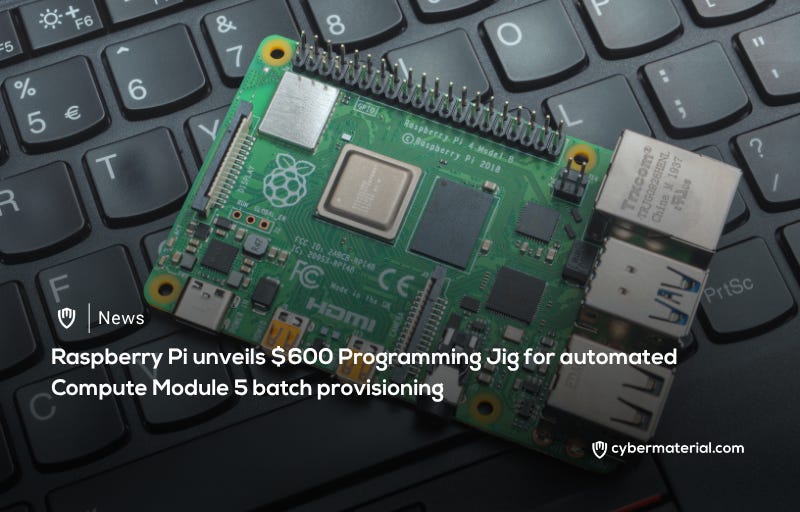
Raspberry Pi has unveiled its latest offering: a dedicated Programming Jig, priced at $600, designed to simplify the often complex task of preparing multiple Compute Module 5 (CM5) boards for deployment in embedded systems. This development aims to alleviate a well-known challenge faced by industrial users who frequently need to provision substantial quantities of modules, complete with the necessary operating systems and security configurations, to meet the demands of their projects.
The Programming Jig effectively integrates the provisioning host and module interface into a single, compact unit weighing 1.8 kg. This innovation eliminates the complications associated with different input/output (IO) boards and the intricate setups that usually accompany multi-device configurations. Historically, provisioning each CM5 involved establishing a connection to a host computer, which was often facilitated through an IO board connected to another Raspberry Pi or a PC. Although Raspberry Pi’s rpi-sb-provisioner software autonomously managed the installation and configuration facets, the hardware arrangement remained a hurdle, particularly for operations needing multiple boards processed simultaneously.
To use the Programming Jig, operators first need to configure it by writing the required operating system and conducting the initial setup via Raspberry Pi Imager. For optimal results, Raspberry Pi suggests utilizing Connect for remote desktop access, specifically for uploading the operating system images intended for the CM5 boards. Following this configuration, the actual provisioning workflow becomes notably streamlined: the operator simply places a CM5 module in the designated clamp, closes the lid, and the provisioning process commences automatically. Remarkably, each installation takes around 90 seconds, with a green status LED signaling when the module is ready for removal, thereby ensuring a smooth and efficient operation.
The device’s single-head design processes one CM5 board at a time, making it particularly beneficial for organizations that are involved in deploying moderate to large batches of modules within industrial or embedded applications. One of the standout features of the Programming Jig is its use of pogo pins to establish connections with the CM5 boards. This innovation guarantees reliable contact during the provisioning process and eliminates the need for manual cable connections—a common source of frustration in previous setups.
With the introduction of the Programming Jig, industrial users engaged in deploying CM5 modules within embedded systems can now provision boards more effectively. The ease of use that the Jig offers replaces the necessity for maintaining multiple separate provisioning stations, representing a significant leap in operational efficiency. By providing a hardware solution that complements the existing software automation tools, the Programming Jig successfully reduces setup time significantly and minimizes the risk of connection errors that can arise during batch deployments.
However, organizations considering the $600 investment in the Programming Jig are advised to evaluate the economic rationale based on their specific provisioning volume. For smaller deployments, where fewer modules are required, employing the less expensive IO board approach may still prove to be a more cost-effective strategy. Thus, each organization must weigh factors such as frequency of use, volume of modules needing provision, and available budget before making a decision.
In summary, the launch of Raspberry Pi’s Programming Jig offers a noteworthy advancement for users relying on CM5 modules in embedded systems. By facilitating a more straightforward and efficient provisioning process, the device not only enhances operational productivity but also highlights Raspberry Pi’s commitment to meeting the evolving needs of its industrial clientele. As technology continues to develop and industrial requirements evolve, such hardware solutions may become increasingly vital in streamlining workflows and enhancing productivity across various sectors.
For more details on this release, you can refer to the original source.