
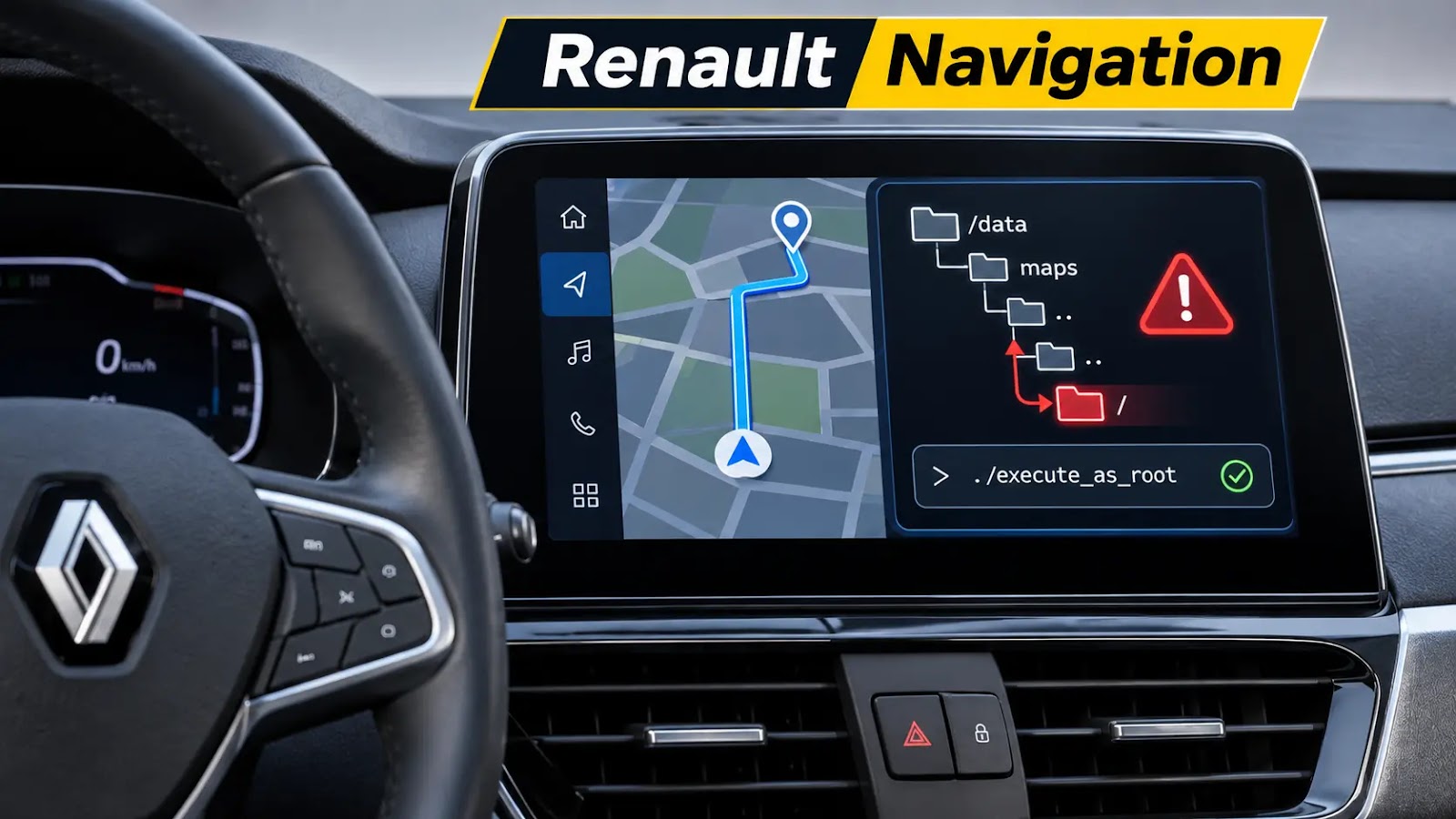
New Security Vulnerability Discovered in Renault’s Car Navigation System
On November 2, 2026, security researcher Rasmus Moorats unveiled a troubling vulnerability linked to the TomTom Carminat LIVE navigation unit, which is installed in various Renault models. This particular find raises significant concerns about vehicle cybersecurity, particularly given that the malicious exploitation of this system can lead to root-level code execution. The implications of this vulnerability point towards a wider issue of security within automotive systems that rely on outdated technology.
The TomTom unit in question is powered by a Samsung S5P6440 chip and operates on a customized version of Linux, specifically the long-held Linux 2.6.28.10 kernel. This kernel’s age is particularly conspicuous, as it predates many security measures that are commonly employed in more modern systems. Given the critical role that these systems play in vehicle navigation and safety, the implications of having outdated software are alarming.
Every time the device is powered on, it searches the attached SD card for a specific file called master.script. Upon locating this file, the user is presented with an on-screen prompt that asks whether they would like to execute the script. Although the requirement for user confirmation provides an element of control, it also showcases a potential point of vulnerability. The embedded script utilizes a custom automation language tailored for menu actions within the system. One crucial aspect is that the program responsible for processing the script, dubbed the ttn program, operates with root permissions. Consequently, any weaknesses identified in this script parser could lead to a complete system compromise.
Moorats meticulously identified two specific weaknesses in the script parser. The LOG command allows the script to write a single line of text to any file specified within the script. However, an inherent flaw in this function lies in its lack of path sanitization. As a result, attackers can leverage path traversal techniques to write data beyond the designated log folder. The second flaw, originating from the SHEX command, permits the execution of a predefined program on the device but fails to accept any arguments, which initially appeared to limit its potential for exploitation.
Interestingly, Moorats’s motivation for delving into the intricacies of this navigation unit stemmed from a mundane task: fixing the clock on his 2014 Renault Latitude. His initial exploration led him to the device’s head unit, codenamed "beaumont," setting off a chain of discoveries that unveiled serious security vulnerabilities.
At first glance, neither of the identified weaknesses seemed particularly advantageous. The root filesystem was set to read-only, and nearly all other partitions, including the SD card, were mounted with noexec flags designed to prevent programs from executing directly from those partitions. However, Moorats employed techniques reminiscent of vulnerabilities exploited within the Linux kernel landscape. By exploiting the LOG vulnerability, he redirected the outputs to a specific area in the filesystem: /proc/sys/kernel/core_pattern, which determines the actions taken by the kernel when a process encounters a crash.
Moorats cunningly manipulated this parameter to point to a command involving a shell executable: |/bin/sh /media/sdcard/payload.sh. This is a critical pivot point in the exploitation process, as the noexec flag does not hinder execution of binaries located in executable partitions. The shell, therefore, interprets the payload file as mere data.
Subsequently, executing the SHEX command calls upon /bin/dbus-monitor, which is programmed to crash in the absence of a recognized system bus. Upon encountering this crash, the kernel executes the attacker’s script, now endowed with root privileges. The entire exploit consists of just three lines of code: a directive pointing to the core_pattern, a LOG statement containing the payload command, and the SHEX command that ultimately initiates the process.
Moorats’s initial proof of concept merely rebooted the navigation unit, effectively confirming the ability for root code execution. The researcher subsequently utilized this access to create a backup of the internal eMMC storage and altered the settings.dat file to adjust the timezone, successfully resolving his initial objective.
It’s important to note that this exploit requires physical access to the vehicle and necessitates the user’s agreement through the script prompt, thereby making widespread or remote exploitation highly unlikely. However, the realistic risks remain, particularly regarding a compromised SD card provided during service or valet operations, or through social engineering tactics aimed at unsuspecting users.
Furthermore, gaining root access introduces significant risks, such as unauthorized exposure of sensitive data, including navigation history, and allows for persistent alterations to the navigation unit. Moorats’s analysis highlights the deficiencies in the navigation unit’s existing defenses, underscoring the urgent need for enhanced security measures in automotive systems as vehicles become increasingly integrated with digital technologies.