
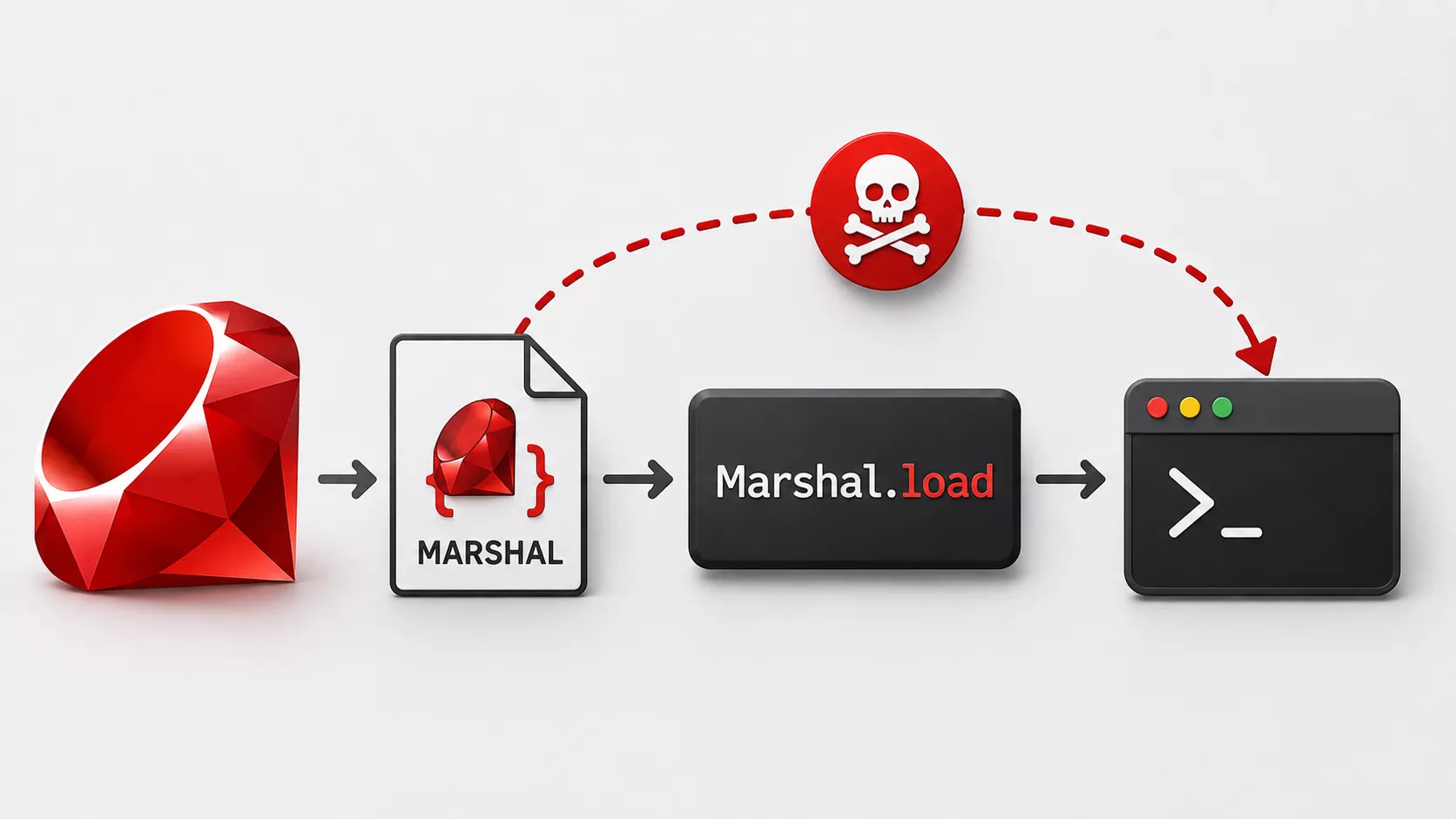
A recently uncovered universal deserialization gadget chain has highlighted a significant vulnerability in Ruby 4.0.6, revealing how a single unsafe Marshal.load operation can lead to remote command execution (RCE). This alarming discovery underscores the ongoing risks associated with exposing Ruby’s native serialization mechanism to potentially malicious data. As detailed in research conducted by elttam, this exploit is not limited to the latest versions; it reportedly operates unchanged on Ruby versions as old as 3.3. The findings reignite concerns regarding the use of Marshal.load, a method responsible for reconstructing Ruby objects from serialized data, which can inadvertently activate both application and language functionalities while resetting object states.
This new security threat builds on a well-documented history of vulnerabilities related to Ruby deserialization, particularly involving Ruby on Rails, YAML.load, RubyGems, and various components in Ruby’s standard library. Previous attempts to mitigate similar risks were somewhat successful, but they were disrupted by updates introduced in Ruby 3.4, prompting fresh investigations into Ruby’s deserialization processes.
The latest method of exploitation presents a significant evolutionary step in the ongoing battle against Ruby vulnerabilities. It reportedly bypasses the dependency and environmental constraints that limited prior proofs of concept. The recently identified gadget chain merges behaviors derived from RubyGems with core Ruby object reconstruction capabilities, establishing an attack pathway that does not necessitate pre-existing files, application-specific dependencies, or even non-default gems installed on the target system.
High-level analysis of the attack begins with a reference to Gem::SpecFetcher. This action activates RubyGems’ autoloading functionality, which then exposes additional classes, even within a Ruby process that appears minimal. The chain effectively synthesizes two dangerous capabilities: the retrieval of content controlled by an attacker and the ability to evaluate that content as executable Ruby code.
Within this framework, a resilient RubyGems gadget can retrieve data compressed on an attacker-controlled HTTPS server and write the uncompressed result to a predetermined writable location, such as /tmp. This complicated process continues with the intervention of the Gem::StubSpecification object, which compels RubyGems to deploy Gem::Specification.load against the file that has just been downloaded.
During the loading process, Ruby reads the targeted file’s contents and uses the powerful eval capability of Ruby to execute them. If an attacker successfully controls both the remote payload and its destination path, this deserialization workflow can result in arbitrary Ruby statements being executed with the permissions assigned to the compromised application.
Notably, two characteristics of this gadget chain make it particularly resilient against typical mitigations through narrowly focused RubyGems modifications. First, it leverages Time deserialization to prompt the download action while simultaneously suppressing expected exceptions. A specifically crafted value navigates through a conversion pathway that ultimately triggers methods controlled by an attacker’s serialized object. Second, the execution is initiated through the standard reconstruction of a hash.
While performing Marshal.load, Ruby reconstructs a Hash and computes hash values for restored keys. The use of a specially crafted Gem::StubSpecification object as a hash key allows Ruby to invoke its hash method, forwarding the operation toward the ongoing file loading and evaluation pathway.
Prior mitigation measures targeting RubyGems were designed to block known chains by implementing type checks and curtailing direct paths executable by attackers. However, as indicated by researcher Luke Jahnke, core functionalities like hash-key processing and lenient Time restoration are challenging to eliminate without causing unintended breaks in expected language behavior.
The practical implications of this vulnerability are grave whenever a Ruby service engages with, processes, or indirectly utilizes data influenced by an attacker via Marshal. Exploiting this weakness may only require access to a modifiable directory and a reachable attacker-controlled HTTPS server. The attack methodology does not necessarily depend on third-party gems or previously positioned files, presenting a considerable and immediate risk.
Developers are urged to treat the invocation of Marshal.load with untrusted input as equivalent to direct code execution. Such operations should be eradicated from workflows that are exposed to network traffic or user controls, which includes cookies, cache entries, job payloads, message queues, uploaded files, and database fields manageable by lower-trust systems.
In instances where serialization is essential, teams should transition to data-only formats like JSON and implement rigorous schemas, explicit type validation, and integrity protections. It is also advisable for existing Ruby installations to undergo thorough audits, specifically targeting Marshal.load, Marshal.restore, YAML.load, and similar insecure deserialization pathways.
Security teams are encouraged to monitor Ruby workloads for any signs of unexpected outbound HTTPS traffic, anomalous file writes in temporary directories, and suspicious Ruby processes initiating commands. Such activities can serve as crucial early-warning indicators of potential or successful attempts at exploiting unsafe deserialization vulnerabilities. This evolving landscape of threats highlights the importance of robust security practices within Ruby applications to safeguard against emerging risks.