
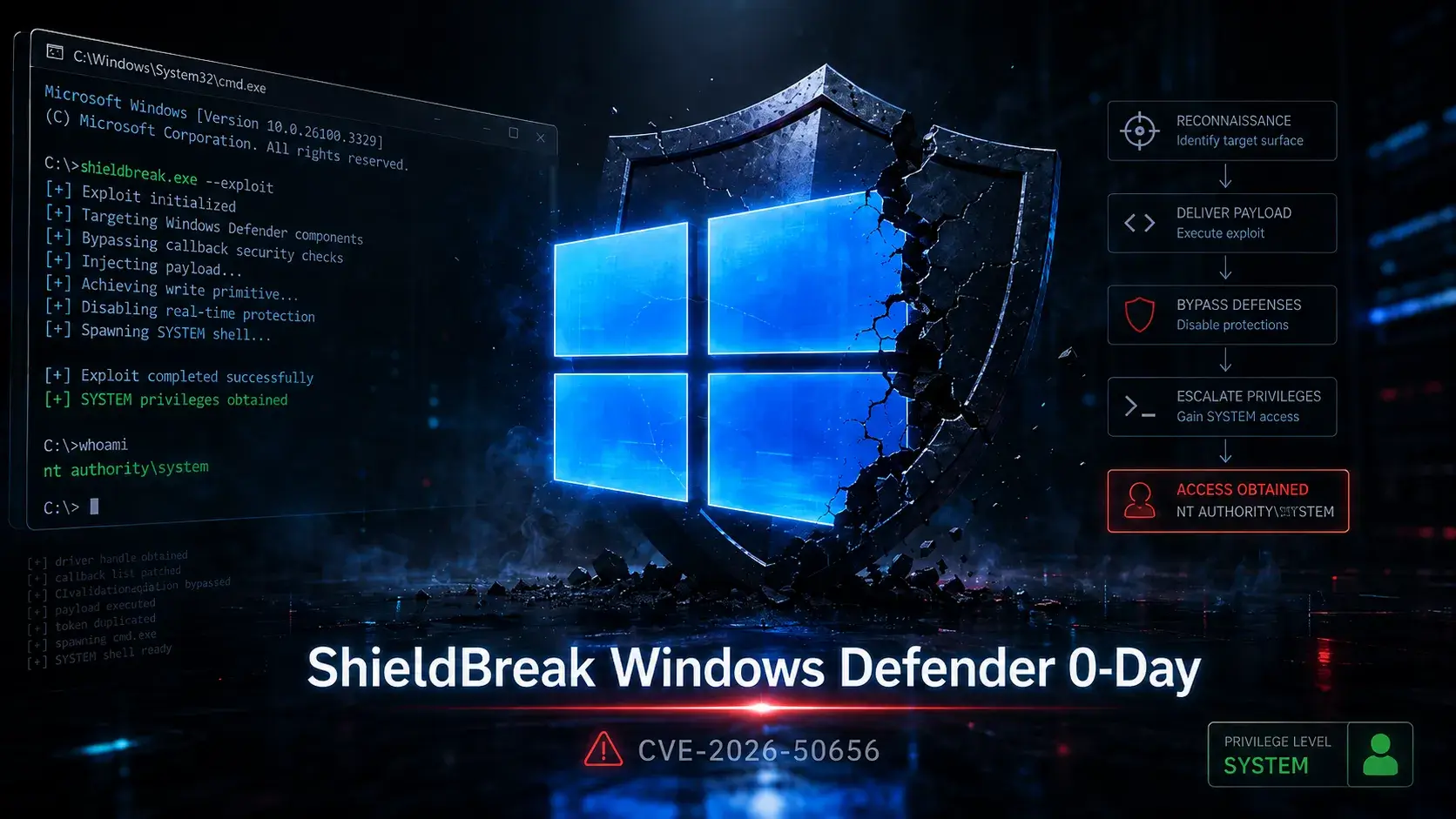


New Windows Exploit: Nightmare-Eclipse Unveils ShieldBreak
A significant development in cybersecurity has emerged as security researcher Nightmare-Eclipse, also recognized in the community as Chaotic Eclipse, has unveiled a Windows privilege escalation exploit named ShieldBreak. This release raises important questions about the effectiveness of past security updates and highlights vulnerabilities within Microsoft’s systems.
The primary claim of ShieldBreak is that it can bypass a fix implemented by Microsoft for the RoguePlanet vulnerability in Windows Defender, specifically noted as CVE-2026-50656. This particular vulnerability was addressed in July 2026, yet ShieldBreak indicates that the patch may not have fully resolved the underlying security issues, suggesting that a broader race-condition flaw could still be exploited by local attackers.
Understanding the RoguePlanet Vulnerability
At the heart of the RoguePlanet flaw is a check-then-act race condition found within mpengine.dll, a critical component tasked with the scanning operations of Windows Defender. The operational weakness it exploited allowed attackers to potentially manipulate the timing of file scans. This manipulation would enable them to redirect Defender’s functionalities and even launch a command shell that operates with NT AUTHORITY\SYSTEM privileges—essentially granting elevated access to attackers.
Microsoft was aware of this vulnerability, assigning it a CVSS score of 7.8, suggesting that exploitation is not only possible but likely. To counteract this threat, the tech giant rolled out a fix in Malware Protection Engine version 1.1.26060.3008 during their July 2026 update cycle.
The Mechanics of ShieldBreak
Nightmare-Eclipse asserts that ShieldBreak circumvents the remedies provided by Microsoft through an alternative attack chain. The methodology involves registering a malicious cloud provider and creating a custom placeholder file that links to it. The exploit then merges Common Log File System (CLFS) manipulation techniques with Object Manager symbolic links, leading to interference with the Defender’s standard file-scanning workflow.
Through this sophisticated technique, attackers could cause Defender to inadvertently lock a legitimate Windows system file, such as phonefo.dll, allowing them to replace it with a malicious version. Once this tampering occurs, the exploit can execute code controlled by the attacker with SYSTEM privileges, effectively giving the attacker control over the system.
Wide-ranging Implications
According to Nightmare-Eclipse, the proof-of-concept behind ShieldBreak claims to have been successfully tested against Windows 11 25H2, including Canary Channel builds, and Windows Server 2025, achieving an alarming 100% success rate in trials. There is also concern that Windows 10 and associated server editions could be similarly affected, although explicit support for those platforms in the current exploit has not been confirmed.
The implications of a reliable local SYSTEM escalation exploit are significant. Within the environment of enterprise endpoints, such an exploit could enhance the repercussions of malware, compromise low-privilege accounts, and escalate post-exploitation activities. The typical nature of race-condition vulnerabilities requires repeated trials, often demanding that attackers capitalize on a very narrow timing window; however, the reliability of ShieldBreak could fundamentally alter this dynamic.
A Pattern of Security Breaches
Importantly, ShieldBreak marks the ninth public Windows exploit introduced by Nightmare-Eclipse in 2026, following previous exploits like BlueHammer, RedSun, and others that have similarly scrutinized Windows Defender’s cloud file management and the critical workflows designed to preserve security without triggering immediate alerts.
However, news has surfaced that Nightmare-Eclipse’s repositories on GitHub and GitLab have been suspended, leading to mirrored versions being hosted on alternative platforms. This action underscores the tension between security research and platform policies regarding the dissemination of exploit information.
Given these developments, organizations are cautioned against assuming that the July Malware Protection Engine update entirely mitigates risks. Security teams are urged to remain vigilant and monitor for any unauthorized registrations of cloud providers, suspicious activities within the Object Manager namespace, unexpected CLFS log operations, or SYSTEM-level shells that are not initiated through established administrative processes.
Until Microsoft offers a comprehensive fix that closes these vulnerabilities, any anomalous activity linked to Windows Defender should be taken seriously, treated as potential indicators of compromise, and acted upon without delay.
In conclusion, the revelation of ShieldBreak not only highlights the ongoing battle between cybersecurity vulnerabilities and their mitigations but stresses the need for organizations to actively enhance their security postures amidst evolving threats. Enhanced vigilance and proactive measures will be crucial in navigating this continually evolving landscape of security challenges.