
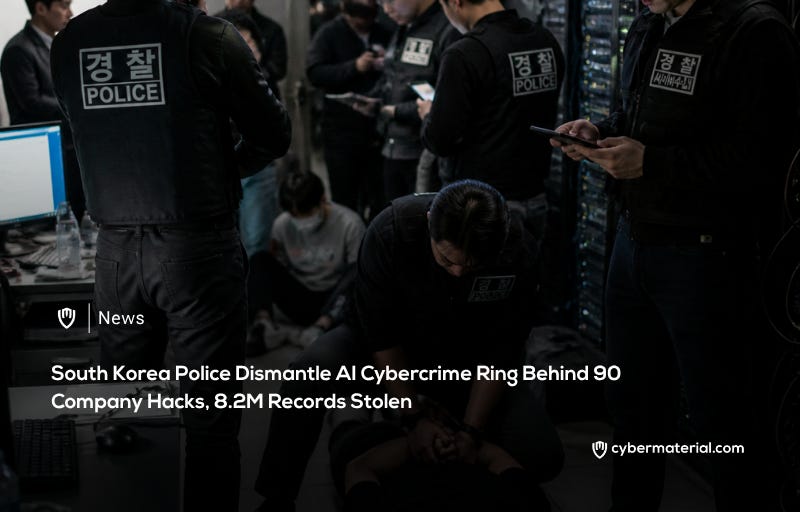


South Korea Cracks Down on First Large-Scale AI-Driven Cybercrime Operation
In a groundbreaking move for cybersecurity, the Seoul Metropolitan Police Agency has successfully dismantled what has been identified as South Korea’s first significant cybercrime operation leveraging generative artificial intelligence (AI). This operation resulted in the arrest of seven suspects who are allegedly responsible for breaching approximately 90 companies and stealing an astonishing 8.2 million personal records from various sectors.
The police conducted their investigation through the Cyber Investigation Division, where they identified a 32-year-old ringleader, referred to as A. This individual has a background in cybersecurity but has no formal education in information technology. From 2019 to 2022, A worked in penetration testing at a cybersecurity firm, honing skills that he later complemented with self-taught hacking techniques. With the initial reliance on automated tools to identify vulnerabilities in web applications, A’s methods dramatically evolved in mid-2024, incorporating cutting-edge generative AI technology. This pivotal change allowed for a marked escalation in the operation’s efficiency and scope.
Beginning in September 2023, A and his accomplices targeted a diverse array of institutions, including private academies, hospitals, golf courses, and affiliates of major conglomerates. Their strategy involved significant extortion tactics, where they communicated threats to their victims indicating that failure to pay would lead to the public disclosure of sensitive stolen information. This extortion created serious repercussions, including reputational damage, potential regulatory fines, and civil lawsuits. The group demanded a staggering total of 360 million won from 38 different companies. However, the response from the targeted sectors was underwhelming, as the suspects only managed to collect around 300,000 won before law enforcement intervened.
The investigation into this elaborate scheme commenced in June 2024, triggered by a complaint from one of the victimized companies. Following that, as additional similar reports surfaced across the nation, authorities consolidated their efforts to identify and arrest those involved. Between July and September, police apprehended five accomplices. Significant progress was made in early January 2025, when law enforcement officers arrested an additional suspect linked to the coordination of the group’s activities via the messaging platform, Telegram.
On January 13, police executed a search warrant at A’s residence located in the upscale Gangnam district of Seoul, where they uncovered the generative AI systems that had been deployed in the cyberattacks. Following an in-depth forensic analysis of access logs and other pertinent digital evidence, authorities arrested A on January 15. This operation led to the seizure of various computers, hacking tools, and accounts associated with the threats made to victims. By January 23, prosecutors secured custody of A for stealing approximately 900,000 records from at least 15 companies that had filed formal complaints.
Police officials have expressed that this case serves as a watershed moment in the field of cybercrime, showcasing how advancements in AI have lowered the barriers to entry, enabling individuals with minimal training to conduct sophisticated multi-target cyberattacks. This unprecedented accessibility may facilitate elaborate campaigns that were once only feasible for organized groups of hackers.
Furthermore, the investigation is ongoing, focusing on the remaining approximate 75 companies that have yet to report any incidents. Authorities are actively working to identify additional accomplices and trace any criminal proceeds that may have been generated through these activities.
Organizations across the nation are urged to heighten their vigilance against unauthorized access attempts, ensure their logging and detection capabilities are fully functional, and report any extortion incidents to law enforcement promptly. This proactive approach may serve to mitigate further victimization and fortify defenses against future cyber threats.
In light of these developments, cybersecurity experts stress the importance of embracing advanced technologies while simultaneously remaining aware of the potential risks they may inadvertently present. The successful intervention by South Korean police highlights an evolving landscape in which cyber threats are increasingly sophisticated, making robust cybersecurity practices more critical than ever.
Source: The Cyber Express