
Emergent Cyber Threats: Understanding Week-to-Week Developments
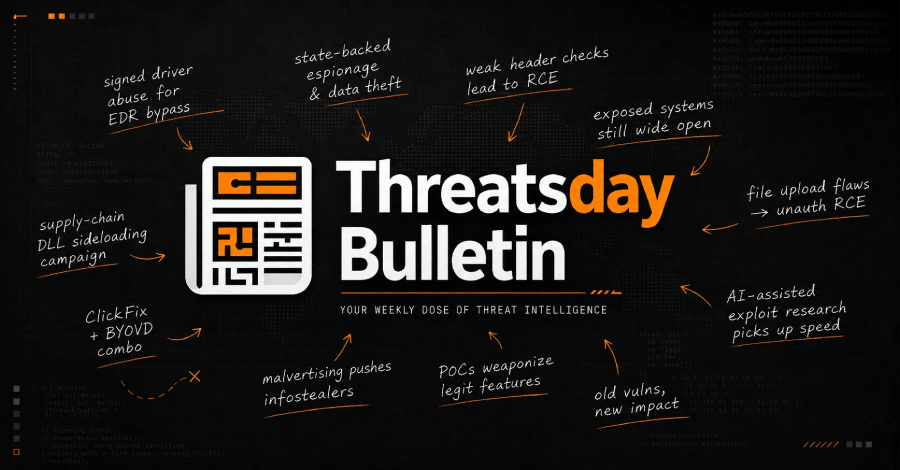
In the constantly evolving landscape of cybersecurity, this week has brought to light several critical vulnerabilities and threats that underscore a fundamental reality: many of the challenges stem from trusted systems and components behaving exactly as they are designed to do.
Research conducted by Check Point has revealed alarming discoveries relating to Microsoft’s Defender Boot-Time Removal driver, known as "BTR.sys." This signed driver, originally intended to enhance security by offering remediation capabilities, has been reverse-engineered to serve as a universal kernel operation engine. These findings highlight how legitimate components can unwittingly become instruments for cybermalicious activities, circumventing endpoint security measures. Jiří Vinopal, a security researcher, explained that an attacker can exploit a specific "golden window" during system startup to execute code without relying on traditional methods like the bring-your-own-vulnerable-driver (BYOVD) strategy. The inadequacy of signature-based blocking mechanisms only amplifies the utility of the BTR.sys component for these nefarious purposes.
On another front, the U.S. Department of Justice has initiated a significant legal action against 17 members of the Mabna Institute, an Iranian cyber espionage organization. Since at least 2013, this group has orchestrated mass cyber intrusions targeting a staggering number of academic institutions, companies, and government agencies. The Daeca Institute’s actions have allegedly resulted in the theft of over 31 terabytes of sensitive data, affecting more than 100,000 professor accounts globally. The operation served the interests of Iran’s Islamic Revolutionary Guard Corps (IRGC) and has raised crucial questions about the privatization of state-sponsored espionage. With the potential reward of $10 million offered for information leading to the identification of specific defendants, this case illustrates how technological expertise can be exploited for state-sponsored tasks at an industrial scale.
Amidst these developments, a new malware campaign has surfaced, utilizing the legitimate Duplicate Files Finder application through a technique known as DLL sideloading. Telemetry reports from Acronis indicate that this malware, referred to as Grandoreiro, remains predominantly a threat in Latin America, with significant activity observed in countries such as Mexico, Spain, Peru, and Argentina. The malware incorporates sophisticated anti-analysis functionality, demonstrating operators’ intent to evade detection by automated systems.
On a more technological front, OpenAI has introduced a new privacy-centric safety feature known as "Private Safety Processing." This initiative aims to monitor potential abuse of AI models without retaining customer data. In an era where data privacy is paramount, such measures signal a response to concerns about the misuse of artificial intelligence technology and showcase the competitive landscape between AI firms.
As companies innovate, some developments raise concerns. One example is the emergence of Kriminal AI, an AI-powered service that promises unrestricted access to answers on any subject without the standard content filters typically found on major platforms. With subscriptions starting as low as $12.99 per month, this service raises ethical questions about the potential for misuse, existing in a readily accessible format rather than lurking on the dark web.
In parallel, Apple faces scrutiny in Germany, where regulatory authorities have directed the tech giant to amend its App Tracking Transparency (ATT) feature. The Federal Cartel Office found that Apple’s own applications were benefiting from more favorable consent prompts compared to third-party developers, putting users and developers at an unfair advantage. This development can significantly impact how user consent is sought and managed across various applications in European markets.
Adding to the growing list of vulnerabilities is the discovery made by Claroty’s Team82, which unveiled several security flaws in Copeland XWEB Pro controllers. These vulnerabilities facilitate root-level remote code execution, potentially enabling malicious actors to manipulate refrigeration systems. Such a breach could have dire repercussions, including compromising food safety standards.
Moreover, a resurgence of sophisticated malware backdoors, specifically an unnamed Windows backdoor, reveals new tactics for hiding command-and-control (C2) domains. Disguised as a legitimate Realtek software, the malware encodes its C2 server address through trailing spaces in a seemingly innocuous desktop.ini file, showcasing an innovative approach to evade detection.
The week also marked the emergence of critical vulnerabilities across platforms like CircleCI and n8n, where attackers can exploit misconfigurations to execute commands without proper authentication, underlining ongoing challenges faced by CI/CD pipelines and workflow automation platforms.
Ultimately, the continuous reckoning of attackers necessitates a proactive approach among organizations and developers alike. While technologies advance, so do methods of exploitation. It is essential for cybersecurity frameworks to adapt, tightening trust assumptions, actively questioning default settings, and addressing overlooked vulnerabilities. The insights gained from this week’s revelations can serve as a guide for mitigating future risks and strengthening defenses in an increasingly complex cyber landscape.