
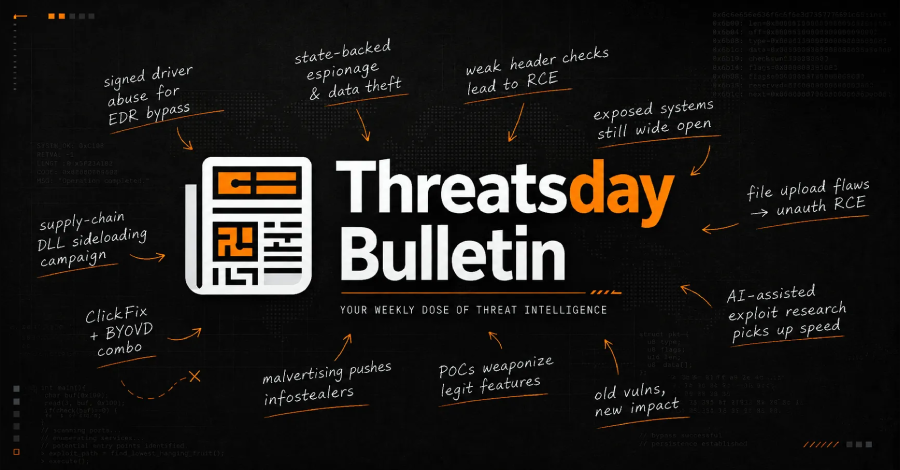


Rising Cybersecurity Threats: A Weekly Synopsis
In the complex world of cybersecurity, this week has been rife with challenges. Many of these issues stem from vulnerabilities that arise when trusted systems are exploited in unexpected ways. Cybersecurity experts have observed a disturbing trend where signed drivers are manipulated, legitimate applications assist malware in evasion, and lapses in security checks provide pathways for malicious code execution. Furthermore, issues relating to exposure of systems, legacy bugs, and even innovative AI-driven exploit research have contributed to a decline in security resilience, making it easier for threats to proliferate.
Exploitation of Signed Drivers
Recent research from Check Point has unveiled alarming findings regarding the misuse of Microsoft Defender’s Boot-Time Removal (BTR.sys) driver. This legitimate Microsoft-signed component has been repurposed into a universal kernel operation engine, allowing users to bypass endpoint security measures. According to security researcher Jiří Vinopal, the method exploits a "golden window" situated between system startup and user mode initialization, eliminating the necessity of using vulnerable drivers. This revelation underscores the irony that the very systems designed to protect networks can also be weaponized against them.
Major Cyber Intrusion Campaign Uncovered
The U.S. Department of Justice has announced charges against 17 individuals linked to the Mabna Institute, an organization based in Iran. Since at least 2013, this institution has executed a well-coordinated cyber intrusion campaign targeting more than 144 universities across the United States. The scale of the operation is staggering, having reportedly compromised approximately 100,000 accounts, and culminating in the theft of over 31 terabytes of academic data. The information was intended for the benefit of Iran’s Islamic Revolutionary Guard Corps (IRGC), highlighting a concerning intersection between state-sponsored activity and cybercrime. The Department of State has offered a $10 million reward for information leading to the capture of key figures associated with this operation.
Malware Campaigns on the Rise
The discovery of a new malware campaign, dubbed Grandoreiro, has raised alarms as it leverages the Duplicate Files Finder (DFF) application for DLL sideloading to execute malicious code. Telemetry data indicates that the campaign has mainly affected Latin America, with countries such as Mexico, Spain, Peru, and Argentina reporting the majority of infections. Acronis noted that the malware includes advanced anti-analysis techniques designed to evade detection, further complicating the cybersecurity landscape.
Another alarming trend is the emergence of ClickFix campaigns, which utilize counterfeit software to distribute malicious payloads. The ErrTraffic framework, operated by a threat actor known as LenAI, has been implicated in delivering a range of malware using this method, including tools specifically designed for stealing sensitive information.
Innovations in AI and Cybersecurity
The landscape of AI-driven cybersecurity tools has become increasingly competitive. OpenAI has introduced a new service named Private Safety Processing, which monitors potential model misuse while ensuring customer data remains confidential. This controversial strategy appears to be an effort to outpace competitors like Anthropic, which retains user data for 30 days.
Meanwhile, a new AI service called Kriminal.AI has surfaced, which aims to provide users unfiltered access to information typically restricted by safety measures in conventional AI systems. Such unregulated access raises ethical concerns, especially given that the service openly markets itself as providing "raw, uncut intelligence."
Changes in App Tracking Transparency
In a significant regulatory development, Apple has agreed to reform its App Tracking Transparency (ATT) feature in response to findings from Germany’s Federal Cartel Office that suggested the ATT provided its applications with an advantage over third-party developers. According to Apple, these adjustments will extend across most European Union nations, emphasizing the necessity for fair competition in the tech space.
Emerging Vulnerabilities and Responses
This week has not been without its discoveries of vulnerabilities. Claroty’s Team82 released findings regarding critical flaws in Copeland refrigeration controllers, which could lead to significant operational disruptions. These vulnerabilities could enable unauthorized remote manipulation of refrigeration systems, potentially putting public health at risk.
Furthermore, an alarming hand-written backdoor was discovered by Gen Digital, where command-and-control (C2) server addresses were concealed within a seemingly benign Windows file. This innovative but devious method highlights the lengths malicious actors will go to in order to infiltrate networks.
Concluding Thoughts
As the week comes to a close, the cybersecurity landscape remains fraught with both new and persistent threats. These attacks frequently exploit trust, weak security assumptions, and inadequately monitored systems. A crucial takeaway for organizations is the importance of scrutinizing trusted components, re-evaluating default settings, and paying attention to security misconfigurations. The latest trends in cyber warfare illustrate that attackers are continually adapting, and it is imperative that defenders do the same.
In a landscape where attacks do not require sophisticated techniques but rather exploit systemic weaknesses, the onus is on organizations to stay vigilant and proactive in their cybersecurity efforts.