
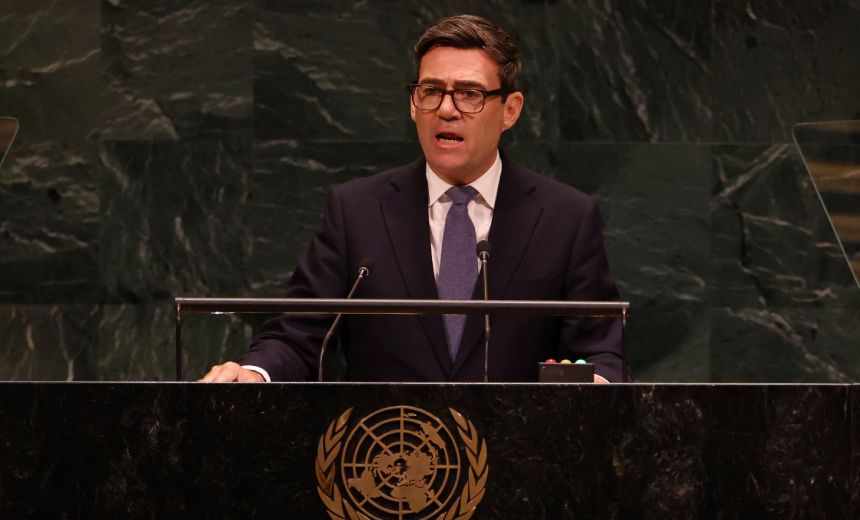
Andy Burnham Announces Counter-Kremlin Initiative Amid UN Address
On September 22, 2026, British Prime Minister Andy Burnham delivered a notable address at the United Nations General Assembly, marking his first significant appearance on the international stage since taking office. During this speech, Burnham identified a critical threat posed by hostile foreign actors, particularly targeting Russia, which he described as conducting an "industrial-scale assault" on information. This declaration underlines the increasing urgency of safeguarding democracies against the pervasive threat of disinformation.
Burnham’s remarks highlighted a broader concern over the manipulation of narratives that propagate division and despair, directly attributing these schemes to Russian interference. He unveiled his plan to establish a new governmental body, the National Centre for Information Defense, dedicated to countering "hostile state information attacks." This center will focus on identifying and disrupting malicious campaigns, including election interference, which Burnham noted was a significant concern in the UK.
The Prime Minister referenced a staggering annual expenditure by the Kremlin of approximately $1.7 billion dedicated to spreading misinformation and interfering in various democratic processes. "Russian agencies have utilized all means available to them to disseminate falsehoods and prey upon the fears of the populace," Burnham stated emphatically, elaborating on the multifaceted strategies employed by these actors. These tactics reportedly included the use of bots, fake websites, and even falsified articles that impersonate credible news sources. Burnham also mentioned specific allegations of Russian efforts to manipulate the outcome of the 2019 general elections in the UK.
In his address, Burnham voiced concerns over the rising threats posed by cyberattacks on various institutions and businesses within the UK. He warned that advancements in artificial intelligence could exacerbate these challenges, potentially increasing the scale and intensity of disinformation campaigns. "We have tiptoed around this issue for too long," he asserted, signaling a decisive shift in the UK’s stance on information security. The Prime Minister tasked security officials with the immediate establishment of the new center with a clear mandate: to detect, attribute, and disrupt malicious information attacks aimed at the UK.
The Prime Minister’s commitment to countering disinformation extends beyond the UK’s borders. He noted the country’s partnership with Moldova to enhance its defenses against Russian influence. Moldova, recognizing the pressing threat of disinformation, had established its own Centre for Strategic Communication and Combating Disinformation in 2023, following a coordinated effort to counteract Russian narratives. This collaborative effort underscores the international dimensions of the disinformation challenge, as smaller nations seek assistance to fortify their democratic processes against external manipulation.
However, Burnham’s bold declaration did not go without criticism. Kremlin spokesman Dmitry Peskov responded unfavorably, accusing the UK government of exacerbating anti-Russian sentiment and fostering a climate of paranoia. This reaction echoes previous tensions outlined in a 2020 intelligence report on Russian interference within UK politics, revealing a long-standing adversarial relationship between the two nations.
Moreover, the UK already possesses a National Security Online Information Team, a predecessor to the new center Burnham announced. Established in 2019, this entity specializes in analyzing and counteracting online disinformation, particularly amid the ongoing challenges posed by the COVID-19 pandemic and the war in Ukraine.
Advocacy organizations have reacted with cautious enthusiasm to Burnham’s announcement. Silkie Carlo, director of Big Brother Watch, emphasized the need for transparency and accountability in the government’s fight against misinformation. She expressed concerns about the potential overreach of such initiatives, arguing, "While action against foreign disinformation campaigns is essential, it is imperative that the public receives assurances that these measures are strictly confined to external threats."
In contrast, parliamentary stakeholders have largely viewed the announcement positively. The Foreign Affairs Committee, which earlier proposed the establishment of a National Counter Disinformation Centre, welcomed Burnham’s initiative. Committee chair Emily Thornberry remarked on the previous complacency observed at the governmental level, underscoring a newfound commitment to addressing foreign misinformation campaigns.
As the UK prepares to launch the National Centre for Information Defense, collaboration with intelligence agencies, law enforcement, and social media firms will be critical in the effort. However, questions remain about how this new body will align with existing initiatives, particularly concerning monitoring and engagement with local communities to prevent the distortion of narratives about Britain.
Historically, much of Russia’s disinformation efforts were channeled through networks like the Internet Research Agency, closely associated with the late Yevgeny Prigozhin. Despite the dissolution of this agency following Prigozhin’s death in 2023, Russian disinformation activities have reportedly persisted through various channels, further complicating the landscape of information warfare.
In summary, Burnham’s announcement signals a significant critical awakening within the UK regarding the urgent need to address the pernicious threat of disinformation. As the UK develops its capacity to combat these challenges, its efforts will serve not only to protect its democratic integrity but also to contribute to a broader international dialogue on safeguarding against information warfare. As nations confront the implications of misinformation in an interconnected world, the outcomes of this initiative may have lasting effects beyond the UK’s shores.