
Business Continuity Management / Disaster Recovery,
Governance & Risk Management
Officials Assert Cyberattack Unlikely as More Than 2,000 Flights Face Disruption
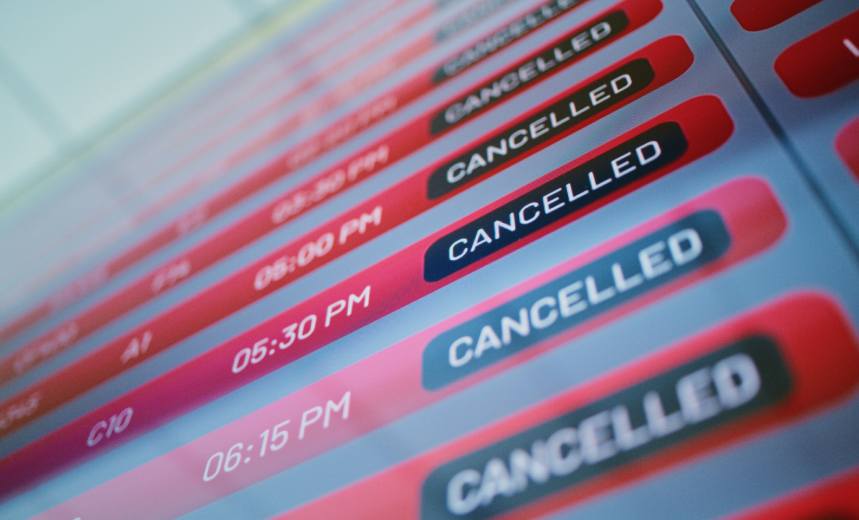
Update Nov. 14, 2026, 2:17 UTC: The U.S. Federal Aviation Administration (FAA) lifted the ground stop around 8:30 p.m. Eastern Time, concluding a four-hour pause that had thrown the national airspace system into disarray.
Also See: Live Webinar | 2027 Cyber Resilience Predictions: A CISO Panel on What’s Next
During a press conference held at the White House, Homeland Security Secretary Markwayne Mullin emphasized that there has been no indication of a cyberattack. “We’ve seen zero evidence that this was a cyberattack or SI attack,” he stated, referencing the previous administration’s preferred term for artificial intelligence.
Transportation Secretary Sean Duffy added that the telecommunications outage was not linked to the recent deployment of an $875 million artificial intelligence system named SMART, designed to assist air traffic controllers. “That SMART system isn’t plugged in to STARS and ERAM,” he clarified, referring to two core air traffic control systems. “This is completely disconnected, and I find it amusing that some people have attributed this as the root cause. If it were, I would certainly let you know. But this is not even in the loop,” he noted.
Duffy attributed the widespread disruption to outdated technology. “We have old, old switches and routers. We’re still using 1980s-style copper lines. It’s a legacy system that failed across the board due to an overload,” he explained.
The Transportation Secretary acknowledged that it would require significant time to restore the thousands of flights that had been canceled or delayed as a result of this incident. He also requested $50 billion from Congress in hopes of modernizing the air traffic control infrastructure in the U.S.
On Friday afternoon, federal authorities ordered a nationwide grounding of aircraft after a significant radio frequency outage disrupted flights. Officials consistently assert that this outage is unlikely linked to malicious cyber activities.
The Federal Aviation Administration issued directives for aircraft operators to remain grounded shortly before 4 p.m. Eastern Time. This directive effectively halted more than 2,500 flights as reported by the tracking site FlightAware.
“There has been a temporary telecommunications outage, and out of an abundance of caution, all flights have been halted,” the FAA publicly announced via X. “Every flight has been accounted for, and international flights will be managed on a case-by-case basis.”
Secretary Duffy described the situation as affecting all U.S. Air Route Traffic Control Centers and mentioned that FAA technicians are currently engaged in a thorough investigation into the matter.
This incident marks the largest flight disruption in the United States since 2023. That previous occurrence led to suspicions of a cyberattack; however, the FAA later attributed it to the loss of a system responsible for real-time flight hazard information sharing.
The grounding of flights came only three days after the FAA implemented its AI-powered, cloud-based air traffic control system, Strategic Management of Airspace, Routes, and Trajectories (SMART). This new platform aggregates a multitude of data streams to provide comprehensive, real-time information to air traffic controllers and aircraft operators.
“SMART utilizes AI to analyze various factors such as airline schedules, weather conditions, airport capacity, airspace constraints, and operational challenges to predict traffic flows and identify potential conflicts before they arise,” asserts the FAA’s overview of the tool.
In a follow-up discussion regarding any potential links between AI technology and the communications outage, Secretary Mullin admitted, “You can’t completely rule anything out at this stage.”
He also noted, “There is no predetermined timeline for the recovery process. Getting everyone back in the air again will require significant effort. This situation cannot be resolved in a matter of hours.”
The FAA’s outage comes on the heels of ongoing disruptions faced by Microsoft, which began the previous Thursday. Microsoft confirmed that these issues stemmed from a network capacity upgrade and emphasized that they are unrelated to cyber threats or AI technology.