
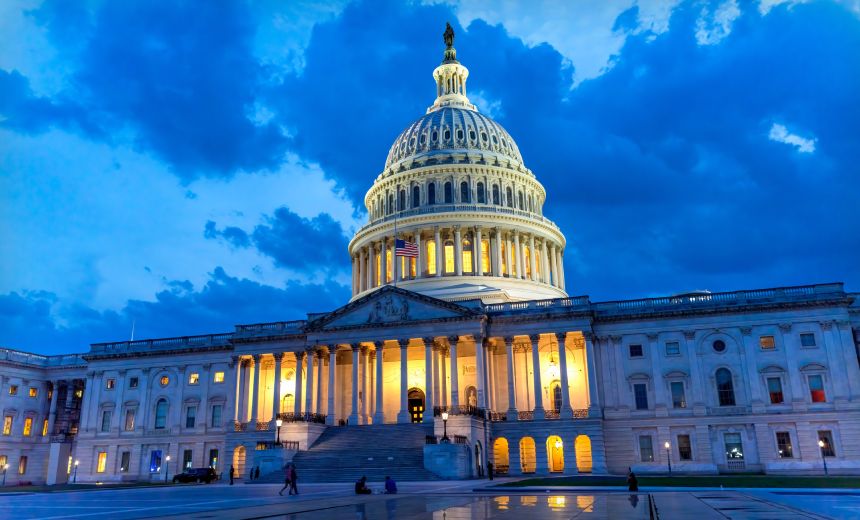
Lawmakers Progress on Key Cyber Law Renewal, Sparking Anticipation for Senate Battle
In a significant legislative development, lawmakers in the U.S. House of Representatives have narrowly voted to extend a pivotal cyberthreat sharing law for an additional decade. This renewal has been incorporated into Washington’s annual defense policy bill, setting the stage for what is expected to be a contentious debate in the Senate.
The approval came as part of the House’s fiscal year 2027 national defense authorization act, which amounted to $1.15 trillion. The final vote, which stood at 216-212, included the renewal of the Cybersecurity Information Sharing Act (CISA) originally enacted in 2015, extending its protections until 2036. This legislative move is particularly urgent, given that the statute is approaching its second expiration within a year. The looming deadline for the current law is September 30, intensifying the push for reauthorization as the expiration date draws nearer.
CISA 2015 serves as a critical legal framework by providing companies that voluntarily share cyberthreat indicators and defensive measures with one another certain protections under liability, antitrust laws, and the Freedom of Information Act. Cybersecurity experts have consistently emphasized the law’s significance as the foundational pillar for public-private collaboration in threat sharing. They warn that the absence of such a framework could severely impede cooperation across vital sectors of critical infrastructure.
The law initially had a 10-year lifespan that expired on October 1 of the previous year. Congress failed to reach an agreement on reauthorization before this expiration, leaving various threat sharing initiatives in a precarious legal situation for almost six weeks. It wasn’t until November that lawmakers managed to renew the statute through a temporary spending package, extending its protections until January 30. This was further pushed to the end of the current fiscal year via a consolidated appropriations measure passed in February.
The provision included in the House’s national defense authorization bill largely mirrors the Widespread Information Management for the Welfare of Infrastructure and Government Act. Although this act had previously garnered unanimous support from the House Homeland Security Committee, it did not receive a vote on the floor. The bill proposes specific updates to CISA, including revised definitions aimed at addressing advancements in artificial intelligence.
However, the road ahead in the Senate appears fraught with challenges. The Senate’s draft of the defense authorization measure does not currently include a corresponding provision to renew the CISA. Supporters of the extension are expected to advocate for it as an amendment during the Senate’s deliberations on the bill. Nonetheless, the Senate’s consideration has recently stalled due to partisan disagreements.
The most significant obstacle may be posed by Senator Rand Paul, a Republican from Kentucky, who chairs the Senate Homeland Security and Governmental Affairs Committee. Paul has vowed to impede any long-term reauthorization unless it incorporates provisions preventing CISA from participating in efforts to counter online disinformation. His previous efforts to block similar reauthorization attempts have raised alarms among supporters of the law.
In last year’s intelligence authorization bill, the Senate Intelligence Committee did attempt to include a straightforward 10-year renewal. However, Paul’s objections led to its removal when that proposal was integrated into the Senate’s National Defense Authorization Act (NDAA).
While the Cybersecurity and Infrastructure Security Agency (CISA) is not directly tied to the information sharing law, Paul has cited the agency’s previous collaborations with social media companies aimed at identifying misinformation as evidence of governmental overreach into areas of protected speech.
In a startling twist, the Kentucky senator has proposed a competing measure aimed at extending the law for just two years. This proposal would also strip vital legal protections, including the liability shield that motivates companies to engage in threat data sharing with federal partners. Industry leaders have strongly contended that such alterations would nullify the law’s core intent and effectiveness.
Groups representing various sectors, including financial services, energy, and telecommunications, have urged Congress for a simple long-term reauthorization. They argue that the ongoing cycle of temporary fixes severely cripples companies’ abilities to strategize and implement reliable information-sharing programs. The pressure on lawmakers continues to mount as they grapple with a law critical to national cybersecurity efforts and the protection of both public and private sector entities.
As discussions progress, the future of this essential legislation remains uncertain, but the stakes are undeniably high for all involved.