
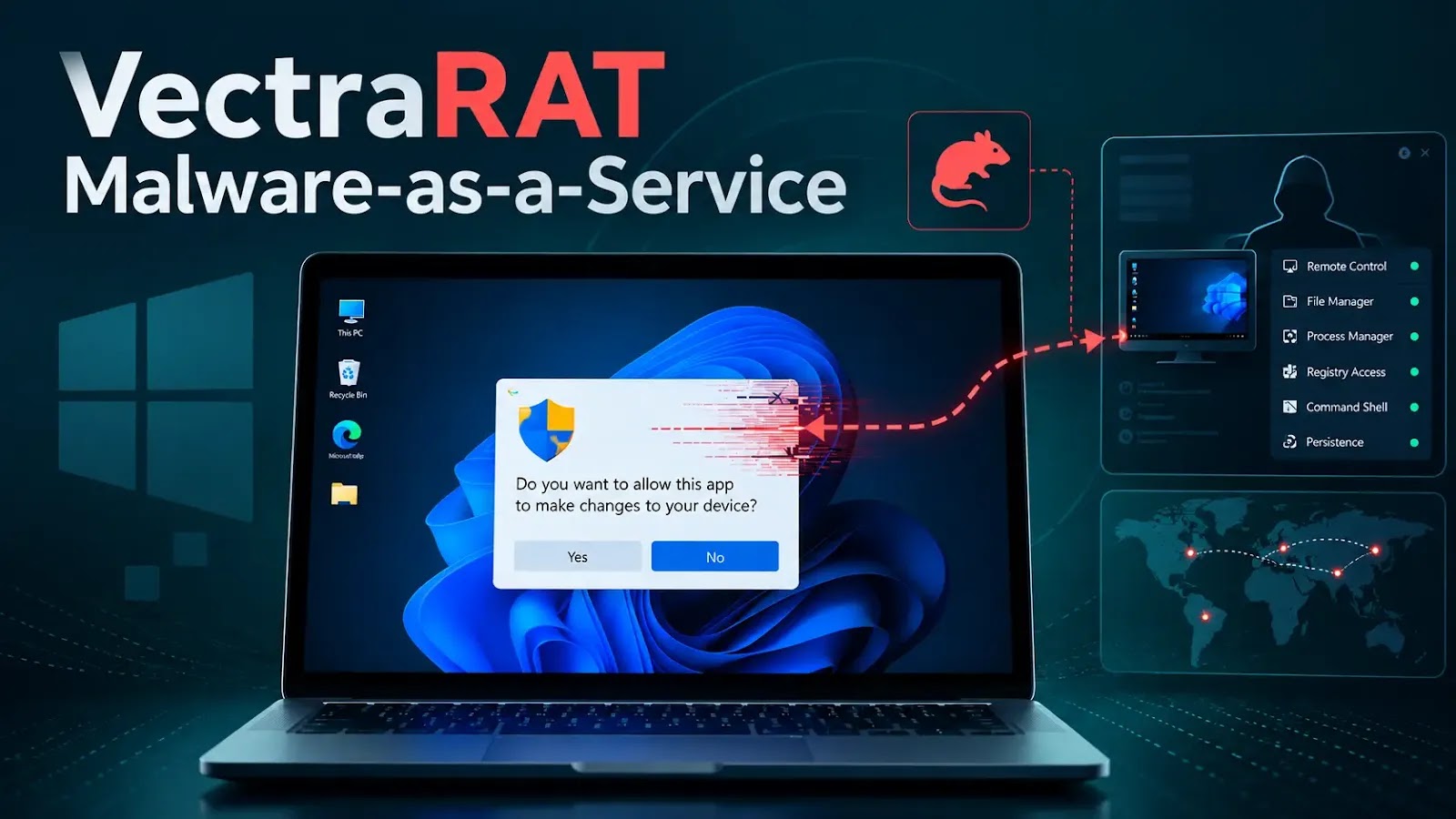
VectraRAT Emerges as a New Malware-as-a-Service Platform
In recent cybersecurity findings, a new and previously undocumented Malware-as-a-Service (MaaS) platform named VectraRAT has come into the spotlight. This sophisticated malware combines the functionalities of a remote-access trojan with automated credential theft mechanisms, alongside a discreet Windows privilege escalation chain that significantly enhances its capabilities for malicious actors.
Unlike many prevalent commodity RATs that recycle previously leaked code such as AsyncRAT, XWorm, or QuasarRAT, VectraRAT is notable for being a purpose-built product. Its development is attributed to a single individual known by the alias “Vectra.” Observers believe that Vectra is rebranding from an older identity called “Nyxel,” which has been tracked back to at least August 2022. This context gives rise to concerns about the continuity of malicious offerings evolving under new guises.
The business model behind VectraRAT is subscription-based, with prices starting at $250 per month. This provides buyers with exclusive access to features like the VectraHub—the Linux command-and-control (C2) server—alongside a web-based operator panel, a Windows payload builder for crafting malicious software, and support via Telegram. Such an infrastructure allows for dynamic interaction modes, making it attractive to cybercriminals seeking enhanced capabilities.
In the analysis of VectraRAT’s architectural design, security researchers have identified more than ten associated servers, a multitude of malware samples, and distinct buyer-operated campaigns. The malware infrastructure includes a specialized Go-based Linux C2 server and a native C++ implant designed for Windows environments. Moreover, this setup integrates a Vue3-based web panel directly into the binary, eliminating the need for separate web stacks in managing the malware.
Communication conducted by VectraRAT occurs via TCP port 3308 through a custom binary protocol. This distinctive feature, which employs a five-byte message header and MessagePack-encoded payloads, distinguishes it from conventional HTTP-based C2 methods. By doing so, it reduces the risk of detection by defenses that focus primarily on web traffic, thus improving the chances of successful infiltration.
Users of the operator panel have the capability to create tailored Windows payloads, modify embedded C2 settings, and even customize metadata associated with PE files. Details such as the default metadata indicating “Product Vectra,” “Company Vectra,” and Version “0.2” create opportunities for security professionals and threat hunters to detect any negligence in payload customization.
Further improving its security, VectraRAT utilizes RSA-PSS-SHA256 for license validation, rendering it difficult for buyers to forge server licenses or operate cloned infrastructures independently. This architecture tightly maintains control within the operator’s ecosystem, reinforcing the rental nature of the platform.
One noteworthy entry point for this malware was traced back to an open HTTP directory hosted on 86.109.75.168, a node within the GorillaServers infrastructure. Its multi-functional feature set spans activities involving credential theft and post-exploitation capabilities. For instance, upon gaining access to a victim’s system, VectraRAT can automatically acquire browser credentials from various web browsers and search for configuration files that may harbor sensitive information such as API keys or database login credentials.
Once operational on a victim’s machine, VectraRAT enables users to utilize hidden virtual network computing capabilities, remote execution of shell commands, keylogging, SOCKS5 proxying, and clipboard monitoring, amongst other malicious functionalities. Particularly alarming is its clipboard replacement feature, which can swap cryptocurrency wallet addresses with those manipulated by attackers, adding another layer of sophistication to their operations.
The urgent need for attention is highlighted by the exposure of VectraRAT on June 23, 2026, when researchers discovered an exposed directory containing various elements such as the VectraHub server binary and panel logs. This incident underscores the vulnerability of organizations that fail to secure sensitive data adequately.
A major differentiator of VectraRAT is its User Account Control (UAC) bypass technique, which circumvents standard security measures. Using an advanced method known as UACME method 41, enhanced by debug-object handle hijacking, VectraRAT can initiate a malicious process without triggering UAC prompts, allowing it to execute functions elevated to high integrity seamlessly.
In light of these developments, defenders are urged to scrutinize the behavior of any suspicious child processes initiated by computerdefaults.exe and to be wary of rapid launch-and-exit patterns associated with winver.exe. As seen in the findings, the global distribution of identified victims includes organizations in the United States, Russia, and Germany, illustrating a need for heightened vigilance across the board.
In conclusion, VectraRAT is an alarming demonstration of how advanced Malware-as-a-Service offerings have evolved, merging credential theft, covert remote access, and privilege escalation into a singular product available for rent. Organizations are strongly advised to harden their defenses and cultivate robust verification procedures to minimize risks posed by such sophisticated threats.