
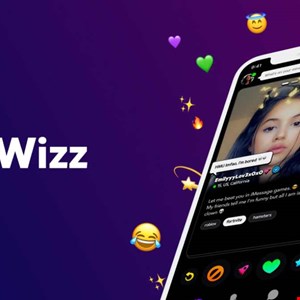


The popular social media app Wizz, targeting American teenagers, was pulled off both the Apple App Store and the Google Play Store on January 30. The decision to remove Wizz came after the US conservative anti-pornography organization National Center on Sexual Exploitation reached out to Apple and Google to express gratitude for taking action against the app, which they believe poses a threat to the safety of young users.
Wizz, a dating app for teenagers owned by Voodoo, has been marketed to provide a safe space for teenagers and has advertised features that supposedly prevent fake profiles and offensive content. However, concerns were raised after the Network Contagion Research Institute (NCRI) reported that Wizz was one of the top platforms used in a surge of financial sextortion attacks aimed at children and teenagers in Australia, Canada, and the US. According to the NCRI, Wizz ranked third in terms of the most used app for sextortion purposes, after Instagram and Snapchat.
The NCRI also noted that Wizz had become one of the fastest-rising platforms for sextortion schemes. Additionally, they reported that the app has received numerous complaints involving minors being coerced into producing self-generated child sexual exploitation material (SG-CSEM), alongside a high frequency of app-serving pornographic ads to minors. These concerning findings led to the removal of Wizz from the two major app stores.
In response to the app’s removal, Voodoo, the owner of Wizz, has stated that they are working closely with Apple and Google to address the concerns and provide a better understanding of the app’s safety measures. The company assured that they are actively innovating to ensure that Wizz maintains a leading role in user safety and has implemented strict security controls to prevent abusive or illegal behavior on the platform.
In a public statement given to Infosecurity, a Voodoo spokesperson defended the app, stating that they have a zero-tolerance policy for scams and inappropriate behavior. They also emphasized that all content on the platform is moderated, age verification is required, and user-reported issues are addressed immediately. Furthermore, Wizz co-founder and CTO, Gautier Gédoux, has disputed the claims made in the NCRI report, arguing that the app is proactive in detecting and removing potential scam attempts.
Gédoux addressed specific claims, such as banning thousands of users daily and implementing advanced technologies to combat the dissemination of inappropriate content on Wizz. However, despite these efforts, the app remains unavailable on both the Apple App Store and the Google Play Store.
The decision to remove Wizz from the app stores not only affects its availability but also raises questions about its safety and effectiveness in protecting its young users. As Voodoo continues to cooperate with Apple and Google to potentially resolve the situation, the fate of Wizz remains uncertain.