


Officials Rule Out Cyberattack and AI Tool as Router Data Flood Draws Scrutiny
In a recent incident that raised alarms across the aviation sector, a router upgrade at a remote radio facility in Arkansas was identified as the cause behind a substantial disruption that grounded air travel in the United States on a Friday afternoon. This revelation effectively dispelled early concerns regarding the potential roles of cyberattacks or artificial intelligence tools in the unfortunate events that unfolded.
According to initial findings published by the Federal Aviation Administration (FAA), the situation originated from two specific sites within the agency’s contractor-operated communications network. The first location was a radio facility in El Dorado, Arkansas, where L3Harris had been engaged in installing a new router. The second was a radar facility in Amarillo, Texas. Both facilities began experiencing a data flood that overwhelmed the network, prompting the FAA to intervene and stabilize the situation. This action only took place after L3Harris disconnected the problematic equipment, as noted by agency representatives.
The FAA revealed that their legacy systems buckled under an onslaught of nearly 1,000 connection attempts every four to five seconds. This overwhelming traffic caused significant disruptions in communication and radar feeds across 17 of the agency’s 22 air route traffic control centers tasked with managing high-altitude traffic. The cascading failures eventually extended to various terminal radar facilities, thereby exacerbating the already critical circumstances.
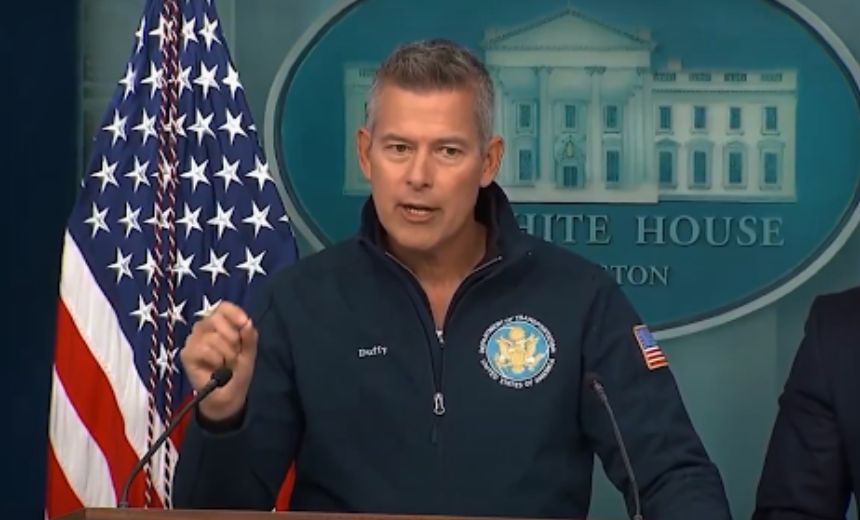
Transportation Secretary Sean Duffy elaborated that the root of the problem stemmed from a copper-to-fiber conversion process taking place in El Dorado. A second device in Amarillo, installed just a few weeks prior, began contributing to the data flood shortly after it was activated, complicating already existing issues. In response to these events, L3Harris has since pulled both routers for testing at one of its facilities in Florida as part of a thorough review. The Federal Bureau of Investigation (FBI) and other law enforcement agencies are also involved in this investigation, indicating the seriousness of the situation. Secretary Duffy remarked that investigators were working to determine whether any incompetence from the contractor or an inherent defect in the equipment was the primary cause of the failures.
FAA Administrator Bryan Bedford clarified that the work performed in El Dorado was part of standard maintenance of the existing network, distinct from the agency’s ongoing efforts to establish a new air traffic control system. “Once we were able to isolate the work being done at this remote location, all of our systems came back online,” Bedford stated during a press conference. As a precautionary measure, the agency has also ceased all broadcasting from new routers.
In a statement, L3Harris expressed its commitment to taking the nationwide ground stop seriously, acknowledging its impact on travelers, airlines, and air traffic operations. Historically, the FAA has dealt with similar issues; the last nationwide ground stop occurred in January 2023, triggered by a contractor error within the agency’s Notice to Air Missions system.
This particular incident is emblematic of broader concerns surrounding the fragility of critical infrastructure. Pam Nigro, a board director at the Information Systems Audit and Control Association, highlighted that the concept of "technical debt" has evolved beyond being merely an IT issue to becoming a national security liability. The vulnerability inherent in critical infrastructure can provide adversaries with an asymmetric advantage, negating the need for sophisticated cyber-weapons when systemic collapses can be prompted through simpler means.
The situation was further complicated just three days before the router incident when the FAA extended its AI-assisted traffic planning platform, known as SMART (Strategic Management of Airspace, Routes, and Trajectories), to all 22 of its en route centers. Homeland Security Secretary Markwayne Mullin received reports of potential links between the AI rollout and the communications failure, a theory that officials subsequently discounted. Duffy reassured the public that SMART was separated from the systems utilized by controllers for aircraft tracking, leaving no possibility for its involvement in the outages.
Despite the severity of the situation, it is worth noting that radio and radar communications never fully collapsed during the disruption. The FAA indicated that certain frequencies and radar feeds maintained stability, allowing every airborne flight to land safely. Bedford recounted that officials observed erratic behavior in systems for approximately 45 minutes before deciding to halt departures as a safety precaution.
This incident serves as a stark reminder of the complexities and vulnerabilities inherent in modern aviation infrastructure. As investigations continue to ascertain the exact factors contributing to the failure, it becomes increasingly crucial to address such vulnerabilities to ensure robust, secure systems capable of withstanding both technical malfunctions and external threats.