



Healthcare Sector Faces Rising Cybersecurity Challenges Amid Budget Cuts
Healthcare organizations worldwide are grappling with increasing financial pressures that compel them to reduce cybersecurity budgets, even as threats to their systems grow more severe. A recent survey conducted by PwC, which included 381 healthcare executives between May and July 2025, highlights a significant disparity between the dangers the sector faces and the protective measures currently in place.
Data Protection Remains a Priority
Data protection stands out as the primary driver of cybersecurity spending within the healthcare sector. However, the survey reveals a concerning reality: only 35% of healthcare organizations have implemented data risk controls that span the entire data life cycle. In comparison, the global average for all sectors is 44%, indicating that healthcare firms are lagging significantly in this aspect.
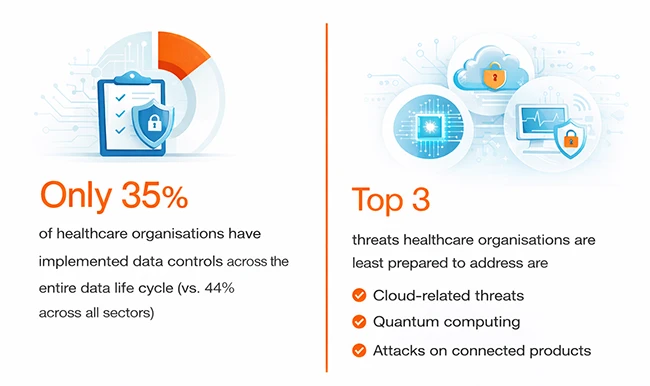
Key findings (Source: PwC)
Unpreparedness for Emerging Threats
Healthcare leaders have identified several emerging threats they feel ill-equipped to tackle. Cloud-related vulnerabilities, risks associated with quantum computing, and attacks on connected medical devices are deemed the three most daunting challenges. This apprehension is evident across different segments of the healthcare industry, including both payers and providers, as well as pharmaceutical and life sciences firms, albeit with some variation in specific concerns.
Within the pharmaceutical sector, the situation concerning quantum preparedness is alarming. More than half of the respondents reported that they had not initiated any measures to implement quantum-resistant security technologies. Furthermore, a mere 7% of these entities plan to allocate budgetary resources toward quantum readiness in 2026.
Fragmented Ecosystems and Identity Fraud
In addition to facing new technological threats, healthcare payers and providers are struggling with fragmented systems that span multiple vendors, platforms, and data repositories. This disjointed environment not only creates significant security gaps but also complicates governance. The juxtaposition of outdated applications and a lack of secure identity management has led to a noticeable uptick in fraud, particularly involving online healthcare accounts and incentives through debit cards for preventive care.
In light of these challenges, healthcare payers and providers are prioritizing investments in data protection and security awareness training as they prepare for the upcoming year. However, data governance remains a considerable concern, with only 39% of these organizations adopting data minimization strategies and a mere 37% implementing controls throughout the data life cycle.
Operational Technology Challenges
On the operational technology front, healthcare providers cite a lack of network segmentation as their top challenge, with 50% of respondents highlighting this issue. Following closely are gaps in operational technology-specific skills and resources, which were noted by 47% of those surveyed, and a lack of clarity in governance concerning operational technology cybersecurity, recognized by 45%.
As regulatory pressures tighten, particularly in the United States, proposed revisions to the HIPAA security rule are expected to require annual security risk assessments and mandate encryption and multi-factor authentication. Similarly, India has introduced the Digital Personal Data Protection Act, which imposes stringent compliance requirements for processing health data and securing patient consent.
Financial Context and Operational Risks
The financial landscape of healthcare is critical to understanding these cybersecurity challenges. Costs in the sector are projected to reach approximately $5 trillion annually, growing at nearly 8% each year. This increase can be attributed to higher insurance claims, reduced government funding, and an escalating administrative workload, alongside the rising prevalence of chronic and mental health conditions. In this context, some healthcare organizations are taking the calculated risk of exposing themselves to greater cybersecurity vulnerabilities to avoid immediate expenditures.
Intellectual Property and Third-Party Risks in Pharma
For pharmaceutical and life sciences companies, the protection of intellectual property is paramount. Proprietary formulas, research data, and clinical trial information are considered high-value targets for cybercriminals. Breaches in this area can lead to significant delays in regulatory approvals and clinical trials, along with substantial financial and reputational repercussions.
Moreover, the risk posed by third-party interactions is increasingly concerning. The pharmaceutical sector operates through vast networks of contractors, researchers, and manufacturers, and a quarter of the leaders surveyed consider third-party breaches among the most significant threats they are least prepared to address.
Investment Trends for 2026
As they look ahead, healthcare payers and providers plan to enhance their cybersecurity budgets in 2026, with artificial intelligence acknowledged as the leading area for investment. Following close behind are cloud security and threat management initiatives. However, a stark difference is visible between proactive and reactive budgeting: only 24% of pharmaceutical and life sciences firms intend to allocate significantly more resources toward proactive measures such as monitoring, training, and governance, in contrast to reactive initiatives focused on incident response and remediation.
As organizations in the healthcare sector navigate these complex challenges, the pressing need for a holistic approach to cybersecurity has never been more apparent, especially as both regulatory demands and the stakes involved continue to rise.